
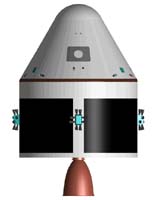
NASA has authorized five-month contract extensions for development of the new Crew Exploration Vehicle, the spacecraft intended to replace the shuttle fleet after 2010, return astronauts to the Moon before 2020, and mount missions to Mars and elsewhere in the solar system.
NASA had selected the contractors – Lockheed Martin Corp., and a team of Northrop Grumman Systems Corp. and The Boeing Co. in June 2005 to begin CEV Phase 1 development, which technically was supposed to end March 31. The companies have been working with the agency to define requirements and develop conceptual designs.
The estimated maximum total value for each of the Phase 1 contracts, including the extension to Aug. 31 and the optional extension periods, is approximately $60 million for each company, and the value of the basic extension period, is $17.5 million each.
One or the other of the Phase 1 contractors will be selected as the Phase 2 prime contractor to design, develop, test, evaluate and produce the CEV, NASA said in a statement. Although the new contract authorizations include options that could extend the Phase 1 work until December, officials said they expect to select the Phase 2 prime contractor by August.
The new contract also adds options for a pair of two-month extensions for each contractor. The first two-month option would extend Phase 1 work to Oct. 31, and the second extension would go until Dec. 31. The CEV development contracts do not include development of the launch vehicle required to boost the spacecraft into orbit.
The spacecraft will operate initially in Low-Earth Orbit. Its design and development include subsystems for crew survival during ascent, environmental control and life support, communications, navigation and control, power, thermal control, thermal protection, radiation protection, propulsion, docking and recovery.
