
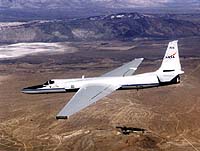
NASA has begun observing the atmosphere in southern Africa by means of its Terra spacecraft and ER-2 high-altitude aircraft, the University of the Witwatersrand announced here.
The study is part of NASA’s six-week Southern African Regional Science Initiative (SAFARI) 2000 programme, launched on August 12 to observe the region’s ecosystems, air quality and land use.
The aim of the first flight, which took place on Thursday, was to observe the haze in the atmosphere, specifically the gas carbon monoxide, which is a major component of air pollution, the university said in a statement.
It said the NASA satellite and high-altitude aircraft were joined during Thursday’s flight by a South African Weather Bureau aircraft.
“Intricate spiral descents” were made by the aircraft through the haze, the statement said, “to directly capture air samples that will be analyzed in the laboratory.”
According to Bob Swap, meteorologist of the South African Weather Bureau, who is involved in the project, instruments on the SAWB plane can also sample ozone, sulfur dioxide, and small particles in the air.
“We’re hoping that the information gathered from this flight will be valuable for … the global observations of the atmosphere,” Swap said.
Sent into orbit in December 1999, the Terra satellite captures information daily on the earth’s environment, to be used to make a detailed study of the interaction between the atmosphere, the earth, the oceans and solar radiation.
Copyright 2000 AFP. All rights reserved. The material on this page is provided by AFP and may not be published, broadcast, rewritten or redistributed.
