
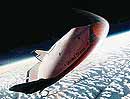
 Washington DC, August 25, 1997 – While a test version of the X-38 astronaut taxi undergoes air drop tests this fall at Edwards Air Force Base in California, NASA is beginning preparations for a year 2000 orbital flight test of a second prototype.
This week, NASA’s Johnson Space Center in Houston, Texas announced plans to
release a request to industry for the design and manufacture of
approximately 600 silica-based thermal tiles for the orbital test craft.
The new tiles will be made of a new advanced lightweight material and
coated with a fibrous insulation. The tiles will cover the X-38 lifting
body space test craft, vehicle no. 201, which will ride into orbit in three
years in the payload bay of the space shuttle, then be released for a free
flight in space and reentry to Earth unpiloted.
The X-38 is designed to be a lifeboat and ferry craft for the
International Space Station Alpha. Should an emergency arise on the
station, astronauts would use one of two X-38 craft docked there to cast
off and make an emergency return to Earth. Each of the wingless craft is
capable of carrying 4 to 8 astronauts, and would use parachutes to land on
a runway following reentry. Since the astronauts won’t need to steer the
X-38, it could be used to return injured or disabled crewmembers that might
be hurt in a station mishap. Designs are also in the planning stages to use
X-38 spacecraft atop expendable rockets like the Atlas or French Ariane 5
in the event the space shuttle fleet were grounded. The X-38 vehicles could
be used as interim shuttles, flying up from Earth to the station and then
back, as the shuttles are planned to do. Twice in the 16 year history of
the shuttle program the winged ships have been grounded; once following the
1986 Challenger accident, and once in late 1990 following a fuel leak in
the orbiters.
This fall, another test version of the X-38 will be drop tested at Edwards
Air Force Base in the California desert. These tests will determine if the
stubby craft can be landed safely by parachute. The X-38 is based on the
1960’s designs of the Air Force X-23/24A research aircraft. The craft were
prototype candidates for the space shuttle before NASA chose a winged shape
for the vehicle’s design in 1971.
Reuseable Launch Vehicle Archive at Spacer.Com
Rotary
Kistler
X-3X
Other Space Planes
General RLV Industry Issues
