
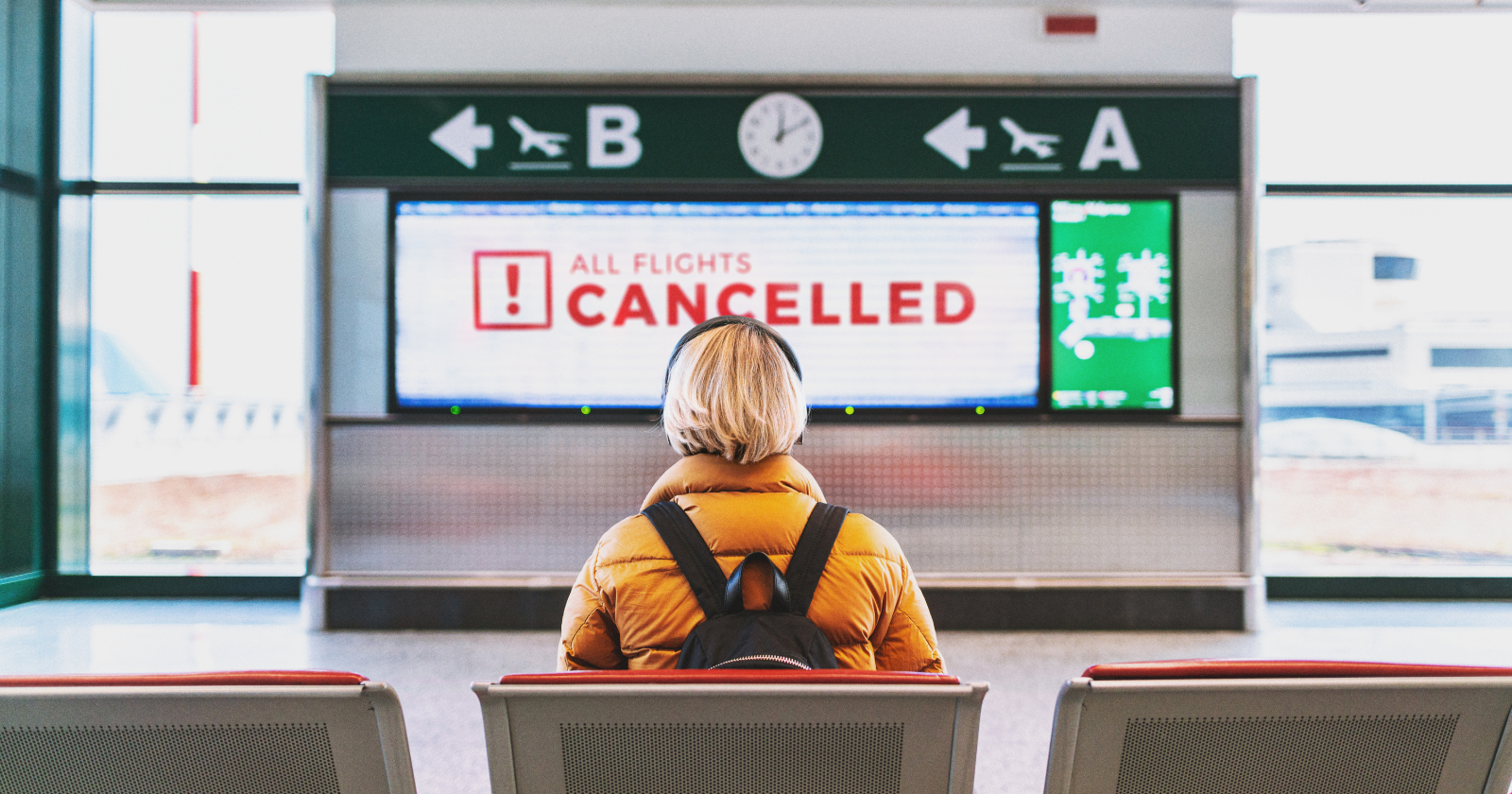
When a flight gets cancelled, the explanation passengers receive is usually some variation of the same short list. Weather. Air traffic congestion. A mechanical issue with the aircraft. An operational problem at the origin airport. These are real causes. They are also, increasingly, incomplete ones.
On October 30, 2025, a JetBlue A320 flying between Cancun and Newark entered a sudden, uncontrolled descent of several seconds while at cruising altitude over the Gulf of Mexico. Numerous passengers were hospitalised. Pilots regained control and diverted to Tampa. The cause was not turbulence. It was not a mechanical failure in the conventional sense. According to Airbus, analysis of the incident revealed that intense solar radiation had corrupted data critical to the functioning of the aircraft’s flight controls. Specifically, neutrons — high-energy particles produced during solar radiation events — had caused malfunctions in onboard computers.
One month later, Airbus issued an urgent recall affecting thousands of aircraft worldwide. Approximately 15 percent required hardware replacement. The remaining 85 percent required software updates. Airlines were advised to act before the aircraft flew again. The global disruption to schedules that followed was reported as an operational problem. The cause, 150 million kilometres away, was barely mentioned.
What the data shows about space weather and cancellations
The JetBlue incident was dramatic enough to generate headlines. The broader pattern it sits within has been accumulating in research literature for years without attracting equivalent attention.
There’s a latest study published in Scientific Reports in February 2026 by researchers at Shanghai Civil Aviation East China Air Traffic Control Engineering Technology that provides the first systematic evidence of space weather’s effect on flight cancellations at scale. The researchers analysed approximately 5 million flight departure records from five major hub airports in China between 2015 and 2019 — a period spanning the declining phase and subsequent minimum of Solar Cycle 24.
The finding is unambiguous: the average flight cancellation rate during space weather events was 96.96 percent higher than during quiet periods. Nearly double. The events that drove this increase were solar flares, interplanetary coronal mass ejections, and solar proton events. The correlation held after accounting for seasonal variation and other confounding factors. The researchers also found a quasi-linear relationship between the magnitude of geomagnetic and ionospheric disturbances and the rate of cancellations — the stronger the space weather event, the more flights did not depart.
The mechanism is not a single point of failure. It is a cascade. Solar activity disrupts high-frequency radio communications, which pilots and air traffic controllers rely on for position reporting and coordination. It degrades GPS accuracy, which modern navigation systems depend on for precision approaches and oceanic routing. It produces energetic particles that can affect the electronics of aircraft flying at altitude, particularly over polar routes where Earth’s magnetic field provides less shielding. Each of these effects alone is manageable under normal conditions.
Together, during a significant solar event, they compound.
The January 2026 event
On January 19, 2026, NOAA’s Space Weather Prediction Center issued a notification of an S4 Severe Solar Radiation Storm — the second-highest rating on NOAA’s five-point scale for solar radiation events. An S4 event produces significant degradation of HF radio communications on the sunlit side of Earth, elevated radiation exposure for passengers and crew on high-altitude polar flights, and the potential for navigation errors in systems that rely on ionospheric signal propagation.
Flight operations during S4 events require rerouting of polar routes, altitude reductions on affected paths, and in some cases ground stops or cancellations for aircraft that cannot be adequately protected. Airlines and air traffic control agencies make these decisions based on real-time space weather data. What they rarely do is explain to passengers, in plain terms, why their flight to London has been rerouted over the Atlantic rather than the Arctic, or why departure has been held for three hours pending an all-clear from a government agency most travellers have never heard of.
The operational disruption from the January 2026 S4 event was real and measurable. It received a fraction of the coverage of a comparably disruptive winter storm.
Why the sky overhead is only half the picture
Aviation weather forecasting is one of the most sophisticated predictive systems humanity has built. It integrates satellite imagery, upper-atmosphere wind data, turbulence models, and lightning detection into decision-support tools that operate in near real-time across every major flight corridor on the planet. The investment in this infrastructure, and the safety record it has helped produce, is genuinely remarkable.
Space weather forecasting operates at a different level of institutional integration. NOAA’s Space Weather Prediction Center provides continuous monitoring and forecasting of solar activity. The European Space Agency runs equivalent services. Airlines and air traffic management organisations receive this data and act on it. But the pipeline between a solar event and a passenger’s boarding pass is longer and less visible than the pipeline between a thunderstorm cell and a flight delay notification.
Part of this is structural. Terrestrial weather is universal — every passenger has encountered it, every airline communicates about it, every airport has protocols that are publicly legible. Space weather affects aviation in ways that are real but that require more explanation, operate on longer timescales, and have until recently lacked the systematic evidence base that the Scientific Reports study now provides.
Part of it is also the same resistance to uncomfortable complexity that shows up elsewhere in how aviation communicates with its passengers. A cancellation blamed on “operational requirements” is easier to process than one that requires a brief explanation of coronal mass ejections and ionospheric disturbance.
What is changing and why it matters
Solar Cycle 25, which began in December 2019, has been significantly more active than forecasters initially predicted. Activity is currently near or at cycle maximum, meaning the frequency and intensity of solar events affecting Earth is at its highest point in the current eleven-year cycle. The conditions that produced the January 2026 S4 event, and that contributed to the October 2025 Airbus incident, are not anomalies. They are the environment aviation now routinely operates in.
The Scientific Reports study notes that its findings imply the importance of integrating space weather as a systematic factor in flight operations and planning. This is already happening at the operational level. What has not caught up is the public-facing layer — the communication infrastructure that explains to passengers why their flight is cancelled, and the regulatory and insurance frameworks that classify space weather as a formal operational risk category rather than an edge case.
The Airbus recall affects thousands of aircraft currently in commercial service. The software and hardware updates being installed across fleets worldwide are, in effect, a belated acknowledgment that the radiation environment of low Earth orbit and high-altitude flight is no longer a niche engineering concern. It is a mainstream one.
The infrastructure problem the industry is still working around
Modern aircraft are more electronically complex than any previous generation of commercial aviation. The same digital integration that has made them safer, more fuel-efficient, and more precisely navigable has also made them more sensitive to the electromagnetic and particle environment they fly through. Redundancy systems catch most errors. Software updates address newly identified vulnerabilities. But the pace of solar cycle activity means that the edge cases are becoming more frequent.
The 96.96 percent figure from the Scientific Reports study is not a marginal finding. It is a large effect documented across millions of flights, and it suggests that space weather is already one of the significant drivers of aviation disruption — just one that does not appear on the departure board when things go wrong.
The next time a flight cancels for reasons that do not quite add up — when the sky outside looks clear, when the aircraft appears serviceable, when no obvious explanation is offered — it may be worth considering what is happening 150 million kilometres away, and whether the forecasting infrastructure designed to monitor it has had anything interesting to report.
