
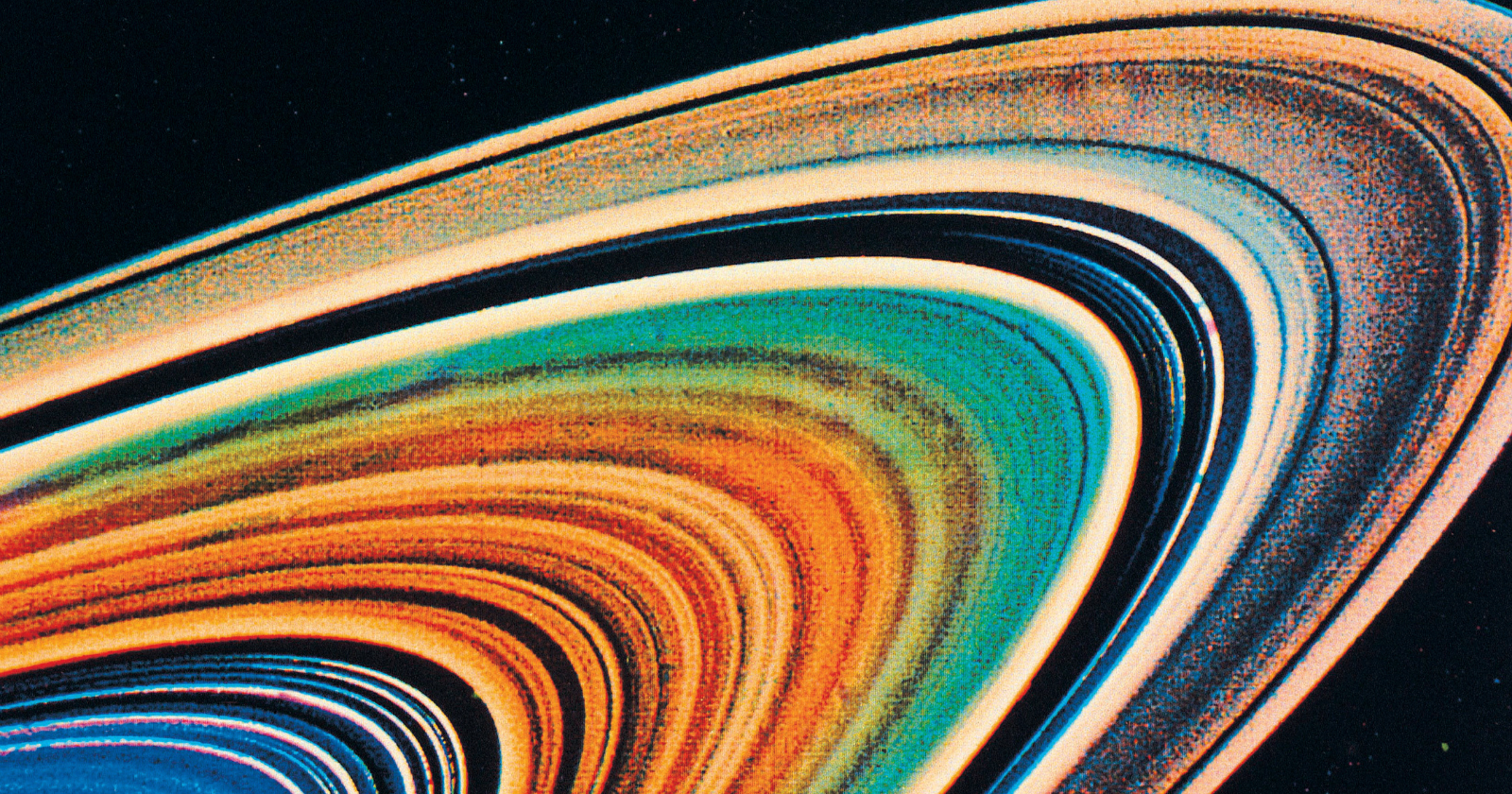
The headline claim, in the form it usually arrives, is that Saturn’s rings are around 400 million years old. The actual finding, published by Sascha Kempf and colleagues in Science Advances in May 2023, is more careful than that. Using the last data from Cassini’s Cosmic Dust Analyzer, the team measured the rate at which micrometeoroid dust falls into the Saturnian system, and from that inferred how long the rings have been exposed to that flux without turning visibly grimy. The result they report is a ring exposure time of less than around 100 to 400 million years.
That is a range, not a number. It also measures exposure time, not necessarily the rings’ age in the strict sense. Both points matter, and both have been contested.
What Cassini actually measured
Saturn’s main rings are about 95 to 98 percent water ice. They are also, on close inspection, slightly polluted by darker, non-icy material. The pollutant fraction is small, somewhere between 0.1 and 2 percent by volume. The Kempf paper assumes this pollutant comes mostly from interplanetary dust falling in from the wider solar system, much of it ultimately from the Kuiper belt. Knowing the inbound flux and the current pollutant fraction, the authors back out how long the rings would have to have been bombarded to reach the dirtiness we now see, starting from clean ice.
The calculation gives an exposure age of roughly 100 to 400 million years. That is short on solar-system timescales. The planet itself is around 4.5 billion years old. The implication, on the face of it, is that whatever process built the rings happened long after Saturn formed.
This is consistent with a separate line of evidence. In 2019, Luciano Iess and colleagues used radio-tracking data from Cassini’s final orbits to measure the gravitational pull of the rings themselves, and arrived at a total ring mass of roughly half that of the small moon Mimas. A lighter ring system is more easily reconciled with a younger age, because less mass takes less time to accumulate visible pollution.
The Chrysalis hypothesis is one explanation, not the explanation
If the rings are young, something relatively recent must have made them. The best-known proposal is the Chrysalis hypothesis, published in Science in September 2022 by Jack Wisdom of MIT and a team including Burkhard Militzer, William Hubbard, Francis Nimmo and Richard French. They propose that Saturn once had an additional icy moon, roughly the size of Iapetus, which became dynamically unstable some 100 to 200 million years ago, drifted too close to Saturn, and was tidally disrupted. Most of the debris fell into the planet. A small remaining fraction, in their model, settled into orbit as the present-day ring system.
The Chrysalis story is constructed to do two things at once. It produces the rings, and it changes Saturn’s moment of inertia in a way that knocks the planet out of an earlier spin-orbit resonance with Neptune, leaving Saturn with its current 26.7 degree tilt. The fit between these two outcomes is the paper’s main argument for the hypothesis.
It remains a hypothesis. Other origin stories continue to be modelled, including capture and tidal disruption of a passing Kuiper belt object. A 2026 numerical study by Hyodo and colleagues in Icarus examines that route. A separate 2026 paper by Petricca and others, also in Icarus, runs smoothed-particle hydrodynamics simulations of the Chrysalis encounter itself to test how the resulting debris would look. The work is ongoing.
Why the age figure is still genuinely disputed
The young-rings picture is not a consensus position in the planetary-science community. The challenge is that exposure age and formation age are not necessarily the same.
A paper by Gregorio Ricerchi and Aurélien Crida in Icarus in 2026 reconsiders the exposure-age calculation and argues that the inferred timescale depends sensitively on assumptions that are themselves uncertain. If the rings are losing dust at some rate, by viscous spreading, by ejection of material in micrometeoroid impacts, or by infall into Saturn, then their measured grimness reflects a steady state rather than a clock since formation. Under those assumptions, Crida’s group argues, an exposure age of 100 to 400 million years is compatible with a real age that is much older, possibly close to the age of the solar system.
This is a normal state of affairs in planetary science. A single well-instrumented measurement, in this case the Cassini dust flux, narrows the parameter space but does not by itself close the question. The argument for young rings now rests on a chain that includes the dust flux, the ring mass, the ice purity, the assumed dynamical and chemical processes acting on the rings, and the plausibility of a recent disruptive event. Each link is doing work.
What this means for the picture in your head
The image most people carry of Saturn, the gold-banded globe with the bright icy hoop around it, is in the strongest version of the young-rings interpretation a recent feature. On Kempf’s exposure-age range, the rings could be younger than the first dinosaurs, which appeared in the Late Triassic roughly 230 million years ago. On the older end of the same range, they would slightly predate them. On the Crida reading, the rings could be billions of years older than any of that and the figure simply does not apply.
What is reasonably well established is that the rings are losing mass. The same Cassini observations that constrained their composition also recorded material draining inward into Saturn’s atmosphere. Estimates of the remaining lifetime, on present-day loss rates, run from tens of millions to a few hundred million years. On any of the current readings, the rings are a transient feature of Saturn’s history rather than a permanent one.
The point that survives all of this is more modest than the headline version. For most of Saturn’s existence, the planet may well have looked different from the picture we know. Whether that period ended 100 million years ago, 400 million years ago, or has not really ended at all, remains an open question.
