
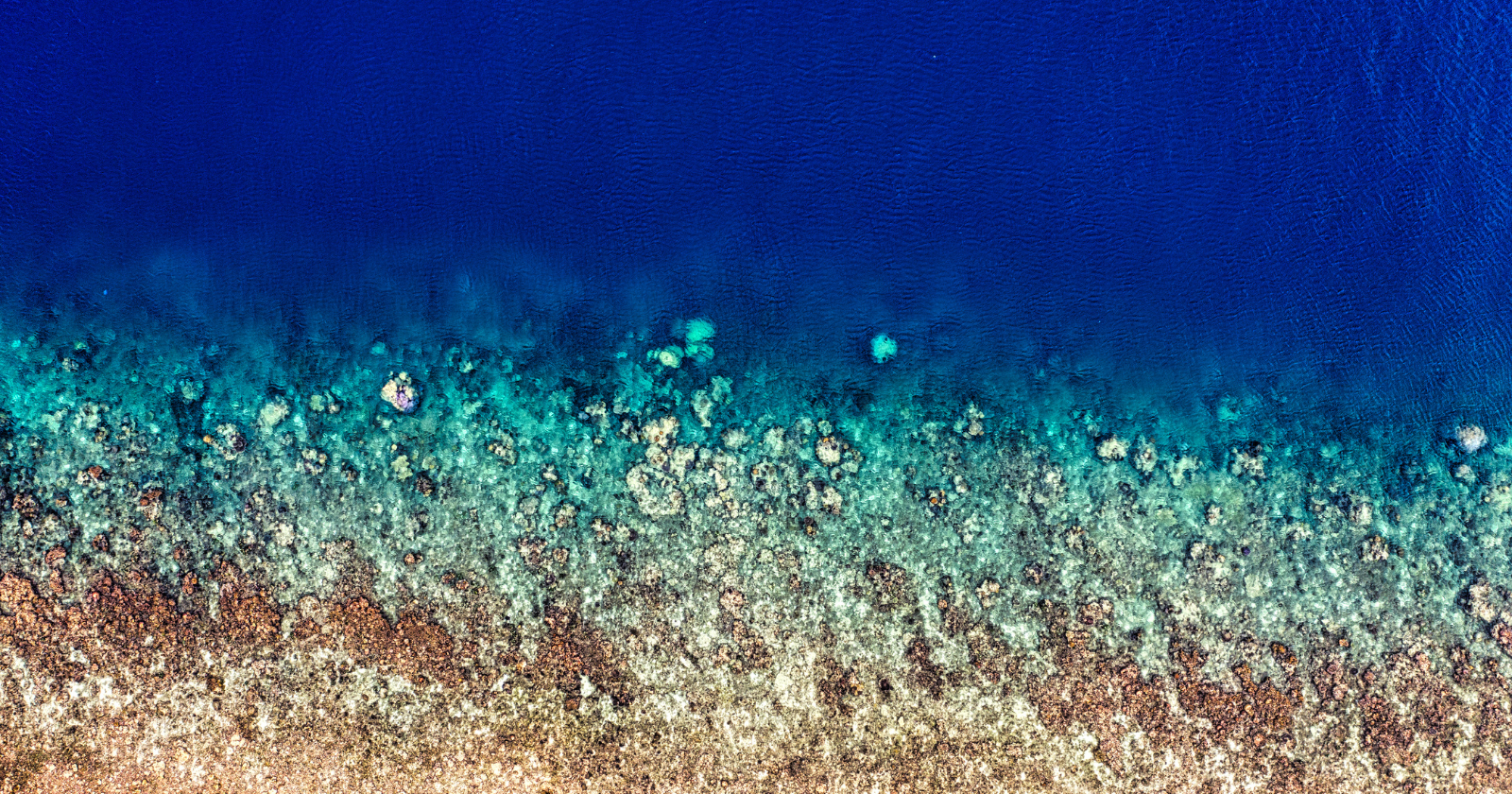
Consider the epistemic situation plainly. Robotic orbiters have imaged the entire surface of Mars at resolutions fine enough to follow individual sand dunes between seasons. NASA’s Mars Reconnaissance Orbiter carries a camera, HiRISE, capable of resolving features at 25 centimetres in targeted areas. The broad picture is similarly detailed: global mosaic maps of Mars exist at resolutions that allow detailed surface characterisation across nearly the entire planet. By contrast, most of Earth’s ocean floor, which covers approximately 71% of the planet’s surface, has never been directly measured at all. Where sonar soundings do exist, large portions come from single-beam instruments that produced one depth reading at a time, leaving vast expanses between ship tracks entirely uncharacterised.
This is not a scandal. It is a consequence of physics, access, and where research funding has historically gone.
Why the ocean floor is harder to map than other planetary surfaces
Mapping another planet’s surface from orbit is, in one important sense, easier than mapping Earth’s ocean floor. Light travels freely through the vacuum of space. It does not penetrate seawater to any useful depth: even in the clearest ocean conditions, visible light is absorbed within the upper few hundred metres. Mapping the abyssal plain, which lies on average around 3,800 metres below the surface, requires acoustic methods. Sound propagates efficiently through water, and multibeam sonar, which fans out dozens of beams simultaneously to produce swath coverage across a strip of seafloor, is the workhorse technology of modern ocean mapping. But a ship can only cover so much ocean. At the speeds and swath widths available to research and survey vessels, mapping the full ocean floor at the resolution targets set by Seabed 2030 — grid cells of 400 metres squared for deep water — would require an enormous number of ship-days. Satellites can infer approximate seafloor topography from gravitational anomalies, but those estimates are rough; they identify large features, not fine structure.
Cost compounds access. Deep-sea survey operations are among the most expensive scientific undertakings conducted routinely. A research vessel with capable multibeam systems costs tens of thousands of dollars per day to operate. And unlike orbital platforms, which can be positioned over any location within their ground track, ships must physically travel to every square kilometre they intend to survey. The Southern Ocean in winter, the Arctic under ice, and the deep trenches of the western Pacific all impose logistical constraints that have no direct parallel in planetary remote sensing.
From 6% to 28.7%: what has changed
When the Nippon Foundation-GEBCO Seabed 2030 Project was formally established in 2017, its baseline assessment found that approximately 6% of the world’s ocean floor had been mapped to what the project defines as modern standards. The number is striking precisely because it is so low. Eight years of intensive effort, coordinated data collection, and deliberate aggregation of previously siloed surveys have lifted that figure to approximately 28.7%, according to NOAA’s tracking data as of early 2026. The Seabed 2030 project’s own announcement on World Hydrography Day in June 2025 recorded 27.3%, noting that more than four million square kilometres of newly mapped seafloor had been added in the preceding year alone, an area roughly equivalent to the Indian subcontinent.
The acceleration reflects several overlapping developments. Multibeam sonar technology has improved and become more widely deployed, including on vessels of opportunity: commercial ships, ferries, and research cruises not specifically tasked with seabed mapping can now contribute data passively as they transit. Over 185 organisations from more than 40 countries have contributed data to the GEBCO global grid that underpins Seabed 2030’s outputs. First-time contributions arrived in 2024 and 2025 from Comoros, Cook Islands, Kenya, Mozambique, and Tanzania, among others. Machine learning is increasingly applied to data processing, enabling faster extraction of depth information from raw sonar returns and more sophisticated gap-filling between survey lines.
The result is a coverage rate that, through the mid-2020s, has been running at several million square kilometres per year.
What 28.7% means in practice, and what it leaves out
The headline figure can be misleading in both directions. It understates progress in heavily transited areas: the North Atlantic, the Mediterranean, and the coastal waters of wealthy maritime nations are substantially mapped. It overstates the global picture by distributing that progress across the full ocean area. The 71% that remains unmapped is disproportionately deep, remote, and difficult. The abyssal plains of the South Pacific, the deep basins of the Indian Ocean, and polar waters beneath seasonal ice represent some of the most logistically demanding survey environments on the planet.
The resolution target of 400-metre grid cells for deep water sounds coarse by land-mapping standards but is difficult to achieve consistently at depth. Depth itself introduces uncertainty: sonar beams spread as they travel, and the geometry of wide-angle beams at the edges of multibeam swaths degrades resolution. Survey planning must account for the tradeoff between swath width and data quality. In shallow coastal waters, the resolution targets are finer still, and those areas carry their own navigational and operational complications.
Four years remain before the project’s 2030 target date. Closing a gap from 28.7% to 100% in that window would require adding roughly 71% of ocean floor coverage, approximately 254 million square kilometres, at a rate that would far exceed anything achieved so far. The project’s own trajectory makes the 2030 deadline unlikely to be met in full. NOAA’s analysis of US waters alone projects that, at current rates of data acquisition, baseline mapping of US offshore waters would not be complete until around 2041. What the deadline does is concentrate attention and resources. It provides a coordination mechanism and a metric against which progress can be publicly assessed each year.
What seabed mapping is actually needed for
The case for mapping the ocean floor is not primarily about satisfying scientific curiosity, although that is a legitimate purpose in its own right. Several concrete, practical applications depend on accurate bathymetric data.
Tsunami modelling is among the most time-sensitive. When a submarine earthquake displaces the seabed, the wave it generates propagates outward with a speed and energy distribution shaped by the topography it travels over. Accurate seafloor maps allow modellers to simulate wave propagation more precisely, improving early-warning system predictions and evacuation planning. The 2004 Indian Ocean tsunami exposed how poorly constrained seafloor topography was in affected regions; subsequent survey work has improved the picture substantially, but gaps remain in many seismically active ocean basins.
Undersea cables carry the overwhelming majority of the world’s international data traffic. Installation and repair of those cables requires detailed bathymetric charts: routes must avoid steep slopes prone to landslides, abyssal trenches, and other features that complicate laying operations or increase cable vulnerability. When a cable breaks, repair ships need accurate seafloor maps to locate the fault and position themselves correctly. This is not an abstract engineering consideration. Cable breaks can affect internet connectivity and financial transaction routing for entire regions.
Climate science has a more diffuse but no less consequential stake. Ocean circulation patterns, which distribute heat and drive weather systems across continents, are shaped by the topography of the seafloor. Ridges, seamounts, and basin geometry affect how water masses mix, where deep upwelling occurs, and how heat is transported between ocean layers. Climate models that represent the ocean with coarse or inaccurate bathymetry introduce systematic errors into projections of regional temperature, precipitation, and sea-level change.
The emerging debate over deep-sea mining adds a further dimension. Polymetallic nodules, cobalt-rich crusts, and hydrothermal vent deposits have attracted commercial interest as a potential source of materials used in battery technology and electronics manufacturing. Several nations and companies hold exploration licences in international waters regulated by the International Seabed Authority. Detailed seabed maps are a prerequisite for any responsible assessment of mining proposals, including the ecological baselines needed to evaluate impact. The scientific community and environmental groups remain divided on whether deep-sea mining can be conducted without irreversible damage to poorly understood ecosystems; the mapping data informs that argument without resolving it.
The geopolitics beneath the surface
Seabed mapping is not politically neutral. Under the United Nations Convention on the Law of the Sea, a coastal state’s rights over the continental shelf can extend beyond the standard 200-nautical-mile exclusive economic zone if it can demonstrate that the shelf extends further. Bathymetric data and geological surveys are central to those submissions. In the Arctic, where warming is opening previously inaccessible waters and where overlapping territorial claims from Russia, Canada, Denmark (via Greenland), Norway, and the United States remain unresolved, seafloor mapping carries direct sovereign implications. Russia has submitted extensive continental shelf claims in the Arctic and has conducted significant survey work to support them. The scientific enterprise of ocean mapping and the geopolitical contest over seabed jurisdiction proceed in parallel, and the same data can serve both.
The 2030 deadline and what follows
The next four years will test whether the pace of data collection established in the early 2020s can be sustained and accelerated. Several factors could affect the trajectory. Autonomous underwater vehicles and uncrewed surface vessels offer the possibility of surveying remote areas at lower cost and without the logistical constraints of crewed research ships. If those technologies mature and are deployed at scale, the rate of coverage gains could increase substantially. Machine learning applied to existing gravity-anomaly data may also yield improved bathymetric estimates in areas where direct sonar survey is unlikely in the near term, even if those estimates do not meet the strict resolution standards Seabed 2030 requires.
Whether the 2030 deadline is met or not, the project has already produced a shift in how the ocean floor is understood and described. The GEBCO grid, freely available and updated continuously, is used by scientists, engineers, governments, and shipping companies across dozens of applications. The 6% figure from 2017 represented a genuine gap in knowledge of this planet. The current figure of approximately 28.7% represents real progress, even as it makes clear how much remains to be done.
The Mars comparison, revisited plainly: there are good reasons why Mars has been mapped more thoroughly than Earth’s ocean floor. Space exploration yields data from orbit at relatively modest cost, and the scientific and political incentives for planetary mapping have been strong and sustained over decades. The ocean floor is harder to reach, harder to image, and harder to fund. That gap is narrowing. It has not yet closed.
