
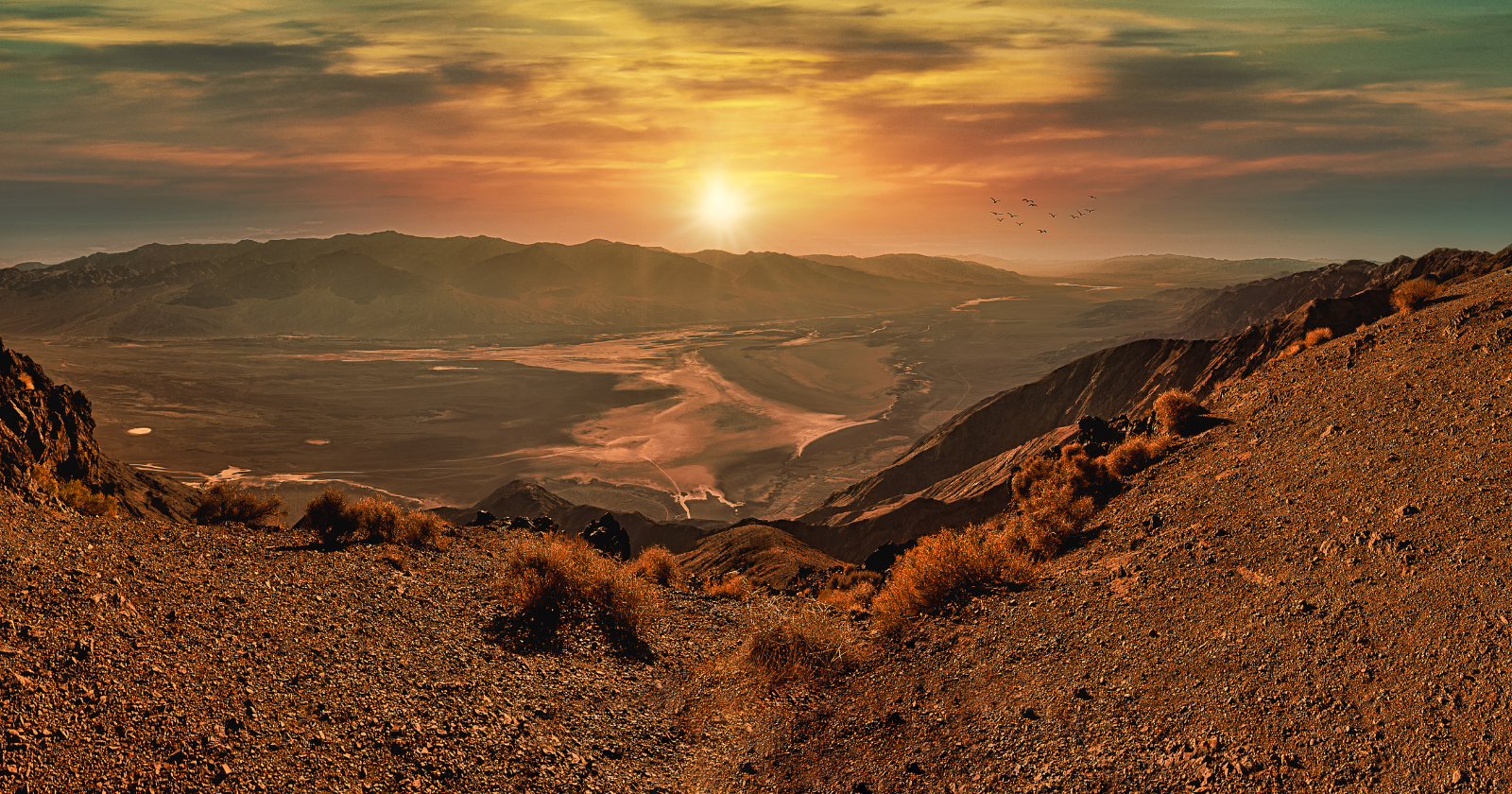
The structure of Hell, as Dante Alighieri laid it out in the early 14th century, is a cone-shaped cavity driven into the earth, narrowing through nine concentric rings toward a frozen pit at the centre of the planet. It was created, in Dante’s telling, when Satan fell from heaven and struck the Southern Hemisphere with enough force to reshape the world. Displaced rock fled to the opposite side of the globe and piled up into the mountain of Purgatory. The geometry is precise. One researcher has argued that the physics, read structurally, resembles what impact science now describes.
Timothy Burbery, a researcher at Marshall University, presented a paper at the European Geosciences Union General Assembly in Vienna on 8 May 2026, arguing that Dante’s Inferno is best understood not only as theological allegory, but as what Burbery calls a gedankenexperiment in impact physics. According to the EGU press release, published 1 May 2026, Burbery proposes that Dante envisioned Satan as a high-velocity impactor hitting the Southern Hemisphere and tunnelling to the Earth’s centre, triggering a planetary chain reaction that matches, in structural outline, what modern meteoritics describes when a sufficiently large object strikes a rocky body.
What the argument actually is
The central claim is structural. Burbery observes that the nine circles of Hell, far from being purely symbolic tiers representing categories of sin, closely resemble the concentric terraced morphology of multi-ring impact basins. These formations appear across the solar system wherever a sufficiently large object has struck a rocky surface: on the Moon, on Venus, on Mars. The terracing is a function of the impact mechanics themselves, produced by the propagation of shock waves through rock after a high-energy collision.
Burbery further argues that the central peak of Mount Purgatory, sitting on the opposite side of the planet from where Satan strikes, corresponds to the antipodal focusing of seismic energy that occurs after large planetary impacts. When an impactor hits with enough force, energy travels through the planet and can produce elevated terrain on the far side. This is not a feature Dante could have read about in any text available to him. It is a phenomenon that was not formally described by science until the modern era.
The scale of the imagined event, in Burbery’s reading, is comparable to the Chicxulub impact, the collision linked to the extinction of the dinosaurs roughly 66 million years ago. He draws further comparisons to the interstellar object Oumuamua in describing the elongated shape of Dante’s Satan, and to the Hoba meteorite, a 60-tonne iron mass found in Namibia that survived its impact largely intact, in discussing how Dante’s Satan remains a coherent physical body rather than vaporising on contact. These are analogies in an interpretive argument, not measurements. Burbery is reading a poem through the lens of planetary science, not extracting data from it.
What Dante knew and what he couldn’t have
This is where the argument becomes genuinely interesting, and where the appropriate care in reading it matters. The Aristotelian cosmology that dominated educated European thought in Dante’s time held the heavens to be perfect and unchanging. Celestial objects were not understood as physical bodies capable of striking planets. Meteors were categorised as atmospheric phenomena, not as rocks falling from space. The scientific framework that would eventually explain impact cratering did not exist in anything like its modern form until the 20th century. Ernst Chladni’s 1794 proposal that meteorites had an extraterrestrial origin was still nearly five centuries away when Dante was writing.
In this context, Burbery’s argument is not that Dante understood meteoritics. It is that Dante imagined, through poetic and theological reasoning, a physical scenario whose structural features happen to parallel what modern impact science describes. Whether that parallelism reflects independent intuition, access to some earlier classical source, or simply the inevitable geometry of things that fall fast and hard into other things, the paper does not resolve. What it notes is that the parallel exists and is more specific than one might expect from coincidence alone.
The EGU press release frames this as evidence that Dante “helped shift the Western paradigm toward recognising celestial bodies as physical agents of change.” That is a stronger claim than the structural parallels alone support, and we read it as the press release’s interpretation of the argument rather than a finding Burbery’s paper establishes empirically.
The wider argument about myth and disaster records
There is a separate strand in Burbery’s paper that is worth noting on its own terms. He situates the Inferno within a broader tradition of what the EGU release calls literary geomythology: the idea that ancient narratives sometimes encode observations about physical catastrophes long before those catastrophes are formally understood by science.
This is not a new idea. There is a small but serious body of scholarship examining whether flood myths, fire narratives, and accounts of sudden landscape changes in ancient literature correspond to actual geological or astronomical events. Some of this work has produced credible findings; some has produced patterns where none existed. Burbery’s contribution is to apply this framework to Dante specifically, and to do so with specific reference to modern impact mechanics rather than in general terms.
The claim that has practical relevance for planetary defence, as the EGU press release notes, is that narratives can preserve awareness of physical threats across long stretches of time, before science has the vocabulary to describe them precisely. Whether the Inferno counts as such a narrative is a question of interpretation. The structural parallels Burbery identifies are real enough to warrant the reading as a serious one.
What the paper is and isn’t
It is worth being precise about the nature of the work. This is a humanities scholar reading a medieval poem through the lens of planetary science and finding that the geometry holds up better than most readers have noticed. It is not a geological analysis, not a new observation about the physical world, and not a claim that Dante had access to knowledge he could not have had. The argument is interpretive, the evidence is textual, and the paper was presented at a geosciences conference rather than submitted to a literary or historical journal, which is itself part of the point Burbery appears to be making: the parallels are specific enough to be worth a geoscientist’s attention.
What keeps the argument from being merely clever is the specificity of the structural matches. Multi-ring crater morphology, antipodal uplift, terminal velocity and crustal penetration: these are not general descriptions of something big hitting something else. They are particular features of large-scale impacts that Dante’s geography reproduces in outline.
The Inferno has been read by millions of people over seven centuries. That the planetary physics embedded in its architecture went largely unremarked until a researcher sat down with both texts says something, though precisely what is a question the paper leaves usefully open.
