

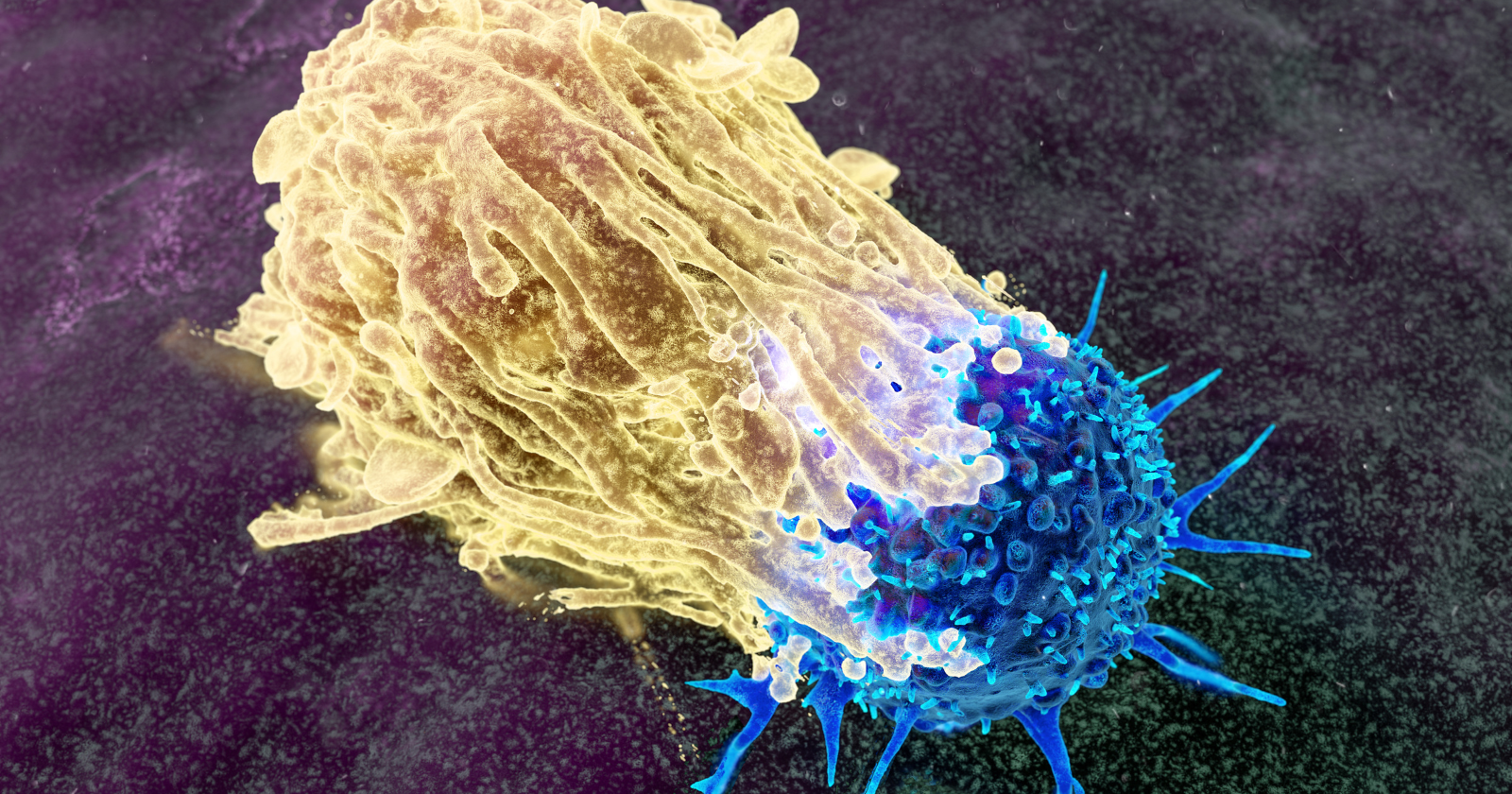
Every cell in the human body carries on its surface a set of molecular flags called MHC class I molecules. Their job is straightforward in principle: they grab fragments of whatever protein is being made inside the cell and hold those fragments up for inspection. When a cell is infected by a virus or has begun dividing uncontrollably, the fragments it displays will look abnormal, and the immune system’s T cells — specifically, the cytotoxic CD8+ variety — will recognize that signal and kill the cell. This is the mechanism by which the adaptive immune system detects cancer, and it has been the dominant framework in cancer immunology for decades.
Cancer, unsurprisingly, found a way around it. Tumor cells frequently downregulate or eliminate MHC class I expression — essentially removing the flags that would draw T cell attention. The phenomenon is well documented across a wide spectrum of human cancers. Without MHC I on the surface, a tumor cell becomes, from a T cell’s perspective, functionally invisible. For researchers developing immunotherapies aimed at T cell recognition, this represents one of the central obstacles in the field.
The second system
What that framing omits is that the immune system is not built around T cells alone. Running alongside the adaptive immune response is an older, faster-responding arm of immunity whose logic works in nearly the opposite way. Natural killer cells — NK cells — do not look for abnormal signals on the surface of a cell. They look for the absence of normal ones.
The conceptual foundation for this was laid by immunologist Klas Kärre in the 1980s, in a hypothesis he called “missing self.” The observation that prompted it was that bone marrow cells lacking MHC class I were rejected by a host even in the absence of a T cell response — suggesting that something else in the immune system was actively targeting MHC-low cells. Kärre proposed that NK cells were not scanning for markers of disease but were instead monitoring for the continuous presence of MHC class I as a marker of health. Cells that displayed MHC I sent an inhibitory signal to NK cells, effectively telling them: I am normal, do not attack. Cells that lacked it sent no such signal, and NK cells, losing their inhibitory input, became activated.
The molecular mechanism behind this is now well characterized. NK cells carry inhibitory receptors — in humans, a family called killer immunoglobulin-like receptors, or KIRs — that bind directly to MHC class I molecules. When those receptors are engaged, NK cell cytotoxicity is suppressed. When MHC I is absent and those receptors find nothing to bind, the suppression is lifted, and the NK cell can kill.
What this means for cancer’s defense
The implication is a structural paradox in how cancer attempts to evade the immune system. Downregulating MHC class I is effective against T cells — they require MHC I presentation to recognize their target, and without it they cannot act. But the same move that hides a tumor cell from the adaptive immune system removes the molecular signal that keeps NK cells at bay. Cancer’s most common evasion strategy against one arm of immunity is, in principle, an invitation to the other.
This does not mean NK cells reliably clear MHC-low tumors. The relationship is considerably more complicated in practice. Solid tumors present significant physical barriers to NK cell infiltration. NK cells in tumor environments can become exhausted or anergic — a state of functional unresponsiveness that develops in part because of the chronic low-level stimulation a tumor environment provides. The immunosuppressive cytokines that tumors secrete, including transforming growth factor-beta, can further blunt NK activity even where MHC I is absent. Research groups have documented that NK cells in MHC I-deficient tumors often show the same exhaustion markers, including co-expression of Tim-3 and PD-1, seen in dysfunctional T cells, and that the anergic state can be partially reversed with cytokine stimulation such as IL-12 and IL-18.
There is also the matter of NK cell education — a calibration process by which NK cells develop their functional capacity in relation to the MHC I molecules present in the host. NK cells educated against high MHC I backgrounds tend to be more reactive against MHC-low targets, but the mechanisms governing this are still being worked out.
Clinical consequences and the checkpoint connection
The missing-self framework has acquired new clinical urgency from observations around checkpoint inhibitor therapy. Drugs that block PD-1 or CTLA-4 — the checkpoints that tumors exploit to suppress T cell activity — can generate strong T cell responses against MHC I-positive cancer cells. But that same selective pressure drives tumors to evolve MHC I loss as a resistance mechanism. In patients whose cancers develop acquired resistance to checkpoint therapy, MHC I downregulation is one of the more frequently observed escape routes. When it occurs, the tumor that has escaped T cell surveillance is, by the logic of missing self, now more susceptible to NK cell attack — creating a therapeutic window that has not yet been reliably exploited in clinical practice.
Several groups are working on approaches designed to activate NK cells in MHC-low tumor environments, including allogeneic NK cell infusions selected for KIR-HLA mismatch, engineered NK cell therapies, and cytokine combinations that can reverse NK exhaustion. The shared aim is to translate the theoretical vulnerability created by MHC I loss into reliable tumor clearance — converting a paradox in cancer biology into a practical treatment strategy.
What to watch next
The missing-self hypothesis is nearly four decades old, but its clinical application remains largely unrealized. The problem is not conceptual — the biology is well understood — but operational: getting NK cells into tumors, keeping them functional there, and activating them reliably against MHC-low targets without triggering toxicity against healthy tissues that also downregulate MHC I under stress.
How the field resolves those constraints will determine whether the immune system’s second surveillance layer becomes as therapeutically central as the T cell response has been.