

In 2001, ahead of the opening of the National Space Centre in Leicester, a teenager on work experience was helping to prepare the exhibits. One of them was a space toilet. She helped unpack it, clean it, and ready it for display.
Claire Parfitt was fourteen when she had written to NASA to ask whether she could work there. NASA said no, which is a reasonable response to an unsolicited application from a schoolgirl in the English Midlands. She found work experience closer to home instead.
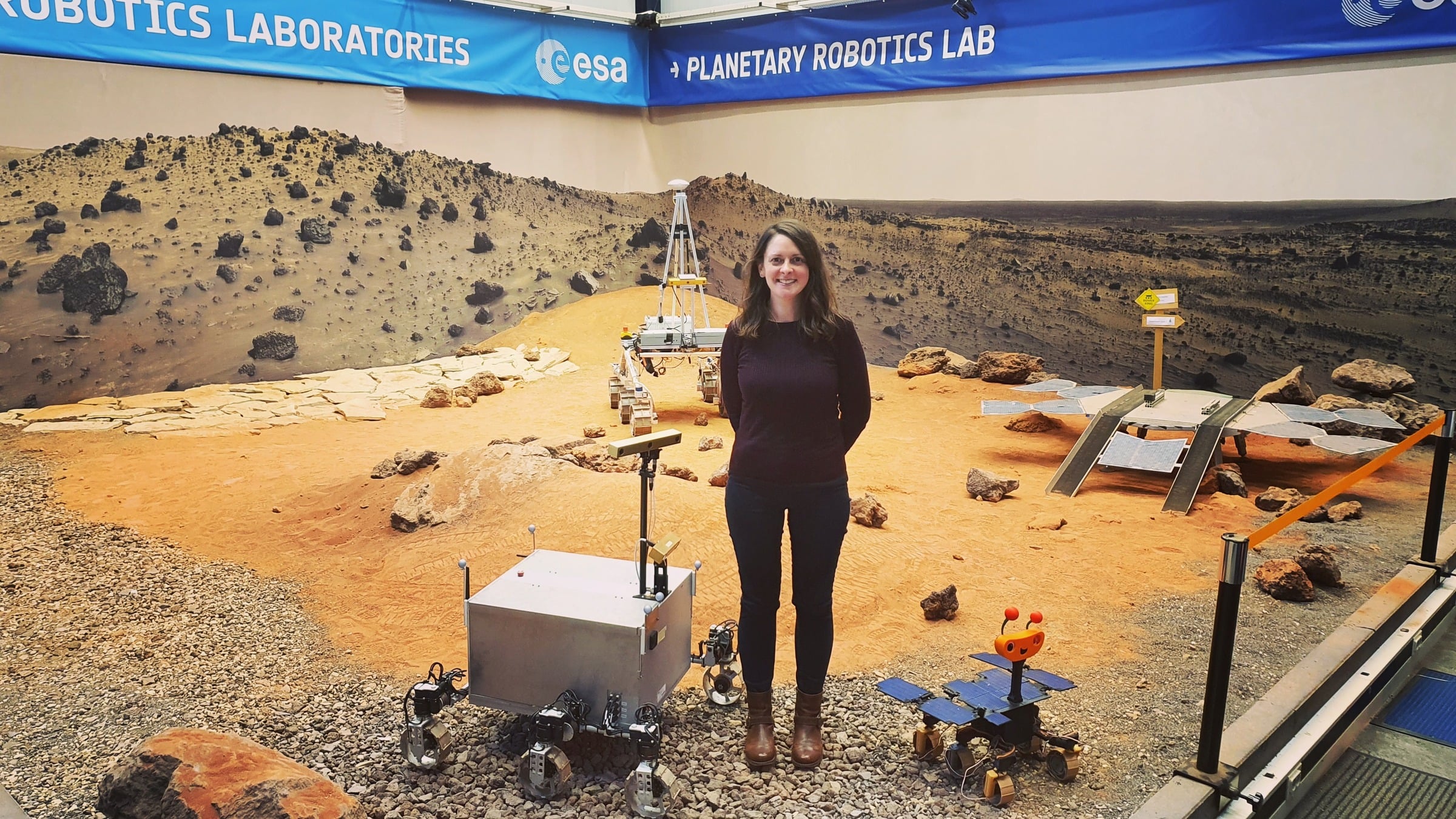
Twenty-five years later, Parfitt is the Mars Exploration Study Lead in the European Space Agency’s Directorate of Human and Robotic Exploration, responsible for the study and technology preparation of future European missions to Mars. She also serves as ESA’s point of contact for the International Mars Exploration Working Group, which ESA currently chairs, a coordination body that brings together space agencies from across the world to align their plans for the future of Mars exploration.
The space toilet is some distance behind her.
Building the path
After her work experience at the National Space Centre, Parfitt pursued a physics degree and then a PhD in spacecraft power systems engineering. She moved into the UK space industry as a systems engineer, working on two missions that have become reference points in European planetary science. One was ExoMars, the ESA programme to search for evidence of past or present life on Mars, which includes the Rosalind Franklin rover designed to drill up to two metres below the Martian surface and access material shielded from the radiation that sterilises the planet’s top layer. The other was SMILE, a joint ESA and Chinese Academy of Sciences mission studying the interaction between the solar wind and Earth’s magnetosphere.
Parfitt joined ESA’s European Space Research and Technology Centre in the Netherlands, initially working in the Concurrent Design Facility, where early-stage mission concepts are developed and assessed by cross-disciplinary teams before the costs and commitments of full development begin. Her specialism was Mars exploration studies. She later moved into the Directorate of Human and Robotic Exploration, taking on the Mars Exploration Study Lead role in 2023.
What the work involves
No space agency has a confirmed crewed Mars mission on its flight manifest. The engineering challenges are substantial and not yet solved at operational scale: the journey takes between six and nine months each way, during which crews are exposed to radiation levels with no analogue in current spaceflight experience; the surface environment requires pressurised habitation and life support systems far beyond anything yet deployed beyond low Earth orbit; and the two-to-three-year round-trip duration rules out emergency return. Human Mars missions belong, for now, in the category of serious preparation rather than near-term planning.
This is precisely where Parfitt’s work sits. Her team’s remit covers the foundational layer: the studies, technology development programmes, and international coordination that would need to be completed before a crewed Mars mission becomes credible. The International Mars Exploration Working Group, which she chairs, includes NASA, ESA, JAXA, and other agencies. Its function is to prevent duplication, identify capability gaps, and establish shared frameworks for the sequence of missions required to build toward human presence on Mars: robotic precursors, sample return, long-duration surface characterisation, and the systems engineering questions that connect them.
The ExoMars Rosalind Franklin rover feeds into this sequence. Understanding the subsurface composition of Mars, including whether it preserves organic chemistry that would survive the surface radiation environment, informs where humans could eventually operate and what the surface environment would do to biological systems over extended stays. Science and human exploration preparation are not separate programmes; the scientific missions are, in part, the reconnaissance for what comes after.
For the person who first encountered the space industry through a toilet exhibit in a Leicester science centre, the path from that afternoon to the International Mars Exploration Working Group was not direct. It ran through a physics degree, a doctoral thesis on power systems, a series of engineering roles in the UK industry, and an eventual move to the Netherlands to join the agency whose work she had been supporting from the outside. The fourteen-year-old who wrote to NASA did not get a placement. She got something harder to arrange and more durable: a career built from the ground up toward a question that no one in the industry has yet answered.