

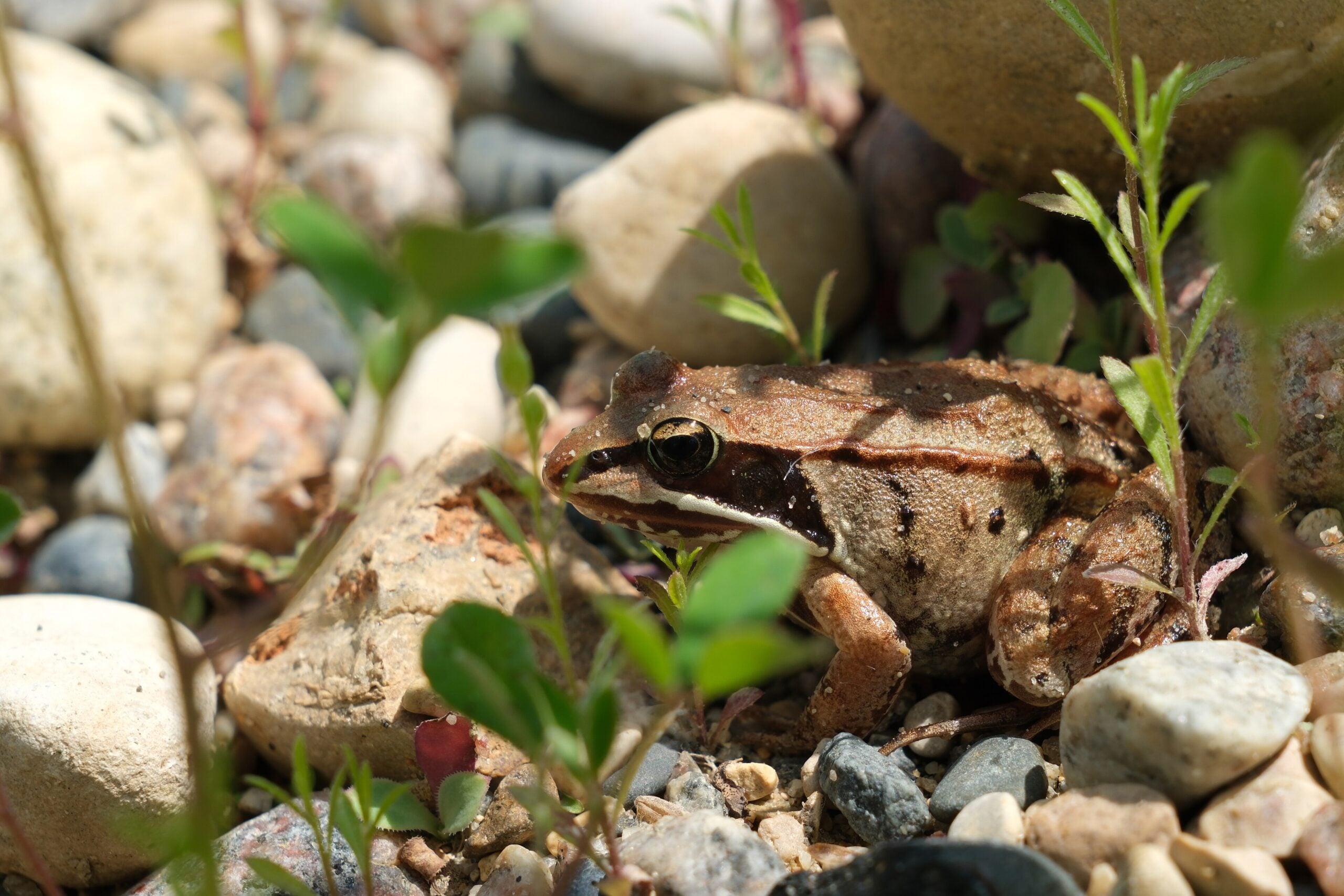
A frozen wood frog has no detectable heartbeat, no breathing, no circulation and no obvious brain activity. Ice fills the spaces around its organs and tissues. Its limbs are rigid. By the ordinary standards applied to a vertebrate, the animal appears to have passed beyond recovery.
When warmth returns, the heart begins beating again. Breathing and reflexes follow. Within hours or days, depending on the severity and duration of the freeze, the frog can resume recognisable behaviour.
The familiar description that wood frogs “freeze solid” is broadly understandable but physiologically imprecise. Up to roughly 65 to 70 per cent of their total body water can become ice, yet the ice is largely kept outside cells. That distinction is the difference between controlled freeze tolerance and lethal cellular destruction.
Winter reaches the frog beneath the leaves
Wood frogs, Lithobates sylvaticus, range across northern North America and above the Arctic Circle. They do not escape winter by retreating below the frost line. Many settle into shallow depressions in soil beneath leaf litter, where snow and dead vegetation provide insulation but do not guarantee temperatures above freezing.
As ice forms in the moist material around a frog, freezing can begin at its permeable skin. The process then advances through blood plasma and extracellular spaces, drawing liquid water out of cells as the ice mass grows. Reviews of wood frog physiology describe 65 to 70 per cent of total body water becoming extracellular ice, including ice around the brain, lungs, heart, eyes and abdominal organs.
This is not passive resistance to cold. It is an organised physiological response to ice formation. The frog must manage dehydration, lack of oxygen, mechanical stress from growing crystals and the chemical disturbance that arrives when circulation eventually resumes.
The heart has one last job before it stops
Freezing does not switch the animal off in an instant. Early in the process, the cardiovascular system remains active long enough to distribute protective compounds.
Electrocardiogram measurements reported in 1989 showed that a wood frog’s heart rate nearly doubled within a minute of freezing beginning, reaching about eight beats per minute. It then slowed over the following hours and stopped near the completion of ice formation, roughly 20 hours later. The heart continues while it can still circulate glucose from the liver into the rest of the body.
That glucose is central to the animal’s survival. Ice formation triggers the rapid breakdown of liver glycogen, flooding blood and tissues with sugar. In research on Alaskan and Ohio frogs, glucose concentrations in several organs rose by dozens of times during a 48-hour freeze. Northern frogs can enter winter with unusually large stores of liver glycogen, giving them more material from which to build this chemical defence.
Glucose is often described as antifreeze, but that word can mislead. It does not keep the whole frog liquid. It reduces the amount of ice that forms, helps cells retain a minimum volume as water is pulled outward and stabilises membranes and proteins under severe osmotic stress.
The ice is directed away from the most vulnerable place
Intracellular ice is usually devastating because crystals can disrupt membranes and internal structures. Wood frog freeze tolerance depends on favouring ice formation outside cells while keeping enough water and protective solutes inside them.
Glucose works alongside urea, which accumulates as the frogs prepare for winter. Both substances alter the movement and freezing behaviour of water, while urea also appears to protect cellular structures and suppress metabolism. A 2015 study of subarctic frogs found that these two cryoprotectants supported survival through repeated and extreme freezing. Five frogs exposed to several freeze-thaw cycles and ultimately cooled to minus 8 degrees Celsius recovered normal behaviour and remained healthy during seven weeks of monitoring.
Populations differ markedly. Experiments reported in the Journal of Experimental Biology found that Alaskan wood frogs survived cooling to minus 16 degrees Celsius, around 10 to 13 degrees below the lethal limits measured in southern animals. The northern frogs carried more glycogen and urea and apparently maintained a larger share of body water in a bound, non-freezing state. The extreme tolerance is a local adaptation, not a uniform limit for every wood frog.
The frozen state also involves a profound reduction in energy use. With no oxygen moving through the body, the frog suppresses non-essential processes and changes the regulation of enzymes, stress proteins, antioxidants and genes involved in survival. It is not dead and later revived. It is alive in an extraordinarily reduced physiological state.
In Alaska, winter can last more than seven months
Laboratory freezes establish what the frogs can survive under controlled conditions. Field measurements show what winter asks of them.
In Interior Alaska, researchers tracked temperatures inside natural hibernation sites occupied by 18 free-living wood frogs. All survived. Temperatures around the frogs remained below their estimated freezing point for an average of 193 days, with a range of 175 to 218 days. The minimum temperatures in individual sites ranged from minus 8.9 to minus 18.1 degrees Celsius.
Those measurements do not prove that every frog remained continuously and uniformly frozen for every hour of that period. They do show that the animals survived long exposure within a winter environment cold enough to freeze them. The study also recorded repeated freeze-thaw cycles in autumn, before stable winter conditions arrived. The field results, published in 2014, extended the observed duration and lower temperature of natural freeze tolerance.
Snow cover matters. Air temperatures at the Alaska site fell below minus 40 degrees Celsius, but trapped air in leaves and snow kept the frogs’ shallow shelters substantially warmer and more stable. The animal’s biochemistry is exceptional, yet it still relies on the physical protection of a well-chosen microhabitat.
Thawing is a sequence, not a magic reset
Recovery begins unevenly as heat enters the body and ice melts. In a 1991 experiment, cardiac function returned before spontaneous breathing and hind-leg reflexes. Faster warming restored functions sooner, although it did not improve survival. The heart is the first major system to restart, allowing circulation to help restore oxygen and redistribute metabolites.
The phrase “hop away as if nothing happened” captures the visible outcome but conceals a real physiological cost. Wood frogs frozen at minus 2 degrees Celsius for 36 hours displayed normal behaviour and near-normal metabolite levels within a day of thawing, yet treadmill tests found a 40 per cent reduction in endurance. The impairment persisted for at least 96 hours. The authors suggested that post-freeze exercise relied more heavily on glycolytic metabolism.
The frog therefore does not emerge untouched. It repairs, rebalances and recovers quickly enough to breed, feed and avoid predators in a season that offers little time. Freeze tolerance is a managed injury rather than immunity to ice.
This physiology attracts interest from cryobiology and organ-preservation research, but it is not a ready-made plan for freezing humans. Wood frogs evolved coordinated control over ice location, cryoprotectant production, dehydration and metabolic suppression across the entire body. A mammalian organ exposed to the same conditions lacks that integrated machinery.
What the wood frog demonstrates is narrower and more useful: in a vertebrate adapted for it, heartbeat and circulation can cease for an extended period without making recovery impossible. The apparent stillness of the frozen animal hides an elaborate preparation made before the last beat, and an equally ordered return when the ice finally recedes.