
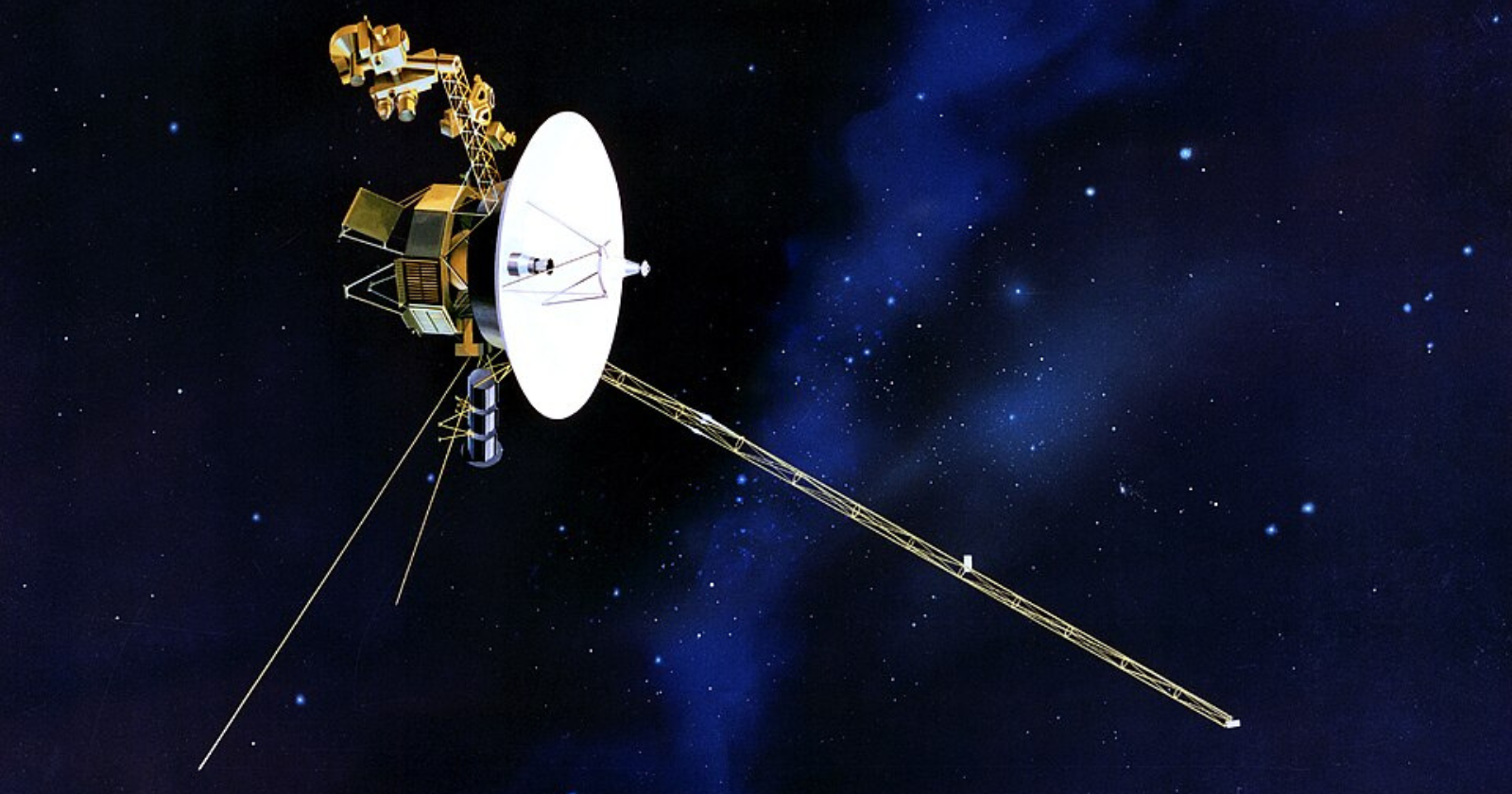
Sending a command to Voyager 1 is closer to mailing a letter than placing a phone call. The probe, launched in September 1977, is now roughly 16 billion miles from Earth, heading away from the Sun at roughly 38,000 miles per hour. In November 2026, Voyager 1 will become the first human-made object to pass one light-day from Earth — the distance at which that signal needs a full 24 hours, each way, to make the trip.
The two-day round-trip
Suzy Dodd, the Voyager project manager at NASA’s Jet Propulsion Laboratory, put the cadence concretely: “If I send a command and say, ‘good morning, Voyager 1,’ at 8 a.m. on a Monday morning, I’m going to get Voyager 1’s response back to me on Wednesday morning at approximately 8 a.m.”
The same gap shaped the most consequential operational episode in the probe’s recent life. In November 2023, Voyager 1 stopped sending back coherent science and engineering data, and the team spent five months working out what had gone wrong and how to fix it. As JPL reported in April 2024, the issue traced to a single failed memory chip on one of the spacecraft’s three onboard computers. There was no way to repair the chip; the workaround was to break the affected software into smaller pieces and store them in different sections of the computer’s memory.
The 2024 fix
Doing that across the distance to interstellar space is not a matter of typing fast. Linda Spilker, the Voyager 1 project scientist at JPL, described the rhythm of those months to NBC News: “With Voyager 1, it takes 22 1/2 hours to get the signal up and 22 1/2 hours to get the signal back, so we’d get the commands ready, send them up, and then like two days later, you’d get the answer if it had worked or not.” There are no working ground simulators left for hardware this old. Spilker described the team’s check on the patch as an old-fashioned read-through: “There were three different people looking through line by line of the patch of the code we were going to send up, looking for anything that they had missed,” she said, calling it “sort of an eyes-only check of the software that we sent up.”
The patch reached the spacecraft on April 18, 2024. The team heard back on April 20 — two days later, with the modification working as intended.
One light-day
What the November 2026 milestone changes is mostly symbolic, but it sharpens the operating picture. Once the round-trip clears 48 hours, every command-and-response cycle is measured in days, not hours. The data rate is already slow: Dodd told CNN the probes send back at around 160 bits per second. Each spacecraft has been designed to handle most surprises on its own. “If they get something going wrong,” Dodd said, “they can put themselves in a safe state so that they can wait until we’re able to talk to the spacecraft and figure out what the problem is and resolve that issue.” The team on Earth is, in effect, on call for a spacecraft that can usually stabilize itself and then wait.
Voyager 2, on its own trajectory, is not expected to reach the one-light-day mark until 2035. Neither probe is likely to be transmitting by then; both are working through a slow shutdown of instruments to conserve dwindling power. As of NASA’s recent instrument status update, Voyager 1 has two science instruments still operating: the magnetometer and plasma wave subsystem. Voyager 2 has three: the cosmic ray subsystem, magnetometer, and plasma wave subsystem. Both spacecraft are being managed through a slow sequence of instrument shutdowns to conserve dwindling power.
On the desks at JPL, the work is mostly patience. Dodd has called the spacecraft “ambassadors for us here on Earth.” Once the round-trip clears two full days, “ambassador” stops sounding like a metaphor and starts sounding like a job description: a representative dispatched far away, sending back occasional slow word, on its own counsel for most of what happens between calls.
