
Sunlight falls through a collapsed ceiling and lands on a forest of trees more than 40 metres tall, growing on a floor that no daylight would otherwise reach. Above them, clouds form and drift along the cave roof. Below, a river runs through the dark. This is the inside of Hang Son Doong, in central Vietnam. More than 200 plant species grow in its sunlit chambers, including trees taller than a ten-storey building.
How does a cave this large stay unknown until 1990? And what does a volume of 38.5 million cubic metres actually look like when you are standing in it?
The answers say as much about the cave as about how few people have seen it.
How Son Doong was found, and why it stayed hidden so long
The entrance was found by accident. A local forager named Ho Khanh stumbled on the opening in 1990 while sheltering from a storm. He noticed something strange about the spot. As a CBS 60 Minutes account describes it, wind was blowing out of the ground, with clouds billowing from the entrance and the sound of a river far below.
Dense jungle swallowed the entrance for the better part of two decades, making it nearly impossible to relocate. Khanh spent years searching for it again. By his own account, he located it again in 2008 and led explorers back in 2009.
When the British-Vietnamese team led by Howard Limbert finally surveyed it, the scale was clear from the first moments inside. The 2009 survey measured it at 38,500,000 cubic metres, confirming it as the largest known cave passage on Earth by volume.
What the numbers actually mean
A figure like 38.5 million cubic metres is hard to picture, so comparisons do the work. The previous record holder, Deer Cave in Malaysia, holds about 9.5 million cubic metres, making Son Doong roughly five times larger.
The main passage runs more than five kilometres and reaches around 200 metres high and 150 metres wide. That is enough room for a 40-storey skyscraper to stand inside it, or for a Boeing 747 to pass through with space to spare. The cave was carved by a river cutting through limestone more than 400 million years old, with the hollowing-out starting around 2.5 million years ago.
The cave may also be larger than the original survey suggested. A 2019 diving expedition explored the underground river and found evidence of a flooded tunnel linking Son Doong to a nearby cave. The connection would add about 1.6 million cubic metres to the total, by Live Science’s account roughly two-thirds of a Great Pyramid.
The living world inside
What makes Son Doong stranger than its measurements is that parts of it are not dark at all. Two sections of the ceiling have collapsed, forming skylights known as dolines, and the sunlight pouring through them supports something close to a self-contained ecosystem. Jungles grow on the cave floor, with trees over 40 metres high reaching toward the openings.
The cave generates its own weather. The temperature difference between the cool interior, a steady 22 to 25°C in summer, and the hotter air outside is enough to spin clouds and mist along the passage. Among the rock formations are stalagmites surveyed at up to 80 metres tall, among the tallest ever recorded.
What it takes to get in
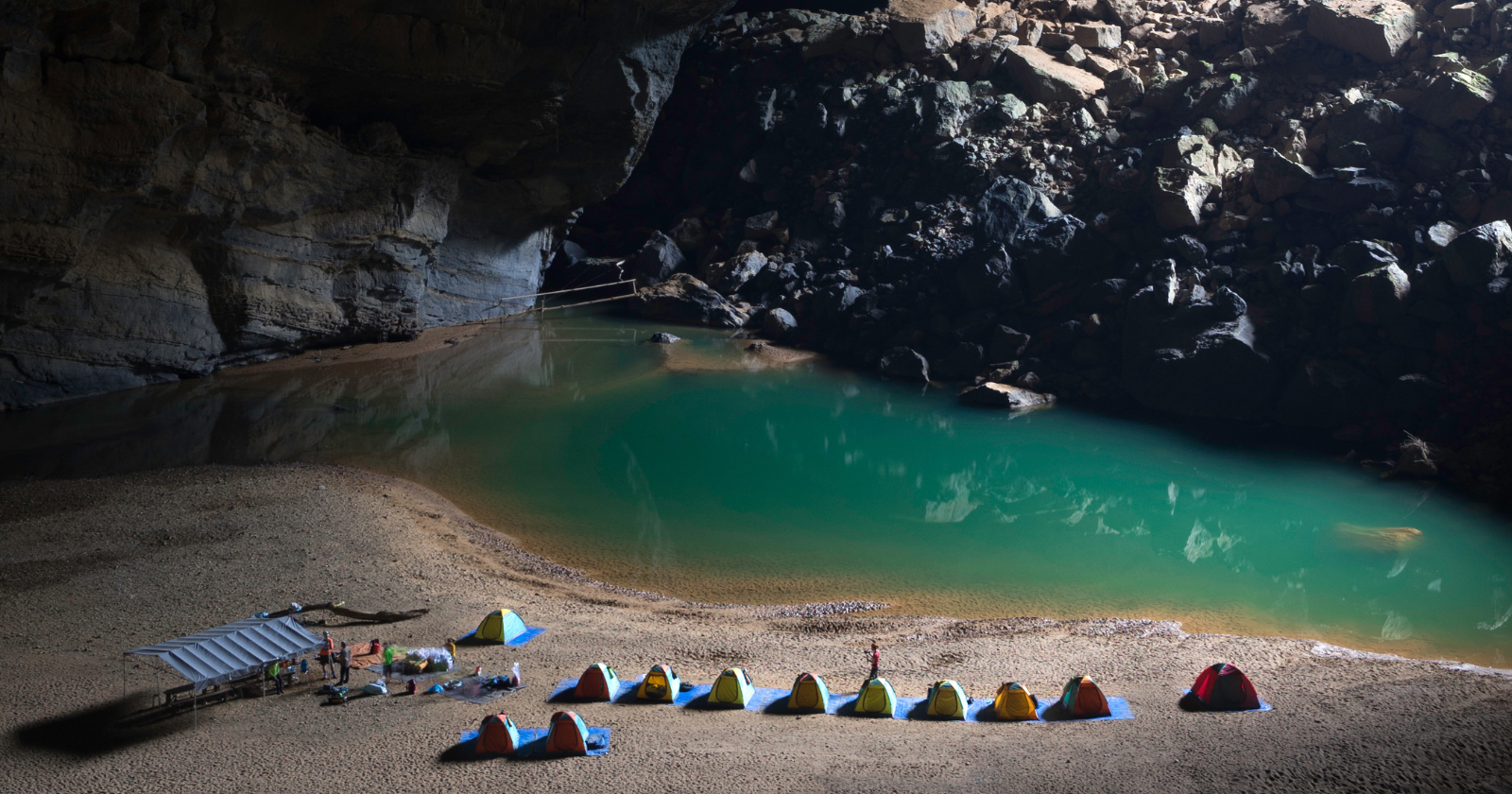
Standing inside that scale does something to a person’s sense of proportion. Photographer Ryan Deboodt, who spent eight days camped in the cave filming a drone video, told National Geographic that inside it “you feel absolutely miniscule.”
Very few people get the chance to feel it: access is tightly controlled to protect the cave, with a cap of about 1,000 visitors a season through a single licensed operator. The expedition costs around US$3,000 per person.
What the numbers translate to on the ground is harder to fix: a hall big enough to hold a skyscraper, lit by its own skylights, growing its own forest, entered each year by no more than 1,000 people.
