
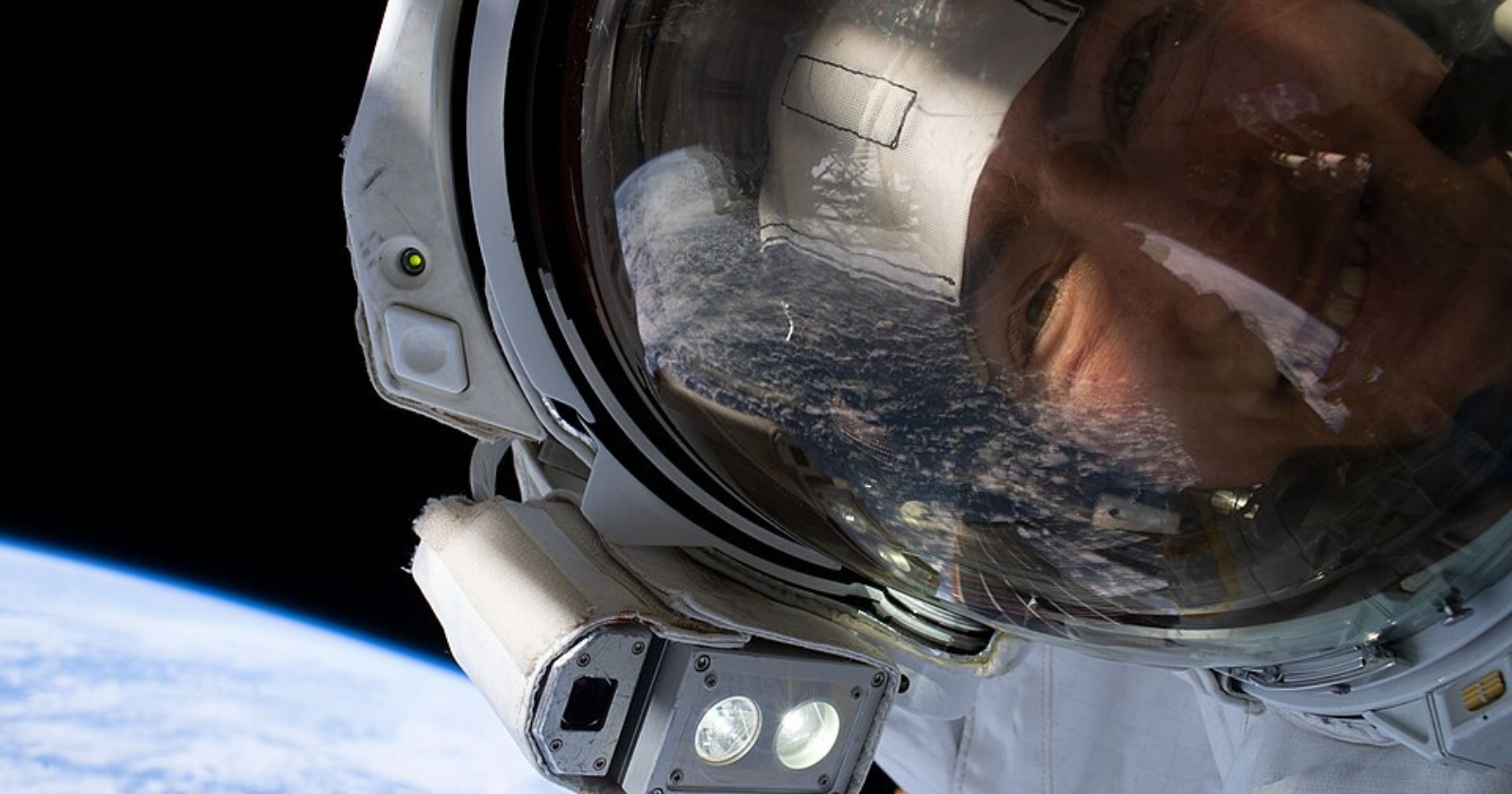
A “medium-size hard upper torso” is a rigid fiberglass shell that forms the chest and shoulders of the spacesuit worn outside the International Space Station. It is one of the key fit-critical components of the suit — the part that has to match the astronaut’s body before the rest of the configuration can work. Two medium torsos, properly configured and ready on the schedule, were the practical difference between the missed March pairing and the October milestone.
This is the story of two walks made the same year, by overlapping crews, in connection with the station’s power-system and battery-upgrade work. One became a footnote about hardware shortages. The other became the first spacewalk in the history of human spaceflight to be carried out entirely by women.
The all-female walk in March that didn’t happen
The first version was supposed to play out on March 29, 2019. NASA astronauts Christina Koch and Anne McClain were assigned together to continue upgrading the station’s nickel-hydrogen batteries — part of a series of spacewalks that had begun a week earlier, when McClain went outside with NASA astronaut Nick Hague on March 22.
The schedule was not designed to be a milestone. As NASA spokeswoman Stephanie Schierholz put it when the assignment first drew attention: “It was not orchestrated to be this way.” The battery-upgrade spacewalks had originally been scheduled for the fall, and the crew pairing was not arranged as a publicity milestone.
Days before the spacewalk, NASA changed the assignment.
What happened was specific. During the March 22 walk, McClain had worn the medium-sized hard upper torso. After working in the medium, she changed her view. “I was planning on changing sizes on the second suit,” she said in the same interview, “and because everything went so well on the first one, we realized … we don’t need to inject any additional unknowns into something that is as important and as dangerous as a spacewalk.”
Koch had also been assigned a medium. Only one medium hard upper torso had been prepared and configured for the upcoming spacewalks. A second medium torso existed on the station, but readying it for use required preparation time the crew did not have in the schedule. NASA swapped Nick Hague back into McClain’s slot, and the March 29 spacewalk went ahead with Koch and Hague.
The walk in October that did
By October, the configuration on station had changed, and the spacewalk schedule had moved on to a new task: replacing a battery charge-discharge unit, the controller that regulates how the station’s batteries collect and distribute solar power. Koch was now on her fourth extravehicular activity. Jessica Meir had not yet been outside.
At October 18, 2019, the two astronauts opened the Quest airlock, replaced the failed unit, picked up a few get-ahead tasks on a European Space Agency platform called Bartolomeo, and came back inside seven hours and seventeen minutes later. According to the NASA blog post , Meir became the fifteenth woman to spacewalk and the fourteenth American woman to do so. “Women have been performing spacewalks since 1984,” Mark A. Garcia wrote, “when Russian cosmonaut Svetlana Savitskaya spacewalked in July and NASA astronaut Kathryn Sullivan spacewalked in October.” The first all-female pairing was thirty-five years downstream of the first woman to do an EVA at all.
Koch remembered the moment itself in physical terms. “The best moment was when Jessica and I both came out of the airlock,” she told Space.com on the first anniversary of the walk. “And before we left … our eyes kind of caught each other and we knew what an amazing moment it really was, and I smiled.”
The suits coming next
That story will not be told this way again, at least not in this hardware. NASA’s next-generation suit — the Axiom Extravehicular Mobility Unit, or AxEMU, derived from the Artemis xEMU program — is being built with a wider sizing range from the start. The 2024 design unveil from Axiom Space states plainly that the suit “accommodates a wide range of crewmembers, including males and females from the first to 99th percentile (anthropometric sizing).” The Artemis program has long been framed around returning astronauts to the lunar surface, with next-generation suits designed from the start for a wider range of bodies.
