
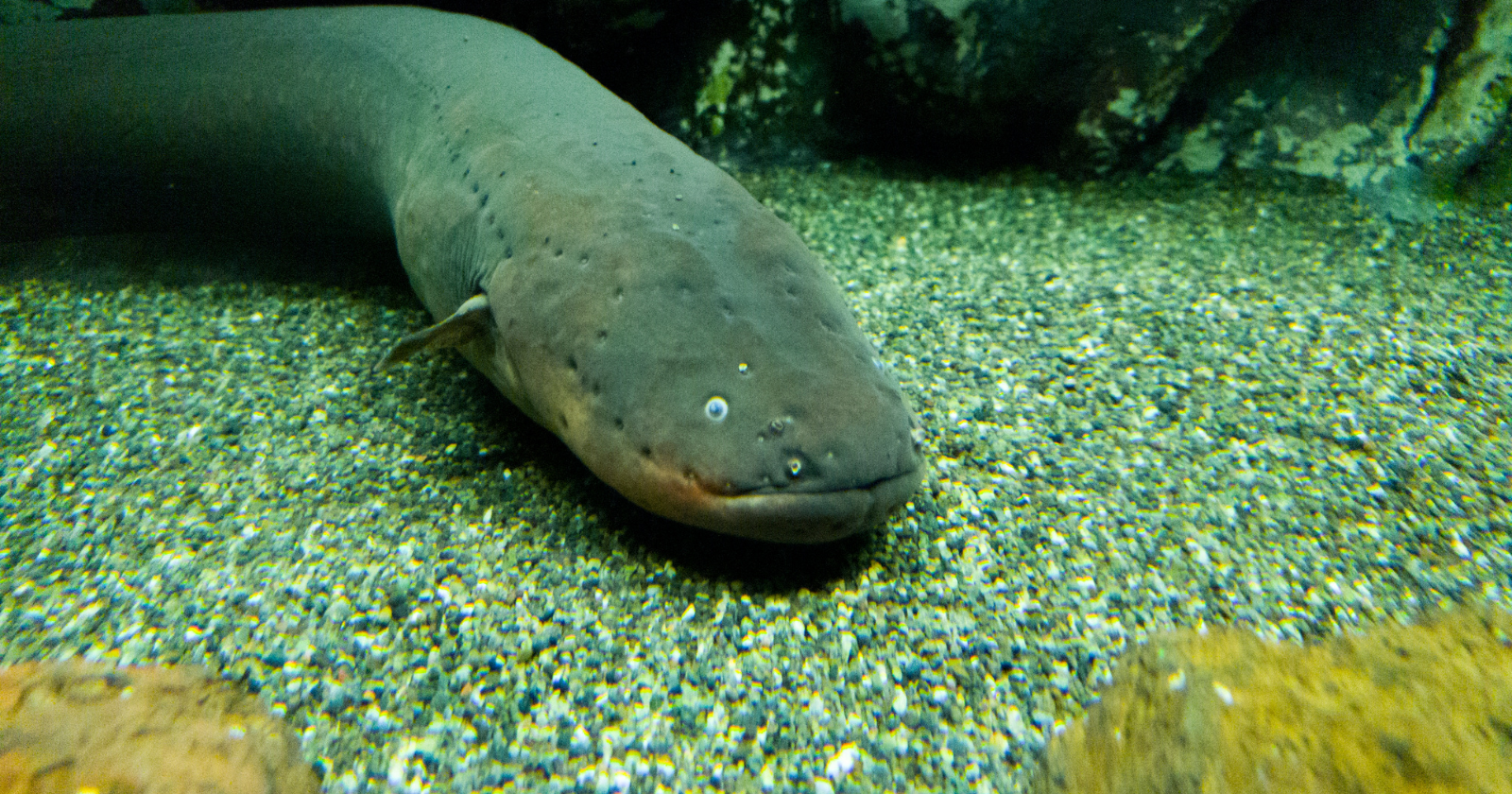
The number that anchors everything is about 600 volts. That is the peak discharge an electric eel can deliver, several times the roughly 120 volts of a North American wall socket. The figure is stranger than it looks: no single part of the eel produces anything close to that. The voltage is assembled, cell by cell, out of thousands of much smaller contributions.
Despite its name, the electric eel is a type of knifefish, and as much as four-fifths of its roughly two-metre body is given over to one job: making electricity.
Each of the specialised cells, called electrocytes, produces only a tiny voltage on its own. A single electrocyte fires at around 150 millivolts, about a seventh of a volt. Stack thousands of them in series and fire them at once, and the small jolts sum the way cells in a battery do. The cells are linked in series to build voltage and in parallel to build current, channelling the combined output toward a target.
The comparison to a battery is more than loose metaphor. The arrangement has long been likened to Alessandro Volta’s voltaic pile of 1799, the first synthetic battery, which stacked metal discs to do what the eel does with living tissue.
Researchers have since built the principle back the other way. A team at the University of Fribourg, working with stacked ion-selective hydrogels to mimic the eel’s total of up to 600 volts, assembled an artificial version that generated 110 volts when thousands of its cells were triggered together.
For most of the time we have known about the eel, the assumption was that it shocked prey underwater and left it at that. Then Kenneth Catania filmed something different.
The Vanderbilt biologist documented and filmed eels rising out of the water to press their chin against a partially submerged threat. The contact point matters: the current exits through the chin into the target and returns to the eel’s tail, completing the circuit through the animal it is attacking rather than dissipating into the surrounding water.
The measurements showed both voltage and current to the target rising the higher the eel climbed. Catania read the behaviour as a defensive move, a way to drive a shock home with maximum effect. This, he wrote, lets the eels deliver shocks “with a maximum amount of power to partially submerged land animals that invade their territory”. He also proposed that the manoeuvre could have arisen in steps, with “each stage” providing “a successive advantage, suggesting how it may have evolved.”
The discovery did more than describe new behaviour — it rehabilitated an old story.
In 1800, the naturalist Alexander von Humboldt described eels in a South American pool attacking horses, with two horses stunned and drowned in the first five minutes of the skirmish. For roughly two centuries afterward, no scientific reports of any such leaping attack appeared, and the tale was treated with skepticism. Catania felt the same pull of disbelief. “The first time I read von Humboldt’s tale, I thought it was completely bizarre,” he said. “Why would the eels attack the horses instead of swimming away?”
The filmed leaps offered an answer. Catania argued that the behaviour, most likely a dry-season defence when crowded eels are cornered in shrinking pools, fit Humboldt’s description closely enough that “it seems reasonable to suggest” the naturalist had watched a similar eel behaviour on 19 March 1800. The hedge is his own, and it stays a careful inference rather than proof. Other researchers found the work persuasive all the same. In the view of James Albert, a University of Louisiana at Lafayette biologist who studies how electric fish evolved their use of electricity, the results “are literally rewriting the book on what we know about electric behaviors of the electric eel.”
