
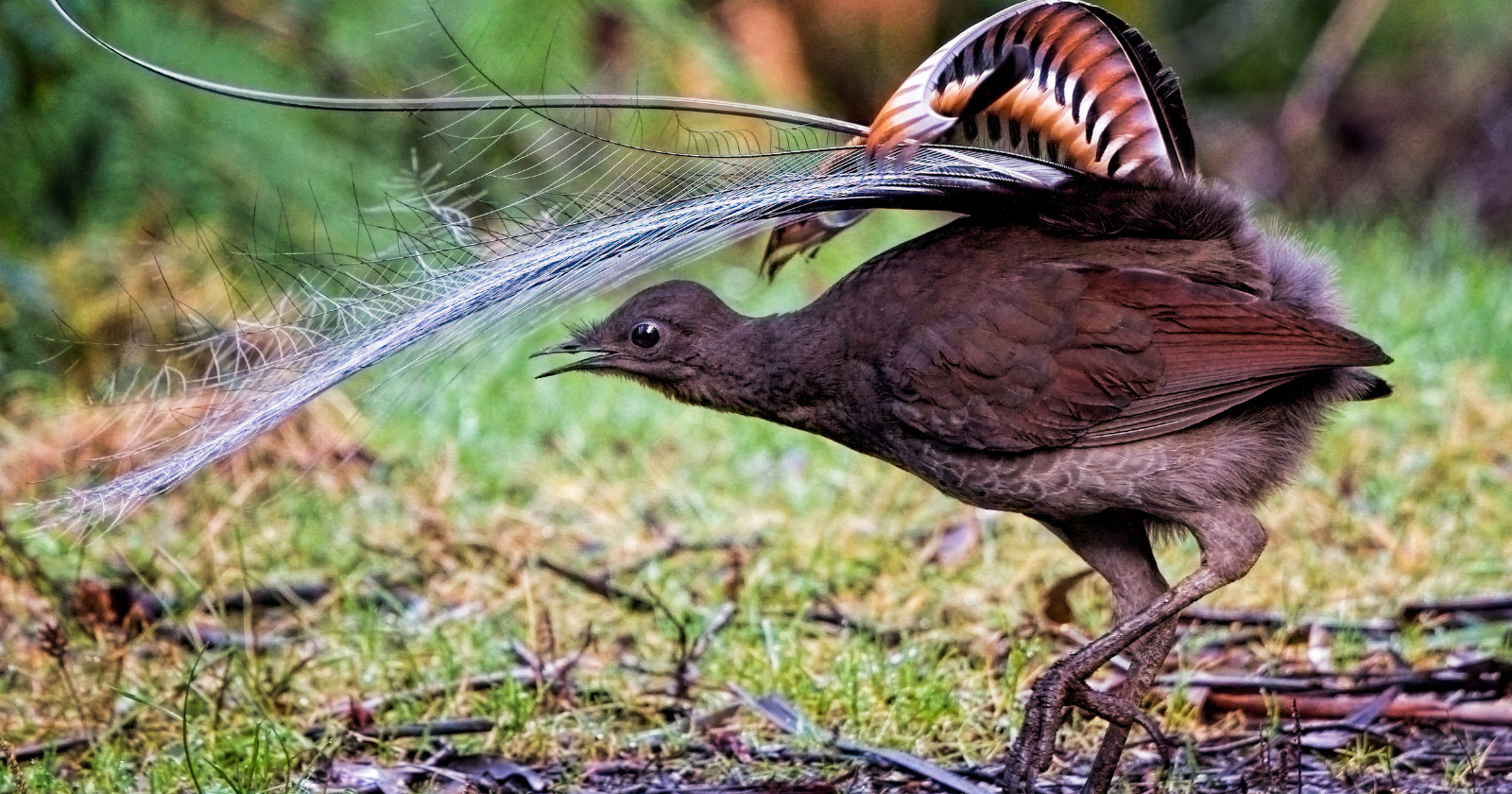
When researchers at the Australian National University played recordings of superb lyrebird mimicry to grey shrike-thrushes, the shrike-thrushes responded to the fakes much as they would to one of their own. As lead author Anastasia Dalziell put it, “Surprisingly, strike-thrushes approached the speaker broadcasting mimicked songs as well as the shrike-thrushes’ own song.”
The superb lyrebird (Menura novaehollandiae) is a large ground-dwelling songbird of the forests of south-eastern Australia, and most of what it sings is borrowed. The bulk of a male’s song is imitation, drawn overwhelmingly from other forest birds. During the breeding season a male will mimic roughly 20 to 25 species.
Dalziell and Robert Magrath measured how close the copies actually were in a study titled “Fooling the Experts.” The acoustic match for grey shrike-thrush song was tight enough that the model species could not reliably tell the imitation from the real thing. “Grey shrike-thrushes sing a complex and beautiful song, but lyrebirds can accurately mimic them all the same,” Dalziell said.
Two cautions belong here. This was a playback experiment measuring acoustic similarity for one model species, not a blanket finding that every lyrebird copy is indistinguishable. The shrike-thrushes also did better at discriminating when given other contextual cues, so “fooled” sits closer to “often fooled” than to “always fooled.”
The chainsaws and car alarms that made the bird globally famous come with their own footnote. The celebrated imitations of saws and drills trace largely to captive birds, including a male named Chook at Adelaide Zoo who died in 2011. Wild lyrebirds overwhelmingly mimic natural forest sounds.
Look closely and it get’s more interesting. A male does not simply replay everything he knows at maximum length. In the “Fooling the Experts” analysis, the lyrebirds abridged the songs they copied, trimming repeated notes, which is consistent with a trade-off between showing off accuracy and packing in variety.
Dalziell described it this way: “This mimicry is the accomplishment of years of practice and is probably used to show female lyrebirds the quality of the singer.” Note the “probably.” It is offered as a hypothesis, not a verdict.
A 2021 study added a stranger wrinkle. Dalziell and colleagues found that males create an acoustic illusion of a whole mixed-species mobbing flock at very particular moments. As Dalziell put it, “The male lyrebird recreates that sound when a potential mate tries to leave a displaying male without copulating, or during copulation itself.” The illusion may work as a sensory trap rather than a simple display of extravagance, though the Cornell write-up is careful that it is not clear exactly how males benefit.
The tidy phrase “all in service of winning over a mate” runs into a basic problem: females mimic too. The first systematic study of female superb lyrebird song found they are skilled mimics in their own right, copying at least 19 species. Co-author Justin Welbergen noted that “The females imitated fewer bird calls than males but performed more imitations of hawks.” A trait that existed only to attract a mate would have no obvious reason to appear, in a different form, in the sex that does not display.
The function is plainly more than one thing. Courtship is the best-documented driver, and mimicry does peak in the breeding season. But the same skill turns up in what looks like deception during copulation, and in displays whose structure shifts depending on the moment. Each of these is a working hypothesis backed by an observational or playback study, not a closed case.
What the lyrebird exposes is perhaps a habit of ours, not of the bird’s. The temptation is to attach one clean purpose to a behaviour because one purpose is easy to tell as a story. The animal keeps refusing to cooperate. The most interesting thing about a bird that can imitate almost anything is that we still cannot say, with confidence, exactly why it bothers.
