
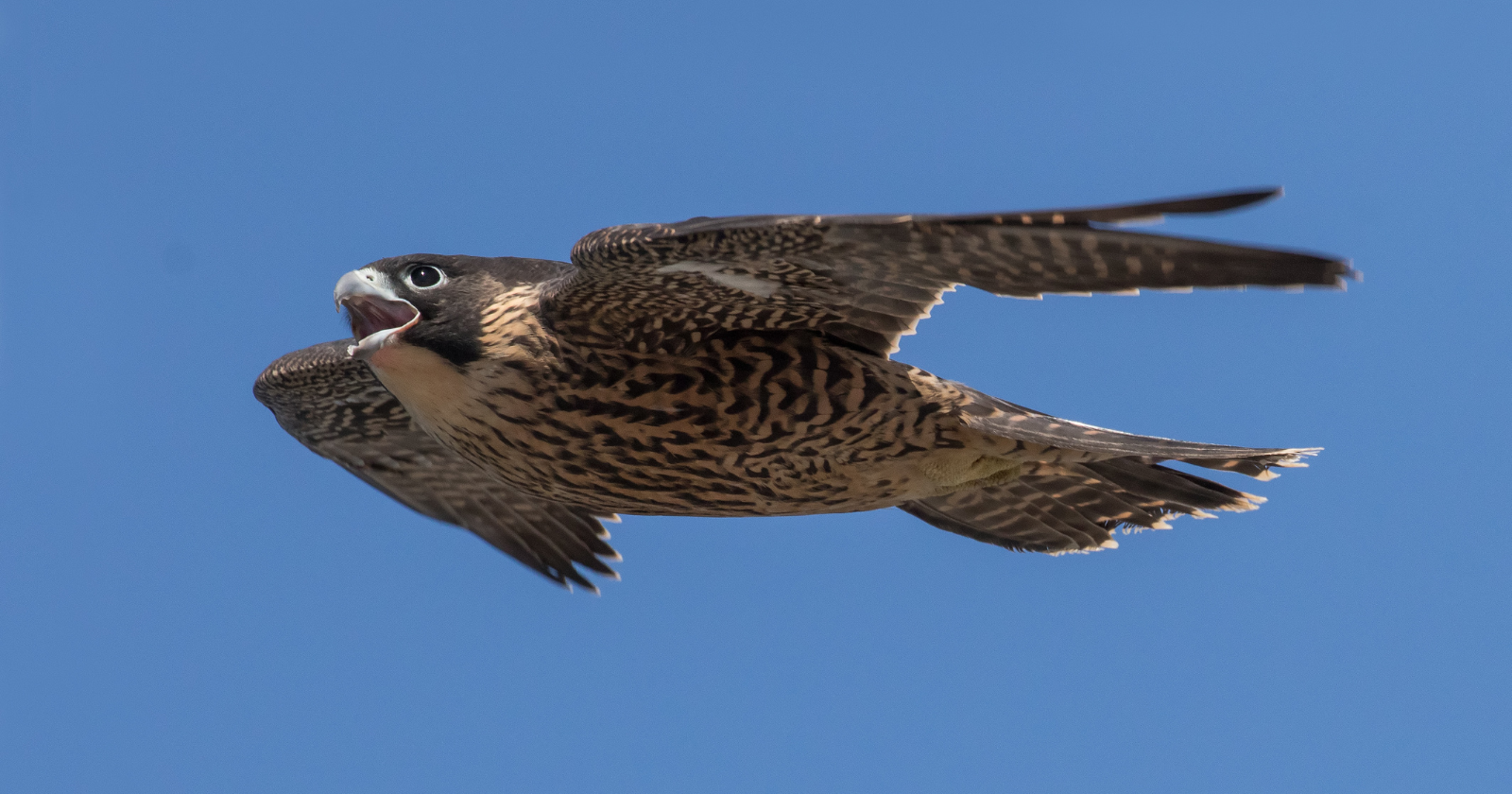
A peregrine falcon in a hunting dive reaches a terminal velocity of about 320 km/h (200 mph), which makes it the fastest animal alive.
That figure is not a guess from a single enthusiast with a stopwatch. A peer-reviewed aerodynamics study notes that peregrines exceed 320 km/h in a full stoop, though its own filmed dives took place past a 60 m dam — short enough that the falcons never reached terminal velocity, but long enough to capture the changing wing shape on high-speed cameras. The record claim sits higher still: a captive falcon named Frightful was reportedly clocked at 389 km/h (242 mph) in 1999 after release from a light aircraft.
For comparison, the Guinness World for the fastest speed in an Formula 1 car is 372.56 km/h (231.51mph). These cars need a long straight and lots of horsepower. The falcon gets there with body mass, gravity, and a folded silhouette, then has to land a precise strike at the end of it. The car only has to keep going straight.
The dive has a name: the stoop. The record speed belongs only to the dive, and the dive depends on shape. Robin Mills, a biologist who has modelled the manoeuvre, describes it this way: “Within the blink of an eye, it dives down – first flapping forcefully and then folding its wings to decrease drag. It basically appears to drop out of the sky.” All of this is in service of the strike at the bottom — the stoop is how the falcon turns altitude into a killing blow.
The peregrine delivers the blow with its feet, used as a blunt weapon rather than as the gripping talons most people picture. The popular image of a clenched fist is roughly right but not exact. The Birds of Stanford essays note that “High-speed cinematographic studies, however, have shown that they strike their prey from above with all four toes fully extended.” The foot may be open at the instant of contact, not closed, though the strike itself remains a percussive hit rather than a grab.
The impact does much of the killing. Peregrines and their close relatives carry only modest talons, so they cannot rely on the crushing grip that some larger raptors use. Instead, as Fowler and colleagues describe in their study of raptor anatomy, “For immobilisation, Falconini rely more strongly on strike impact and breaking the necks of their prey, having evolved a ‘tooth’ on the beak to aid in doing so.” The dive does the work, and the notched beak finishes what the blow starts.
The speed record hides something. A car at 320 km/h is being asked to follow a known line on a known surface. The falcon is being asked to intercept a small, frightened, swerving target in open air, and to do it while its own anatomy works against it. The peregrine’s sharpest vision sits off to the side of its eye, not straight ahead. Tucker and colleagues put the problem plainly: “When diving at prey straight ahead from great distances at high speeds, a peregrine has a conflict between vision and aerodynamics.”
To see the prey clearly, the bird “must turn its head approximately 40 ° to one side” to fix the target on the most acute part of its eye, but a turned head adds drag and slows the dive. Wild peregrines solve this not by turning the head but by curving the whole approach. Tucker’s team observed birds tracking distant prey along a curved path resembling a logarithmic spiral, which keeps the target pinned on that sideways high-acuity vision while the head stays streamlined. It is the aerial equivalent of taking the racing line rather than the shortest one.
The precision goes deeper than the path. A 2018 simulation by Mills and colleagues at Groningen and Oxford modelled the attack and found the diving falcon steers using the same proportional-navigation logic that guides missiles. The same work is careful about what high speed actually buys. The simulations suggest that when prey moves erratically, high-altitude stoops raise catch success compared with low-altitude attacks, but only if the falcon’s guidance law is finely tuned and its vision and control are precise. Speed without that control is just a fast miss. This is a modelling result rather than a field measurement, so it is best read as a clue to how the real birds manage it, not the last word.
The body comes equipped for the rest. Bony tubercles inside the nostrils are thought to limit the air rushing in at speed, and a translucent third eyelid sweeps across the eye to protect it while still letting the falcon see, a built-in visor for a pilot who cannot afford to blink at the wrong moment.
