
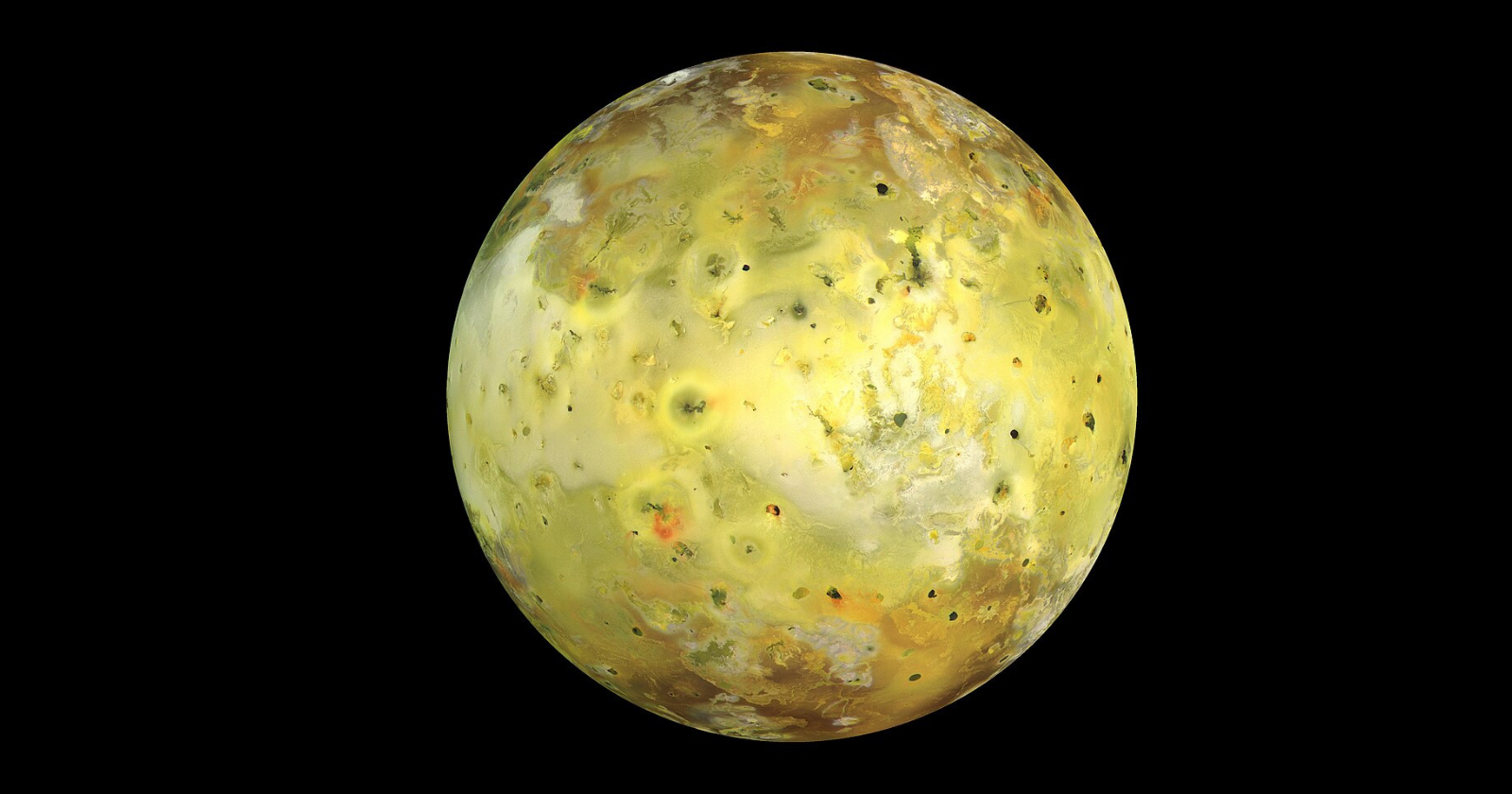
On the morning of March 9, 1979, navigation engineer Linda Morabito was running the lowest-priority frames of the Voyager encounter at JPL’s image processing lab — long-exposure navigation shots of Io, taken to help refine the spacecraft’s trajectory after its closest approach to Jupiter four days earlier. She applied a standard contrast stretch to bring out dim background stars. A shape appeared above the moon’s limb: vast, umbrella-formed, raining back down in an arc roughly 270 kilometers above the surface. It had its own crescent, its own illuminated dark side. She later recalled: “I just kept asking myself ‘what is that?’ over and over again. I think I thought if I asked myself that question enough, the answer would finally occur to me.”
The answer was a volcanic plume. Io was erupting. It was the first active volcanism ever detected beyond Earth.
Morabito had not been looking for volcanoes. Her task was to find precise star positions, not to do planetary science. The Io frames were, by her own account, the last thing on her list. She processed them anyway, and when she applied a stretch to bring out the stellar background, something else came with it. Speaking to BBC Sky at Night Magazine in 2025, she described the moment: “I performed what is known as a ‘linear stretch’ on the image to bring out the contrast and pick out small variations in brightness. At that moment, a gigantic object appeared off the limb of the moon.”
The crater-free surface Voyager had already revealed was a clue that something unusual was driving Io’s geology, though most scientists had not yet connected it to active volcanism. Before the encounter, the expectation was that Io, roughly the size of Earth’s Moon and at a similar distance from Jupiter, would be geologically quiet. Morabito described the consensus she had absorbed: scientists “were pretty confident that we would see an object with craters that was potentially geologically somewhat dead like our Moon, but that’s not what happened!”
Working with colleagues through the rest of that day to eliminate every alternative — imaging artifacts, a previously unknown satellite — Morabito had her answer by evening. Voyager project scientist Edward Stone was called in and understood immediately what he was seeing. Commands were sent to other instruments to gather corroborating data. Io had active volcanoes. When scientists searched back through Voyager 1 frames already taken, they found seven more active plumes — eight in all in that first set of images. Of the moment alone with the image early that morning, Morabito later said: “It was the stuff of dreams, because I knew I was seeing something that most likely no human being had ever seen before.”
Io today carries an estimated 400 volcanoes and is the most volcanically active body known in the solar system, with plumes that can reach hundreds of kilometers. The question Voyager left open — how the volcanoes are fed from below — took more than four decades to address. Two possibilities had long divided scientists: either a shallow global ocean of magma lurking beneath the surface was supplying the eruptions, or each volcano was drawing from its own localized chamber.
In December 2024, NASA’s Juno mission provided the strongest evidence yet for an answer. During two close flybys of Io in late 2023 and early 2024, Juno used precision tracking of its own acceleration to measure how Io’s gravity field flexed under tidal forces. A global magma ocean would have produced a measurably larger tidal signature; the data showed no such signature — pointing strongly toward a more rigid interior in which each volcano is likely fed by its own chamber beneath the surface.
