
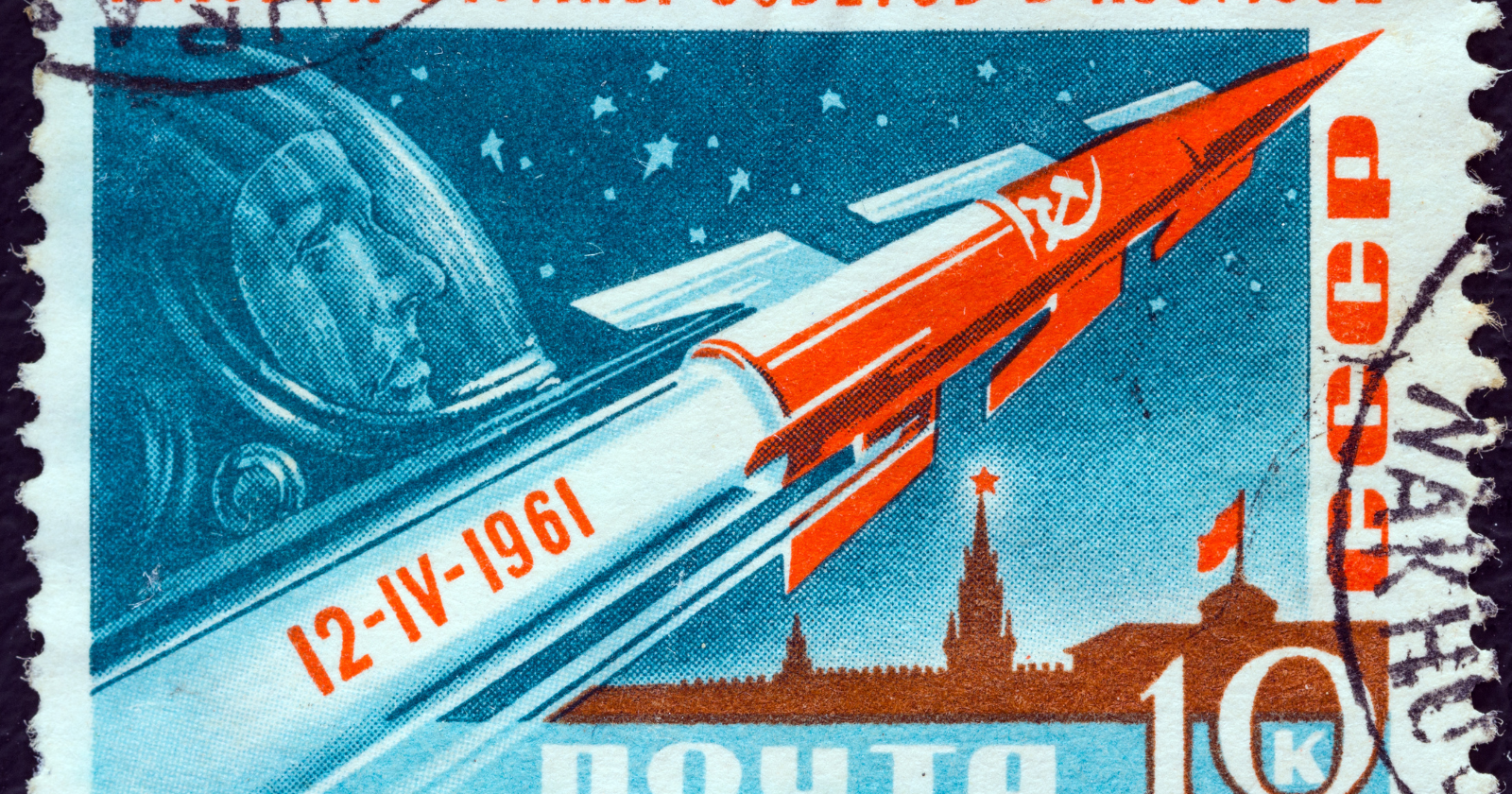
On 12 April 1961, Yuri Gagarin lifted off, circled the Earth once, and came home a legend. The flight lasted about 108 minutes. The world was told it went perfectly. It did not. The most dangerous part came at the very end, on the way down, and for a stretch of it the first man in space thought he was about to die.
The flight that almost wasn’t a triumph
The trouble began the moment the braking rocket finished firing. A valve failed to close. Fuel leaked, the engine cut off early, and the escaping gas set the craft spinning. That is the account of Anatoly Zak of RussianSpaceWeb. The engine slowed Vostok 1 slightly less than planned, and the leaking fuel lines left the ship tumbling.
Then a second fault made things worse. The round capsule Gagarin sat in was meant to break away cleanly from the equipment section behind it. It didn’t.The joined craft tumbled through the upper atmosphere before the wires finally burned or broke. Only then did the capsule settle into the right position for reentry.
Gagarin’s own account of the first jolt is plain and precise. In his post-flight report he put it this way: “As soon as TDU (braking engine) shut down, there was a sharp jolt. The spacecraft started spinning about its axis with very high speed.” He guessed peed of rotation was around 30 degrees per second, his own estimate rather than a measured figure. At one point his sight nearly went. “There was a moment, about 2-3 seconds, when data on the control gauges started looking blurry,” he said. “It was starting turning gray in my eyes.”
Why Gagarin thought he was dying
As the capsule hit thicker air, the outside began to heat up. Every returning spacecraft glows as it slams into the atmosphere, wrapped in superheated gas. Through the portholes, Gagarin saw a fierce red light. He had no way to know it was normal. No human had ever come back from orbit before.
An Associated Press retrospective carried by NBC News reports that Gagarin, seeing the flames and thinking his ship was on fire, radioed: “I’m burning. Goodbye, comrades.” He was wrong about the danger. The glow was reentry heat, and he was on a safe path. But in that moment he believed the mission was ending with him inside a burning capsule.
What stands out is how calm he stayed alongside the fear. Even while the craft was still tumbling, Gagarin chose not to declare an emergency. He recalled afterwards: “I decided that the situation was not an emergency, with the code system I transmitted VN4, which stands for “Vse Normalno,” (Everything alright).” The ship was spinning wildly as he sent that signal. He judged that whatever was going wrong, it wasn’t worth alarming the ground.
Vostok had no soft-landing system, so he ejected at about 7 km and parachuted into a field on his own.The Soviet Union left the ejection out of the record submitted to international aviation authorities, and kept up the story for years.
What the moment reveals
The Gagarin the world got in 1961 was a poster. Handsome, grinning, faultless, a symbol of a system that did everything right. The Gagarin in the post-flight report is a man strapped inside a machine that was misbehaving badly, watching fire outside his window, working out whether to call it in, and briefly saying goodbye.
Much of the cover-up was straightforward propaganda. But the gap between the myth and the record matters for a reason that has nothing to do with Cold War image-making. The flight was harder than anyone was allowed to say, and Gagarin flew it anyway, on hardware nobody had ever tested with a person on board.
The fear on the descent doesn’t shrink the achievement. It fills it in. A man who truly believed, for a few seconds, that he was burning to death, and who still had the presence of mind to signal that everything was fine, is a more interesting figure than the flawless portrait the Soviet press ran. The glow outside the porthole was ordinary physics. What Gagarin did while looking at it was not.
