
Why would a company hand a rival the one thing worth patenting? That question sits at the center of a decision Volvo made more than six decades ago, and it still reads as odd today.
A firm develops something genuinely valuable, files for a patent, and then, instead of licensing it for a fortune, gives it away to every competitor who wants it. That is roughly what happened with the seatbelt in your car right now.
The short version: in the late 1950s a Swedish engineer designed the three-point belt, Volvo built it into its cars, and then the company opened the patent so any other manufacturer could copy it for free. The reasoning was that the design would do more good as a shared standard than as a private advantage.
What follows is our attempt to understand that call, and why it looks stranger, not more familiar, with time.
What Bohlin actually solved
Before the three-point belt, most cars that had belts at all used a simple lap strap across the waist, borrowed loosely from aviation. Those did something in a crash, but they left the upper body free to snap forward. The problem Volvo’s engineer set out to solve was this: how to hold both the chest and the hips in place at once, with a belt an ordinary person would actually bother to put on.
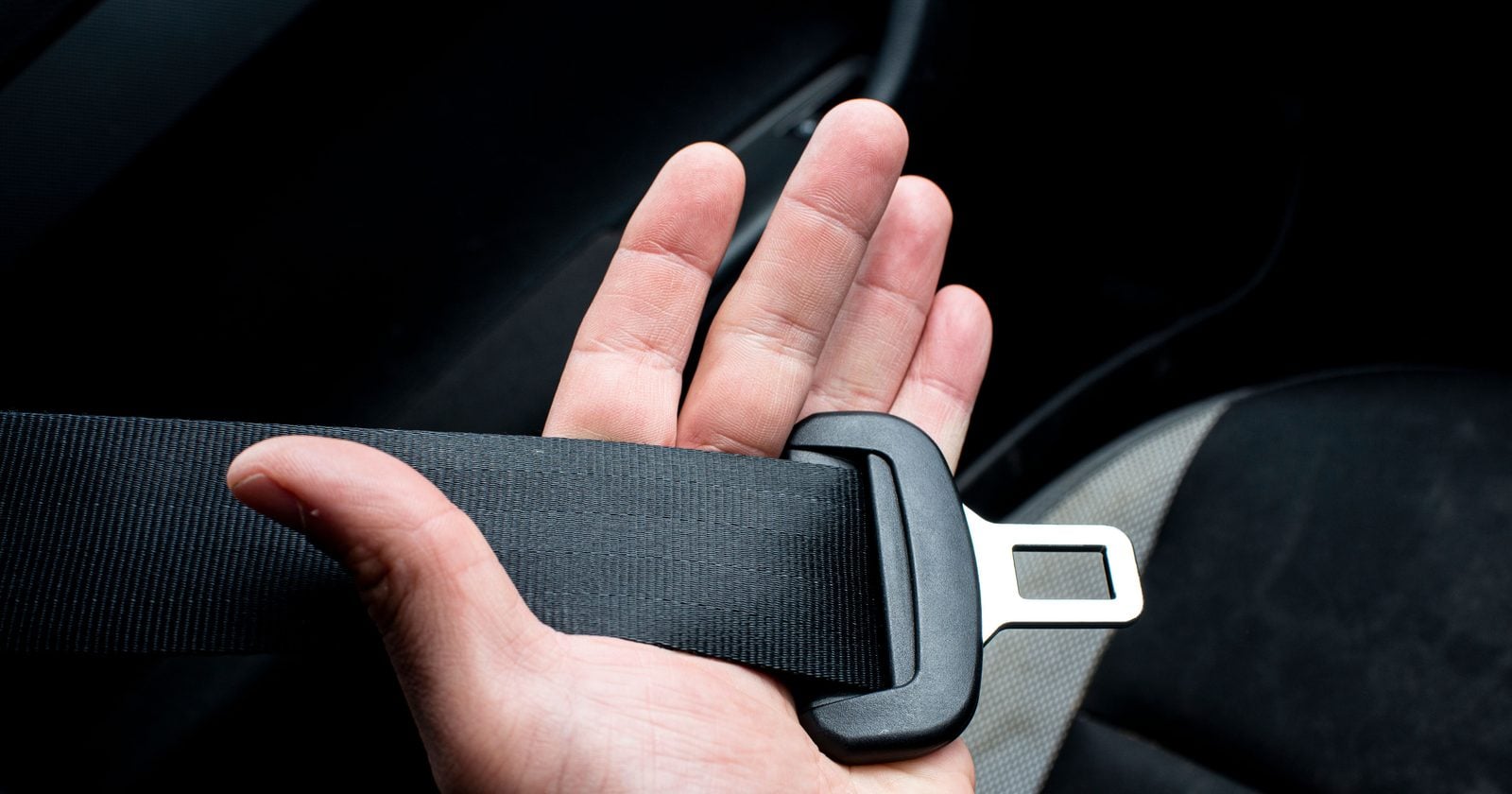
The man given the job was Nils Bohlin. He had previously designed ejector seats for Saab’s fighter aircraft, so he already thought about how to hold a human body against violent force. Hired as Volvo’s first chief safety engineer in 1958, he worked out a V-shaped strap that crossed the chest and the lap and clicked into a fixed anchor down by the hip, all of it fastened with one hand.
He described the aim plainly. Bohlin recalled it was “just a matter of finding a solution that was simple, effective and could be put on conveniently with one hand.” That line reaches us secondhand, quoted in his 2002 obituary rather than a primary interview, but it matches everything about the design. The one-handed part mattered as much as the physics. A belt people find fiddly is a belt people leave unbuckled.
The patent itself put the goal in drier language: “to provide a safety belt which independently of the strength of the seat and its connection with the vehicle in an effective and physiologically favorable manner retains the upper as well as the lower part of the body.” In plainer words: a belt that holds both the top and bottom of the body without relying on the seat to stay strong. Volvo introduced the belt as standard on its cars in 1959.
The number that changed the calculation
A design is a claim until someone tests it. In 1967, Bohlin published a study that did exactly that.
Working through Volvo’s crash records, Bohlin’s 1967 study analysed more than 28,000 accident cases, involving 37,511 belted and unbelted front-seat occupants. The results were striking: unbelted occupants suffered fatal injuries across the whole range of crash speeds, while none of the belted occupants was fatally injured at accident speeds below 60 mph. The study also found that the three-point belt substantially reduced injuries and was effective at preventing occupants from being thrown from the car.
It was one study, carried out by Nils Bohlin of Volvo’s Passenger Car Engineering Department, so it is best treated as an important early piece of evidence rather than the final word on seat-belt effectiveness. Later reviews continued to cite Bohlin’s work as one of the largest and best-known early studies of safety-belt effectiveness.
Volvo now credits the three-point belt with saving at least a million lives worldwide since it appeared. In the United States alone, the National Inventors Hall of Fame cites a government estimate that seat belts save more than four thousand lives and prevent over 100,000 injuries every year. A patent attached to numbers like those is, on paper, worth a great deal in licensing fees.
The company faced a genuine fork. It could treat the belt the way patents are usually treated, as an asset to defend and charge for, or it could treat the goal of the belt, keeping people alive, as the thing that mattered. Volvo picked the second, making the design free for every other manufacturer on the reasoning that the invention was worth more as a shared tool than as a source of profit.
What open-patenting looked like in practice
Giving a patent away is not the same as abandoning it. Bohlin still received US Patent No. 3,043,625, filed in August 1959 and granted in July 1962, with the rights assigned to Volvo. The company held the legal claim. It simply chose not to use that claim to lock competitors out, letting them build the belt without paying for it.
The result was that the three-point belt could spread as a shared standard rather than a Volvo feature. By 1968, three-point belts were required on new American vehicles, and versions of the same design ended up in essentially every passenger car on the road. The belt you clip in today comes straight from the one Bohlin sketched, largely because no one had to work around a patent to install it.
Volvo, for its part, keeps making the case for the design. Hans Nyth, head of the company’s Safety Centre, has said that “what makes the three-point belt unique is that it improves safety for all types of occupants, in all types of accidents. In both the front and the rear seats.”The same release puts the belt’s benefit at roughly a 50 percent reduction in the risk of serious injury or death, the kind of figure that made the original decision look wise in hindsight.
What we take from a 67-year-old decision
A patent is meant to give its holder a stretch of exclusive rights as a reward for inventing something. Volvo had that reward in hand and set it down on purpose. A firm walking away from a defensible, life-saving monopoly reads as almost illogical.
Our read is less a lesson about corporate virtue than a point about how value works for something like this. A seatbelt that only Volvo owners could use would have saved some lives. A seatbelt in every car saved, by Volvo’s own count, more than a million. The design became worth more precisely because the company stopped trying to own it.
