

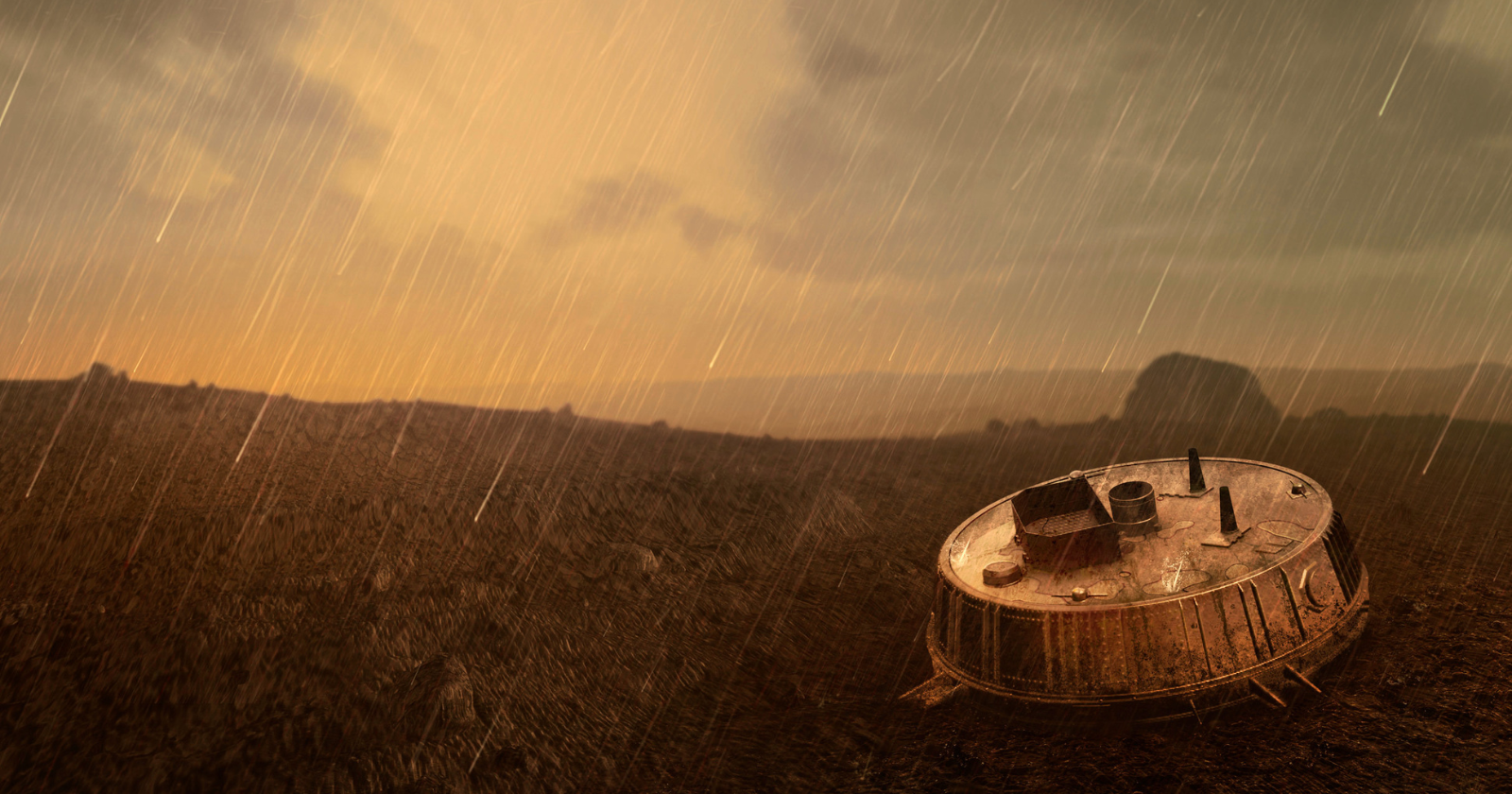
Picture standing over a patch of ground and letting a ball fall from about waist height, roughly a metre up. It lands with a soft thud. No drama, no crater, just a little dent and a small hop.
Now imagine that ball weighs about 200 kilograms and has just crossed more than a billion kilometres of space to reach the surface of a moon nobody has ever set foot on. That is more or less what happened when Europe’s Huygens probe met Titan.
We tend to imagine landings on other worlds as violent things, all retro-rockets and airbags and held breath. Huygens just gently bumped into Titan and settled. And because that landing was so undramatic, the detail of what happened in those first few seconds is interesting. It took scientists years to piece it together.
What the probe did in ten seconds
Huygens was carried to Saturn by NASA’s Cassini spacecraft. In January 2005, it descended through Titan’s atmosphere, making the first landing by a spacecraft in the outer Solar System. The probe weighed about 200 kilograms and hit the ground at a speed similar to dropping a ball on Earth from about one metre up.
On first contact the probe dug a hole about 12 centimetres deep. Then it bounced out of that hole onto flatter ground, slid roughly 30 to 40 centimetres across the surface, and tilted by about 10 degrees in the direction it was moving. Finally it wobbled back and forth five times, each wobble about half the size of the one before, until the motion faded away nearly 10 seconds after touchdown.
Dent, bounce, slide, five wobbles, rest. All of it inside about ten seconds, with no external camera watching the touchdown in real time.
How they reconstructed a landing no external camera saw
No camera watched this happen from outside the probe. There was no camera pointed at the probe from the side. So how do you know it bounced and slid and wobbled five specific times?
The answer came in a 2012 study by Stefan Schröder, Erich Karkoschka, and Ralph Lorenz, published in Planetary and Space Science. This is one careful reconstruction, not a live recording, so it is best read as a well-supported model of what happened rather than a frame-by-frame film.
What the team had to work with was indirect: the tiny jolts and shifts recorded by the probe’s own instruments as it came to rest.
They took those readings, which showed the probe did not stop the moment it hit, and combined them with computer simulations and a physical drop test of a model probe. Line those three things up, and the motion that best fits them is the dent-bounce-slide-wobble sequence. It is detective work, running the evidence backwards to find the story that best explains every twitch in the data.
One of those twitches turned out to be surprisingly specific. According to lead author Schröder, “a spike in the acceleration data suggests that during the first wobble, the probe likely encountered a pebble protruding by around an inch from the surface of Titan, and may have even pushed it into the ground, suggesting that the surface had a consistency of soft, damp sand.” Note how hedged that is. A spike in the data, a probe that likely met a pebble, a surface that suggests damp sand. That is honest science talking, and it points at the real payoff of all this work.
The snow-frozen-on-top surface
The way Huygens moved, punching a 12-centimetre dent on contact but then bouncing out and skidding along the top, told the team something about the ground itself. Co-author Erich Karkoschka, a planetary scientist at the University of Arizona, put it plainly. “It is like snow that has been frozen on top,” he said.
He took the picture a step further. “If you walk carefully, you can walk as on a solid surface, but if you step on the snow a little too hard, you break in very deeply,” Karkoschka explained. A surface that could feel firm under light pressure but give way under heavier pressure, which is exactly what would let a probe both dent the ground and then move across it.
The analogy is one co-author’s way of describing the behaviour, not a settled physical model of Titan. But it does the job of turning a scatter of data spikes into something you can imagine standing on.
There was one more small clue in the data: a fluffy, dust-like material, likely dry organic particles, that stayed suspended for about four seconds after impact, suggesting the landing site had not seen methane or ethane rain in some time.
The bounce, the skid, the five fading wobbles were not a footnote to reaching Titan. They were how the team learned that its surface could resist light pressure but yield under heavier pressure, read off nothing more than the way a probe settled down and went still.