

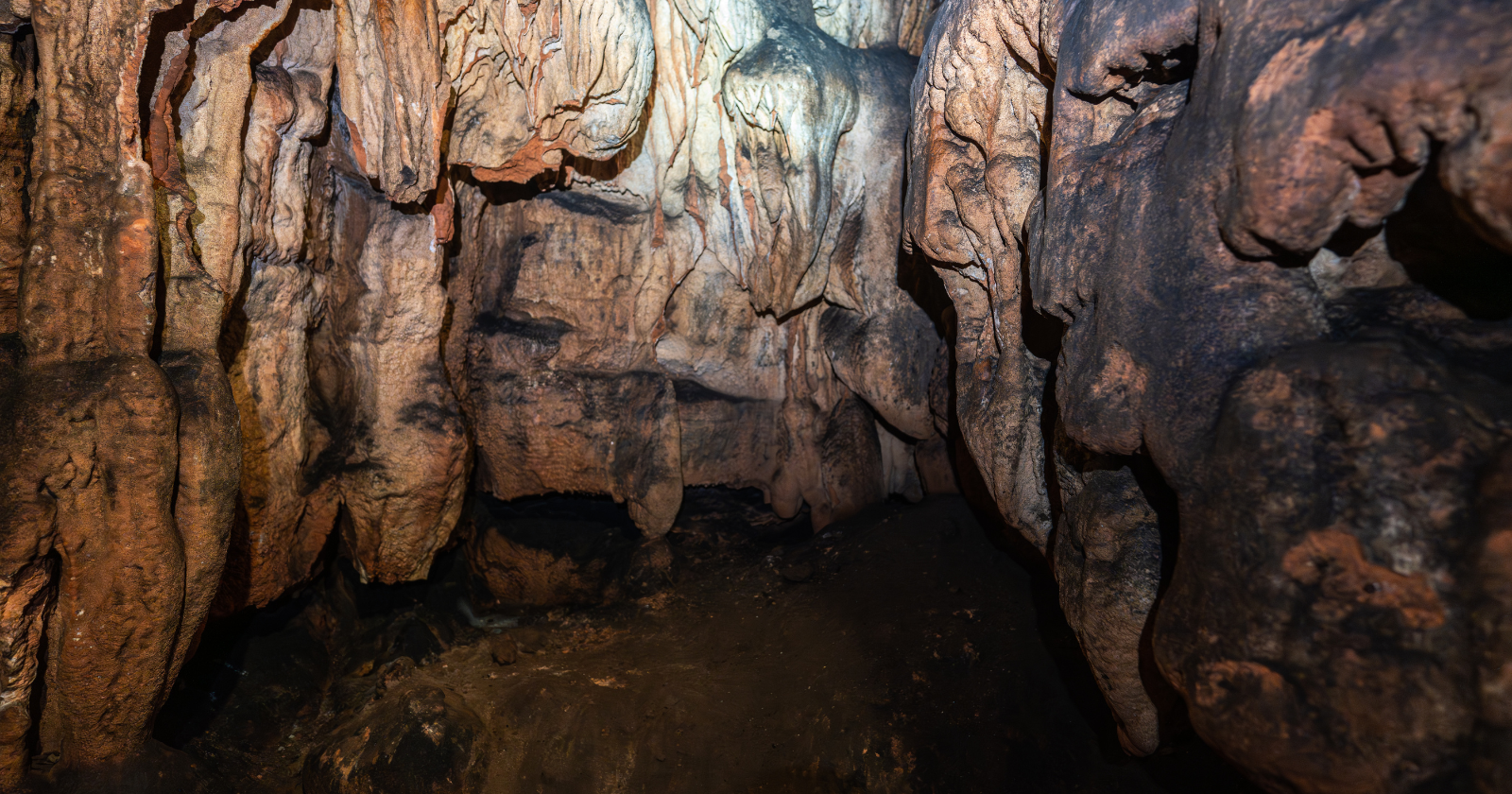
A multi-year biodiversity survey of limestone caves in western Cambodia has documented at least 11 species apparently new to science, among them a pit viper, several geckos, micro-snails and millipedes.
The work was led by the conservation charity Fauna & Flora with Cambodia’s Ministry of Environment. The published report compiles field surveys of four taxonomic groups plus a camera-trapping programme across the karst hills of Battambang province (the wider study also reached Stung Treng), with the cave bat survey alone covering 64 caves across 10 hills. The fieldwork ran from November 2023 to July 2025, and the report was released in March 2026.
Among the new species, the report lists three geckos already formally described — Cyrtodactylus kampingpoiensis, Hemiphyllodactylus khpoh and Dixonius noctivagus — alongside two micro-snails (Clostophis udayaditinus and Chamalycaeus aduncus) and two millipedes (Orthomorpha efefai and Orthomorpha battambangiensis). A further three geckos and one new pit viper of the genus Trimeresurus are still being formally described.
In all, seven have been described and published, with four more in progress.
Why one stretch of rock keeps producing new species
The reason such caves yield so many unfamiliar animals has less to do with luck than with geography. Cambodia’s karst — the eroded limestone formations that hold the caves — forms isolated hills, each cut off from its neighbours. A population that settles on one hill can evolve in confinement, separated from the same species only a few kilometres away.
The report frames these limestone landscapes as having high conservation value precisely because they harbour such localised, range-restricted animals. Researchers on the survey have likened the hills to a repeated natural experiment, with related lineages evolving independently on separate outcrops. That confinement is also what makes the species fragile: a gecko or millipede found on a single hill, and nowhere else, may have nowhere to go if that hill changes.
Discovery and destruction running in parallel
The caves are largely unprotected. The same limestone that makes the hills biologically distinctive also makes them commercially valuable, and the report documents extensive stone quarrying on some hills — at Phnom Takriem, for instance, roughly a fifth of the hill area has been given over to quarries. Across the world, only about 1% of karst ecosystems sit under any kind of protection.
Pablo Sinovas of Fauna & Flora ties the geography directly to the risk: destroy the only place a species lives, and you risk wiping it out altogether. Sothearen Thi, the survey’s karst biodiversity coordinator, has made a related point — that biologically significant species could disappear before science has ever recorded them.
What the report changes, and what it doesn’t
The survey did not cover everything. The team did not enter the interiors of several caves holding very large bat colonies — some numbering in the hundreds of thousands, and more than a million in the biggest roosts. In at least one major colony cave, the ammonia inside was simply too concentrated to go in; other caves went unsurveyed because of unsafe vertical entrances, time constraints or a lack of climbing equipment. More exploration remains to be done.
What the report does is move these species from undocumented to documented — the precondition for any argument about protecting them. Whether that shifts the calculus for the hills themselves remains open. Fauna & Flora says it is working with the Cambodian government and local partners to strengthen protection of the landscapes.
Source: Fauna & Flora (2026). Karst Biodiversity Report: Battambang and Stung Treng Provinces, Cambodia — November 2023–July 2025.