

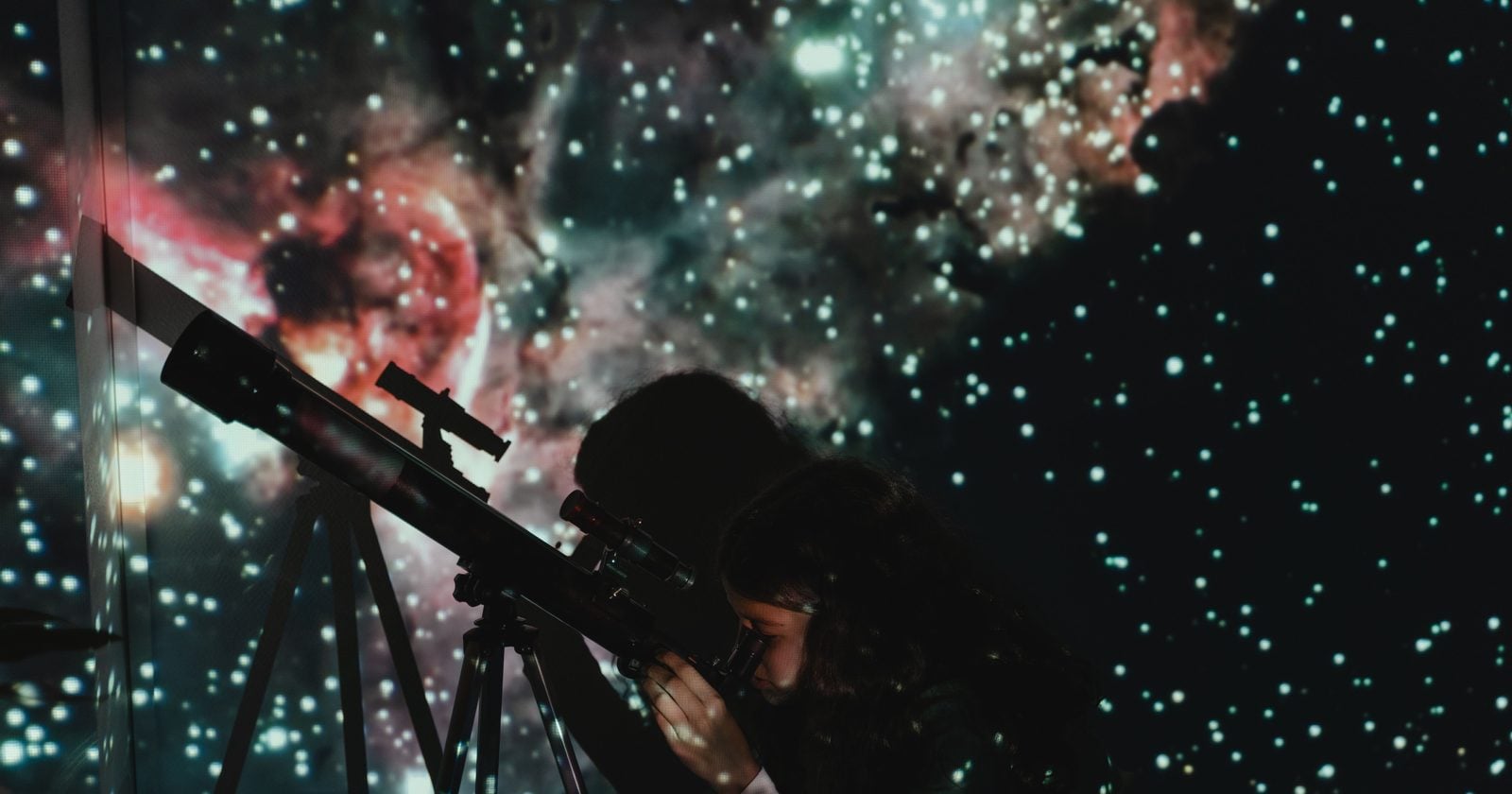
A child at a desk after school, two screens glowing in front of her, clicking through frames of the night sky one after another. Not a game. Not homework in the usual sense. She is looking for faint dots that move against the fixed background of stars, the sign of a rock drifting through the solar system. In 2021 that was the daily routine of Nicole Oliveira, known as Nicolinha, an eight-year-old in Fortaleza. She told AFP she had already logged 18 asteroid detections.
What caught our attention is not really the record, though the record is a good hook. It is how ordinary the path to it turned out to be.
The record that has stood since 1999
The mark to beat belongs to Luigi Sannino, an Italian amateur astronomer. Guinness World Records lists him as the youngest person to discover an asteroid. He co-discovered asteroid 12575 Palmaria on 4 September 1999 at the age of 18. It is a small rock in the main asteroid belt; the record entry notes it orbits the Sun every 3.47 years.
Eighteen years old, working at a telescope, in an era when finding an asteroid still meant pointing an instrument at the sky and waiting. If any of Nicolinha’s detections are eventually certified, she would take that title at a fraction of the age. The gap between eighteen and eight says less about her and more about how the work has changed.
What a “preliminary detection” actually means
There is a catch, and it matters. A preliminary detection is not a discovery. It is the first step on a long road, and most of the steps above it take time.
In the citizen-science project she was part of, a candidate object has to pass a chain of checks before anyone’s name attaches to it. According to a detailed account of how the work is done by the Pan-African Citizen Science e-Lab, a genuine report first becomes a preliminary discovery. It is then checked, and only then can it be upgraded to a provisional discovery. Naming, if it ever comes, is further down the line.
So in 2021 the right framing was a hope, not a done deal. Nicolinha herself talked about the far end of the process, the naming, with a child’s directness. If her finds were ever certified, she told AFP she would give them “the names of Brazilian scientists, or members of my family, like my mom or my dad.” That is the reward at the end of a process that outlasts most childhood enthusiasms.
The machinery behind the two screens
The reason an eight-year-old could do any of this is a program built to hand real data to people who are not professional astronomers.
Nicolinha took part in Asteroid Hunters, the Brazilian arm of the International Astronomical Search Collaboration, a NASA-affiliated effort that Patrick Miller founded at Hardin-Simmons University in Abilene, Texas. Participants examine survey images, and a detection can later be promoted toward an official designation if it holds up in follow-up checks.
The scale is the surprising part. In 2022 Miller described the reach of the program as more than 6,300 schools across 89 countries, with close to 40,000 students taking part. He also said that since January 2019 the students had turned up over 10,000 faint asteroids the sky surveys had missed, and that around 1% of those were possible near-Earth objects. The finds are real, and some of them matter for tracking what crosses our neighborhood.
What it says about who gets to do science
No telescope, no observatory, no institutional membership, no fee. The data is shared out widely. The tools are free.
A kid in Fortaleza with two screens and an attentive teacher is looking at the same survey images a university group might. The record, if she gets it, is a by-product of that access, not the point of it.
Her teacher put the value somewhere other than the record too. The most important thing, as Moreira sees it, is that “she shares her knowledge with other children. She contributes to the dissemination of science.” Nicolinha said something in the same spirit, a wish rather than a boast: “I would also like all children in Brazil to have access to science.”
The record makes the headline, and it may yet stand, because certification is slow and uncertain. But the story underneath it is plainer and, we think, better: a system exists that can take an ordinary after-school hour and turn it into a line in a real astronomical database. An eight-year-old walked straight into it. That she could is the finding worth keeping.