
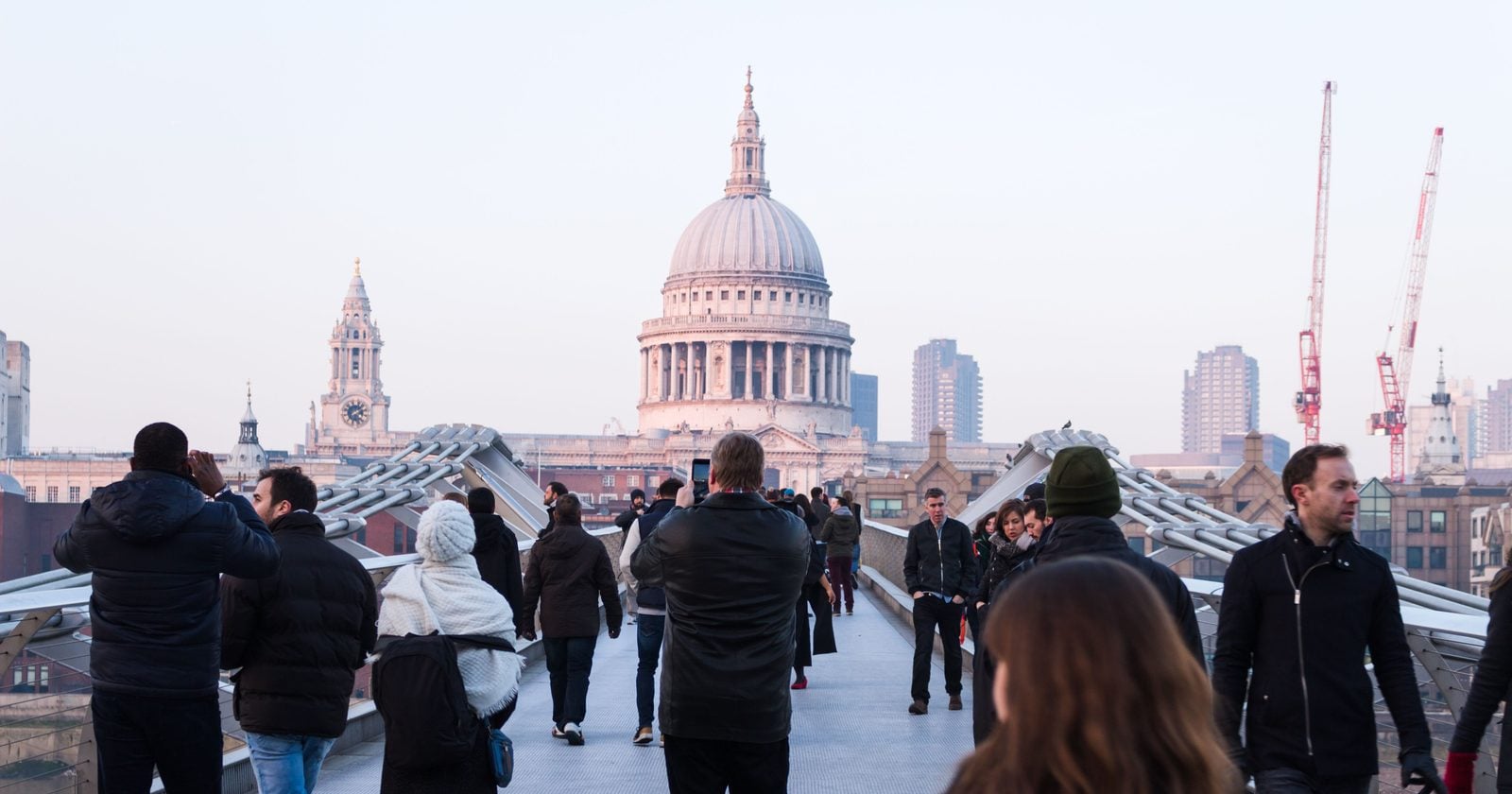
The story most people carry about the “wobbly bridge” is that crowds marching in step shook it, or that a flashy, over-ambitious design simply wasn’t built to hold the weight.
Neither is quite right.
What happened on London’s Millennium Bridge in June 2000 was stranger than either version, and it exposed a mistake that had been hiding in footbridge design for decades: a modest crowd, walking normally, can set a bridge swaying, and it takes far fewer people than you’d think.
The bridge is a pedestrian crossing over the Thames, running from St Paul’s Cathedral to Tate Modern. It opened on 10 June 2000, and about 90,000 people crossed it that day, with up to 2,000 on the deck at once. It swayed sideways so alarmingly that people grabbed the handrails and stopped walking. Two days later, it was closed.
It wasn’t marching, and it wasn’t a doomed design
The “soldiers breaking step” idea is old and real, but it doesn’t fit here. Nobody was marching. People were doing the most ordinary thing imaginable, ambling across a bridge on a summer day.
The design-blunder version misses the point too. The applied mathematician Steven Strogatz, who later helped model the whole thing, put the blame question bluntly. Strogatz argued that “a lot of people were blaming it on the beautiful innovative structure, the design of the Millennium Bridge itself, which was a radical design. But that is not true.”
The structure did play a part: the bridge was flexible, and its natural sway rate sat near the rhythm of a walking pace. So this wasn’t a simple “too weak, too clever” failure. It was a feedback problem, and feedback problems come from the crowd and the deck interacting, not from either one alone.
How a small sway feeds itself
The mechanism has a name: synchronous lateral excitation.
When a footbridge sways very slightly to the side, people on it instinctively adjust their footing to stay balanced, widening their stance and shifting their weight against the motion. The trouble is that everyone corrects at roughly the same moment and in the same direction, and those little corrections push the deck the way it was already going. A barely perceptible sway nudges the crowd, the crowd nudges the sway back harder, and the loop tightens. On the Millennium Bridge the deck moved as much as 70 millimetres to the side, close to three inches, enough to make a person feel the ground pitch underneath them.
Strogatz was clear that his team’s job was the crowd half of the equation, not the steel. As he put it, “I’m not a civil engineer. I know nothing about bridges. What I do know is group behavior. That was our contribution.” The pedestrians didn’t need to start in step. The sway did the organising for them. In his model, “if the people are initially disorganized and random, if a few of them get into sync by accident, the bridge would become unstable.”
The number that surprises everyone
The figure that tends to stop people is how few walkers it takes. Not thousands, and not even most of the 2,000 who packed the deck on opening day.
Testing after the closure, and modelling by Strogatz and his co-authors, put the tipping point as low as 160 pedestrians. Below that, the crowd’s random footfalls cancel out and the deck stays quiet. Above it, the synchronising effect takes over. It’s a threshold, not a gradual slope, which is part of why the wobble seemed to arrive so suddenly once the bridge filled up.
This is one account, not the last word. Strogatz and colleagues published their version in the journal Nature in 2005, borrowing math first built to describe how things in nature, like fireflies and neurons, fall into rhythm.
The fix wasn’t “walk differently”
Of course, telling people not to fall into step was never on the table. You cannot police the walk of a summer crowd, and the whole problem was that the syncing happened without anyone intending it. So the engineers went after the deck instead. According to John Macdonald, a professor at Bristol’s civil engineering department, the shape of the bridge wasn’t the culprit: large swaying “can occur on virtually any long bridge when carrying a sufficiently large crowd.”
The answer was to bolt on machinery that soaks up motion. Arup’s retrofit added nearly 40 piston-like dampers at key points along the structure, plus more units to absorb up-and-down movement. The work cost about £5 million. The bridge reopened in February 2002 and has stayed steady since, even though the “wobbly bridge” nickname never washed off. Arup checked the fix the honest way, by running around 2,000 people across it in January 2002 and watching for the sway. It didn’t come.
Why the wobble was more useful than embarrassing
It’s tempting to file this under expensive mistake, and the £5 million and the shuttered launch make that easy. But we’d read it the other way. The sideways-sync effect wasn’t something the Millennium Bridge’s engineers uniquely got wrong. It was a factor the whole field had never properly anticipated, hiding because most bridges were either too stiff to sway at walking pace or never carried a big enough crowd to cross the threshold. A smooth opening would have left that blind spot in place. The very public failure dragged it into the open.
Strogatz thought the value of getting the mechanism right was preventive. He suggested the theory could let engineers “solve the problem before they build it,” catching a wobble on paper instead of on opening day. Checking for pedestrian-driven sideways sway became a standard part of footbridge design, and the London bridge became the case study everyone points to. A crossing that had worked perfectly on 10 June 2000 would have taught the profession almost nothing. The one that swayed taught it a rule it now applies everywhere.
