
A year 70 million years ago held more days than a year does now, yet it lasted essentially as long.
That sounds like a contradiction until you separate the two things we lump together as time. The number of days went up because each day was shorter. Roughly 372 days fit into the year, against about 365.24 today. A single spin of the planet took about 23.5 hours rather than 24.
Where that number came from is the stranger part. Not from astronomy or from tracking planetary orbits, but from a single fossil clam pulled out of the mountains of Oman.
The clam that kept a Cretaceous calendar
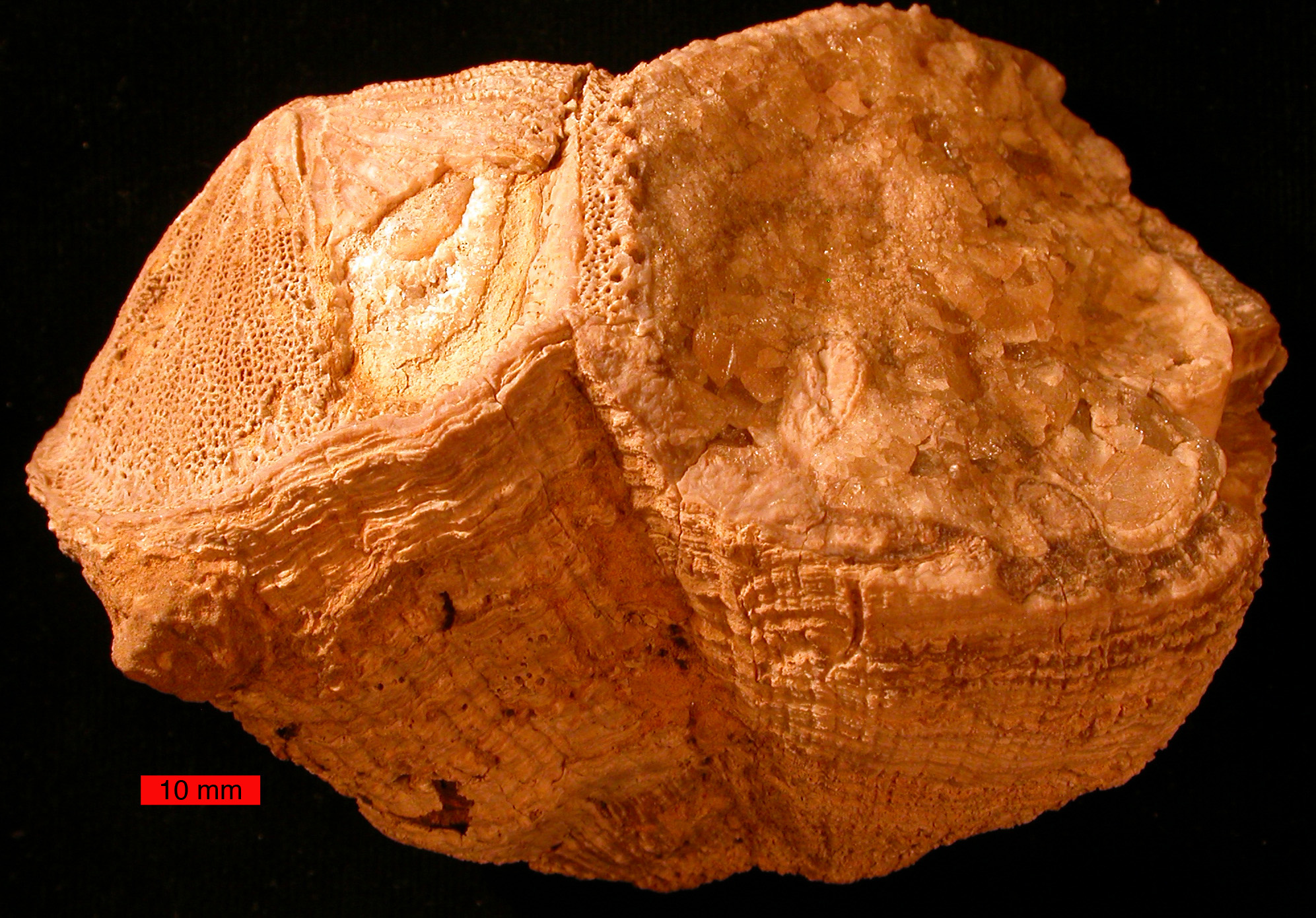
The clam is Torreites sanchezi, a reef-building rudist bivalve with no close living relative. It lived in a warm, shallow tropical sea that has since dried out and risen into dry land. The researchers who studied it were struck by how alien it was. “Rudists are quite special bivalves,” Niels de Winter, an analytical geochemist said. “There’s nothing like it living today.”
These shellfish were not a fringe oddity of the period. As de Winter put it, “In the late Cretaceous especially, worldwide most of the reef builders are these bivalves. So they really took on the ecosystem building role that the corals have nowadays.”
What made this shell useful is that it grew fast and lived more than nine years, apparently laying down a fresh growth layer each day. To read those layers, the team used lasers to make spots about 10 micrometres wide, roughly the width of a red blood cell, and measured the chemistry inside each one. That resolution is what makes the result unusual. “We have about four to five data points per day,” de Winter said, “and this is something that you almost never get in geological history.” Combining several ways of reading the daily layers and yearly cycles gave a composite estimate of 372 days per year, with an uncertainty of 8.4 days.
Why the year stayed the same but the day shrank
A year is one trip around the Sun, and over 70 million years its length has been essentially unchanged for this purpose. A day is one spin of the Earth on its axis, and that has changed considerably. The planet used to spin faster, so it packed more turns into the same orbit.
The reason it has slowed is mainly the Moon. The Moon’s gravity raises tides in Earth’s oceans. Because the tidal bulges do not line up exactly with the Moon, their interaction slows Earth’s rotation while pushing the Moon gradually outward. NASA notes that the Moon is drifting away by about 4 centimetres a year, its retreat slowing as it goes. That modern rate is measured by bouncing lasers off reflectors left on the Moon by Apollo astronauts (lunar laser ranging puts it at about 3.8 centimetres per year.)
The broad picture lines up: a faster-spinning Earth, a somewhat closer Moon and a shorter day are what tidal evolution predicts. But the modern 3.8-centimetre rate cannot simply be projected backward through all of Earth’s history. The Moon’s retreat rate has changed over time, which is one reason fossil records like this one are useful.
What the shell says about its Cretaceous world
The sea the clam lived in was extremely warm. Chemical analysis of the shell indicated summer ocean temperatures as high as 40 degrees Celsius, while winter temperatures exceeded 30 degrees Celsius.
The chemistry inside the shell also showed the clam grew faster in daylight than at night. That suggests it may have relied on tiny light-loving partners living in its tissues, the way giant clams and some corals do today, drawing energy from sunlight as well as from feeding.
Peter Skelton, a rudist specialist at The Open University who was not part of the study, said the dataset’s high fidelity let the authors draw inferences about both the Cretaceous calendar and the animal’s biology. He also cautioned that the photosymbiosis finding applies to Torreites and cannot be assumed for other rudists.
One shell, one number, and why it holds
The figure comes from a single individual, but not from a single layer count. The researchers compared layer counting, spectral analysis and chemical layer counting across nine growth years, producing a composite estimate of 372 daily laminae per year with a propagated uncertainty of 8.4 days. This is one shell sampled in exceptional detail, not a survey of the whole Late Cretaceous.
What makes it more than a curiosity is de Winter’s summary of what the method delivers. “We can basically look at a day 70 million years ago,” he said. “It’s pretty amazing.”
The technique may be the more significant result beyond the single number it produced. If day-by-day chemistry can be read this cleanly out of one clam, it can be tested in others, from other ages and other seas. The open question is whether the next well-preserved shell, from a different stretch of deep time, sharpens the 372 estimate or shifts it.
