
In 1999, out on the gravel flats of central Oman, someone picked up a dark, unremarkable rock. It went into the Natural History Museum in London the following year, catalogued as Sayh al Uhaymir 008, or SaU 008.
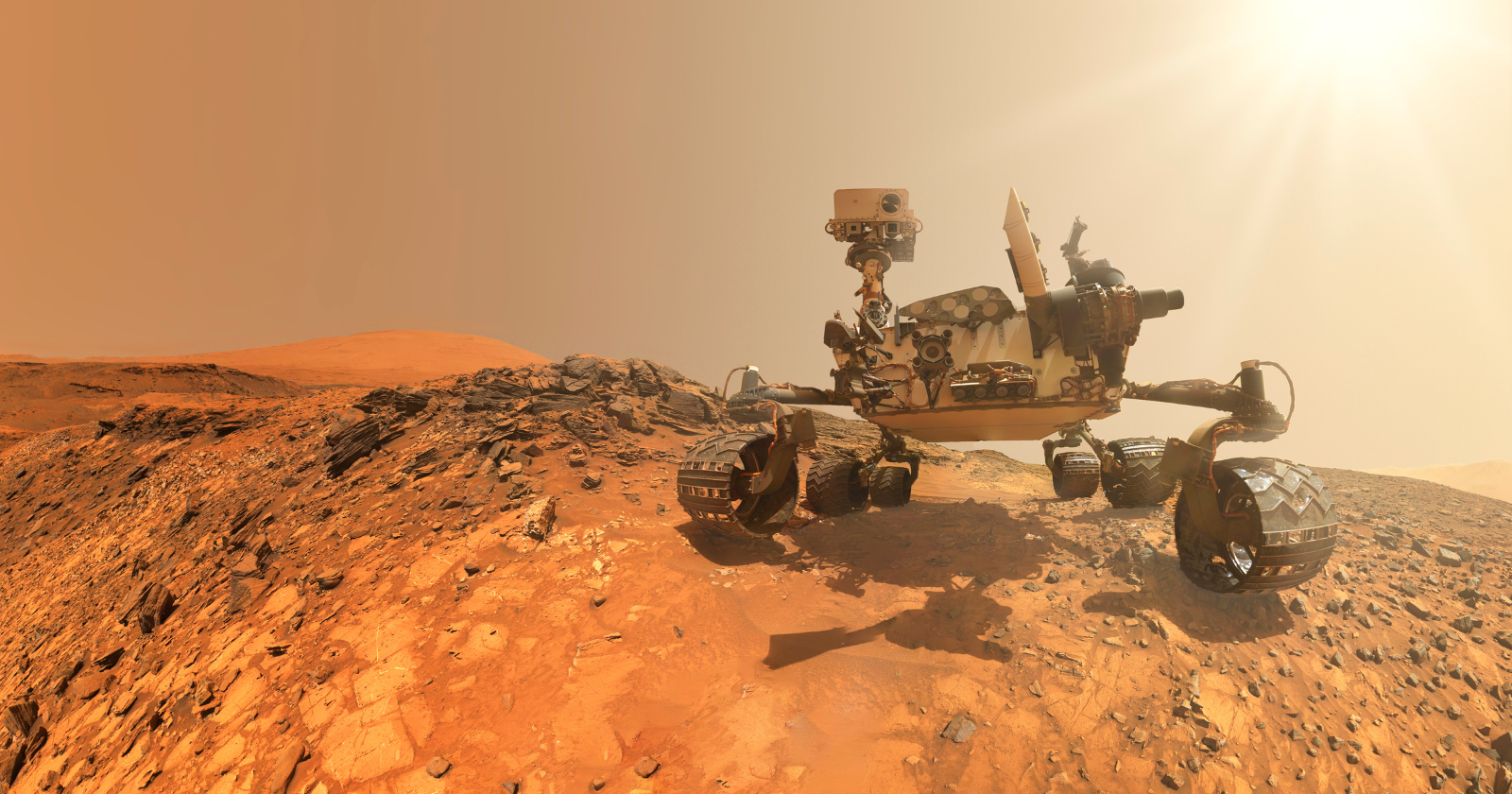
That rock is a fragment of Mars and today a slice of it is bolted to a rover driving around Jezero crater, doing a small, practical job on the planet it was thrown off of hundreds of thousands of years ago.
The rock itself
SaU 008 is a shergottite, a type of volcanic rock that makes up most of the Martian meteorites we have on Earth. Scientists identify Martian meteorites through their rock and noble-gas chemistry and mineralogy, including gases trapped in some specimens that match measurements of the Martian atmosphere. The slice sent to Mars contains olivine, maskelynite and iron-magnesium pyroxenes, plus calcium-carbonate weathering features acquired during its stay in the Arabian desert.
Caroline Smith, then the Museum’s Principal Curator of Meteorites, put the choice plainly when the loan was announced. The piece “was specifically chosen because it is the right material in terms of chemistry, but also it is a very tough rock.” Toughness matters more than it sounds. Anything going to Mars has to survive launch and landing, and many interesting samples are too fragile for that. Smith’s shorthand for this is relatable: “This meteorite is as tough as old boots.”
How it got here, and how it got back
The trip out was violent. An impact on Mars, thought to have happened roughly 600,000 to 700,000 years ago, hit hard enough to fling debris off the planet entirely. One of those fragments eventually reached Earth, then sat in the Oman desert until it was found in 1999.
The trip home was considerably more organized. In 2018 the Mars 2020 team selected a slice of SaU 008 for the rover, and Perseverance landed in Jezero crater on 18 February 2021. That made it the first Martian meteorite fragment returned to the planet’s surface. Smith didn’t oversell the moment, but she didn’t undersell it either: “This is a first for us,” she said, “sending one of our samples back home for the benefit of science.”
Why a piece of Mars makes a good calibration target
The slice isn’t riding along as a souvenir. It’s one of ten targets on SHERLOC’s external calibration assembly. SHERLOC uses deep-ultraviolet Raman and fluorescence spectroscopy, together with imaging, to map minerals and organic compounds in Martian rocks. The other targets include optical standards and samples of spacesuit materials.
SaU 008 provides something especially useful: a natural Martian sample whose mineralogy and organic signatures were characterized on Earth before launch. That gives the team ground truth for checking how SHERLOC reads comparable materials on Mars. Rohit Bhartia, SHERLOC’s deputy principal investigator, explained why the meteorite suited the job: “This kind of science requires texture and organic chemicals — two things that our target meteorite will provide.”
Repeated measurements also let the team check whether the instrument’s response, or the exposed sample itself, changes with time on Mars. Smith expected that studying it across the mission “will help us to understand the chemical interactions between the Martian surface and its atmosphere.”
That has started to pay off. A 2025 analysis in the Journal of Geophysical Research: Planets compared SHERLOC observations of SaU 008 over Perseverance’s first 1,000 sols with measurements made before launch. The instrument repeatedly detected the same Raman and fluorescence signatures in the same locations. For a calibration target, boring and consistent is exactly the result you want.
A working tool, not a monument
The symmetry that gets written up as if it were the whole story goes like this: a rock leaves Mars, wanders through space, lands in a desert, gets catalogued in London, and then goes back.
Told that way it sounds like a homecoming.
But it’s almost the opposite. SaU 008 didn’t go back to be reunited with anything. It went back because it was the right material and tough enough to make the trip, and now it sits on a rover serving as a known reference while an instrument reads Martian rocks. It’s doing an ordinary job.
A piece of one planet spent hundreds of thousands of years getting home by accident, and when it finally arrived on purpose, we gave it a chore.
