
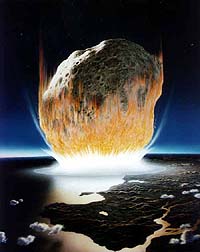
Muller too emphasizes the role impacts have played in the history of life on Earth. It’s not surprising that the recent intense period of meteor activity coincides with the rapid radiation of life on Earth, he said.
“We’re only beginning to realize the role played by catastrophe in the evolution of life,” he said. “When it comes to survival of the fittest, it’s not only the ability to compete with other species that counts, but also the ability to survive occasional catastrophe. That requires complexity and flexibility.”
Muller has proposed several controversial theories about the solar system, including that the sun has an unseen companion star, one he calls Nemesis, that orbits the sun every 26 million years and periodically knocks comets out of their orbits, sending them hurtling toward the inner solar system. He also has proposed that periodic climate changes are the result of the Earth’s orbit periodically tilting up out of the orbital plane of the planets and intersecting a cloud of dust, debris and meteoroids.
The current research was suggested by Muller in 1991, in part as a way to determine whether the moon’s impact record shows evidence of a 26 million-year cycle. Earth is not a good place to search for such evidence, because weathering and tectonic activity, plus sedimentation in the oceans, obliterate most evidence of impacts on Earth after a few hundred million years. On the moon, however, the surface records impacts going back more than four billion years. Mare Imbrium (Sea of Rains), the dark crater that dominates the face of the moon, has been dated to 3.8 billion years ago.
Based on earlier dating of a few young craters, plus crater counts within larger maria (seas), scientists have concluded that the lunar impact rate has been roughly the same for the past three billion years.
Muller hit upon the idea of argon-40/argon-39 dating of lunar spherules as a way to get a more precise chronology of the intensity of bombardment of the moon and, by implication, the Earth.
“I realized that we didn’t have to go to the individual craters in order to determine their age, because the craters sent samples to us,” Muller said. “We could obtain samples of hundreds of different craters from just one location, without having the expense of going back to the moon. This idea is likely to open up a completely new round of lunar analysis.”
Spherules are mostly basaltic glass, Culler said, created when a meteor hits the surface and generates intense heat that melts the rock and splatters it outward. As droplets of molten rock fall back to the surface they quickly cool to form a glass, much like obsidian.
Culler says that pea-sized and even millimeter-diameter meteoroids create enough heat to splatter molten rock and create these glass beads, which range in size from less than 100 microns to more than 250 microns (1/4 millimeter, or a hundredth of an inch) in diameter.
Argon/argon dating relies on the fact that during the melting process, most gas in the rock escapes. Through subsequent radioactive decay of naturally occurring potassium-40 to the rare isotope argon-40, the glass spherules slowly reaccumulate argon gas. The process is very slow, since the half-life of potassium-40 is 1.25 billion years.
In the argon-40/argon-39 method of radioactive dating, first developed at UC Berkeley in the 1960s, samples are irradiated with neutrons to convert the remaining potassium-39 to argon-39, which is normally not present in nature. The ratio of argon-40 to argon-39 gives a measure of the age of the sample.
