
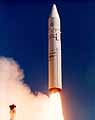

Washington DC – August 25, 1997 – Ending two years of recovery and redesign, the Lockheed Martin LMLV-1 roared away from a nighttime launch pad at Vandenberg Air Force Base late Friday, putting the TRW-built NASA “Lewis” satellite into orbit. The picture perfect blast-off came at 11:51pm local time following months of delays in getting both booster and payload ready. Lockheed Martin officials must be easing a sigh of relief as this week
starts, for the Lewis launch is just the beginning of a series of planned
LMLV-1 and 2 launches for civil and government payloads. The satellites had
been waiting for the Lewis mission as the “proving” flight for the small
launcher, which was first flight tested in August 1995 lifting the VITASAT
towards space. Both rocket and satellite were destroyed minutes after
lift-off, in what became a major delay for the new booster project.
At Cape Canaveral’s Pad 46, a LMLV-2 booster is set to lift NASA’s Lunar
Prospector satellite to the Moon this fall, another in the space agency’s
series of “smaller, faster, cheaper” satellite missions following in the
footsteps of the Mars Pathfinder. A failure to loft Lewis might have
grounded the lunar mission, set to search for water ice at the Moon’s
poles, for several months. Friday’s success may clear the way for that
endangered robotic flight.
Lockheed offers three versions of the basic LMLV space vehicle to
customers. The smallest in the rocket family, the LMLV-1 stands 65 feet
tall and is built atop a Thiokol Castor 120 solid fueled rocket motor. It
can orbit one ton of payload into a 100 mile high low orbit. The larger
LMLV-2 and 3 can lift 4,390 and more than 6,000 pounds of payload,
respectively. Launch control is conducted via a small van near the rocket’s
pad. The Friday night blast-off was also the first successful space mission
launched from what was once called “Slick 6”, or U.S. Space launch Complex
6 at the military spaceport on the southern California coast. Originally
built for use in the 1960’s Manned Orbiting Laboratory program, which was
cancelled, the pad was redesigned for the space shuttle, providing a second
launching base for the winged vehicles. But following the 1986 Challenger
disaster, west coast launches of the shuttles by the U.S. Air Force were
cancelled as well. In 1994, the Air Force joined with the California
Spaceport Authority in releasing SLC-6 for commercial use. The 1995 LMLV-1
launch failure was the first time a rocket actually was fired from the pad.
The NASA Lewis satellite carries hyperspectral imager and a series of
sensors to study ultraviolet radiation in deep space. A sister craft,
dubbed “Clark” is also planned for launch, but delays with the spacecraft
and its payloads have caused cost overruns which may result in cancellation
of the flight.
