
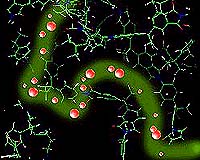
To discuss the trillion-dollar nanotechnology market that experts believe will be born from research at the molecular scale, 250 leaders from industry, academia and government will converge Aug. 19 at NASA Research Park at NASA Ames Research Center in California’s Silicon Valley.
NASA is co-hosting the Bay Area Nanotechnology Forum with U.S. Rep. Mike Honda, co-sponsor of the Boehlert-Honda Nanotechnology Bill, H.R. 766. During comments at the forum, he will describe the current outlook for national competition for federal R & D dollars and the international competition for nanotechnology leadership.
Nanotechnology is the creation of materials, devices and systems through the control of matter on the nanometer scale. A nanometer is one-billionth of a meter. Scientists say nanotechnology could lead to changes in almost everything from computers and medicine to even automobiles and spacecraft.
“The attendees will learn about nanotechnology research and development in the San Francisco Bay area,” said G. Scott Hubbard, director of NASA Ames. “As part of our pursuit of NASA aeronautics and space programs, NASA Ames is working to fuse information technology, biotechnology and nanotechnology R&D. This will facilitate NASA’s ability to achieve the nation’s goals in aeronautics and space. We can reduce the cost of space exploration, bring back better information and help determine whether there is life beyond our planet,” Hubbard added.
“NASA’s interest in nanotechnology is that it will result in stronger materials, ultra-small electronic devices, perhaps even intelligent spacecraft. Miniaturization also may well enable new space missions with lower weight parts requiring less power and fuel,” Hubbard said.
Following a talk by Dr. Meyya Meyyappan of NASA Ames, from 9:30 a.m. to 9:50 a.m. PDT, experts will conduct four panel sessions: Federal Labs Panel, including NASA, Lawrence Livermore National Laboratory, Sandia National Laboratories, Lawrence Berkeley National Laboratory; Industry Panel, including Hewlett Packard, Intel, Solectron, Agilent and Nanosys; University Panel, including Stanford, University of California-Berkeley, University of California-Santa Cruz, and Santa Clara University and finally a Bay Area Resources Panel, including Joint Venture Silicon Valley, Silicon Valley Manufacturing Group, Northern California Nanotechnology Initiative, and the Bay Area Science and Innovation Consortium.
Additional information about the forum is on the Internet here
