
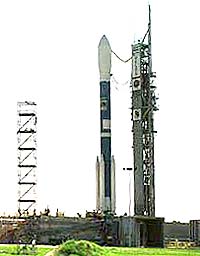
NASA on Monday postponed to late April the launch of its new infrared space telescope designed to study objects that otherwise would be too dust-concealed, too cold or too distant to be detected by existing equipment.
The Space Infrared Telescope Facility (SIRTF) will be launched on April 27 aboard a Delta II rocket from the Cape Canaveral, Florida at 4:25 a.m. (0825 GMT), NASA officials said.
It was originally scheduled to be launched on Friday.
“Additional time is needed to complete launch readiness evaluations for the Delta II launch vehicle,” NASA said in a statement.
The mission of the 1.2-billion SIRTF, planned to last for five years, will complete the range of US space telescopes that include the Hubble Space Telescope, the Compton Gamma Ray, and the Chandra X-ray Observatories.
Researchers will use the new four metre (13 feet) long telescope to study planets and stellar fragments that surround certain stars, in the hope of finding a planet similar to Earth with favorable conditions for life.
The SIRTF’s infrared sensors will allow it to see further into the universe than ever before, according to NASA.
The telescope, with an 85-centimeter (33.5-inch) diameter lens, whose mission could last up to five years, is equipped with three scientific cryogenic cooling instruments.
It has an infrared array camera to study near-to-mid-infrared rays, an infrared spectrograph that breaks light into wavelengths similar to a prism, and a multi-band imaging photometer that operates at far-infrared wavelengths to study cool, dusty objects.
