
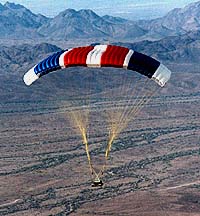
The latest prototype of the proposed ISS Crew Return Vehicle – the X-38 Vehicle 131R has arrived at NASA’s Dryden Flight Research Center at Edwards AFB. Atmospheric drop tests of the X-38 prototypes will continue at Dryden for the next two years using increasingly complex test vehicles.
Vehicle 131 was the first X-38 prototype, and flew three free flights before being shipped to Johnson Space Center, Houston, Texas for modifications, becoming V-131R.
Vehicle 131R will be transported in Johnson’s Super Guppy cargo airplane, regularly used to carry space station elements from manufacturers to the launch site, Kennedy Space Center, Fla. The Super Guppy’s 25-foot diameter fuselage is designed to handle oversize loads. It provides flexibility in transportation by vaulting over constraints such as railroad and highway overpasses.
A radical modification to a 50-year-old Stratocruiser propeller-driven transport design, the Super Guppy is part of a family of huge modified cargo aircraft that began in the 1960s with a transporter for sections of the Saturn moon rocket. The combination of the venerable Super Guppy and the new X-38 provides a striking contrast that helps visually define America’s long ongoing journey into space.
The primary objectives for V-131R flights are to evaluate its new aerodynamic shape, which more closely resembles the CRV, test the 7,500 square-foot parafoil with the modified X-38 lifting body shape, and the new drogue chute, both of which will actually be used on the CRV.
The upcoming flights of V-131R mark the beginning of international participation in flight testing of the European Space Agency’s guidance and navigation software to be used on the CRV. A European engineer will also be in the control room to monitor the software operation. A captive-carry flight for V-131R is slated for end of this summer and a free flight planned by year’s end.
When operational, the CRV would be an emergency vehicle to return up to seven ISS crewmembers to Earth. It would be carried to the space station in the cargo bay of a space shuttle, then attached to an ISS docking port. If an emergency arises that forces the ISS crew to leave the space station, the CRV would be undocked and -after a deorbit engine burn-would return to Earth much like a space shuttle.
