
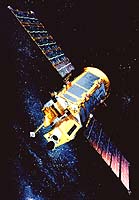
Eight weeks after its launch on December 20 (PST) from Vandenberg Air Force Base in California, the Korean Multipurpose Satellite (Kompsat) has started sending science data to its ground station in Taejon, Korea.
Kompsat, known in Korea as Arrirang I, is in a 685 kilometer, sun-synchronous orbit at 98 degrees to the Earth’s equatorial plane.
Developed by Korean Aerospace Research Institute (KARI) and Korean industry jointly with TRW Inc., Kompsat is carrying three science instruments.
These include two instruments built by TRW for remote sensing applications and a space physics instrument package built by the Korean Advanced Institute of Space & Technology for characterizing the space environment.
“We are pleased with the performance of the instruments and the spacecraft,” said Dr. Jang-Soo Ryoo, vice president, KARI. “Data from the remote sensing instruments will help us to gain a better understanding of the Korean peninsula and the oceans surrounding Korea, while the space physics data will help us to understand the effects of space on electronic components.”
Kompsat’s primary payload instrument is an electro-optical camera (EOC), which has started to provide images for the production of digital elevation models of the Korean peninsula.
The models will be used for topographical disciplines, such as land development planning, monitoring floods, avalanches and landslides, archeological surveys and hydrological studies. The EOC is a pan-chromatic camera with 6.6 meter resolution.
The second instrument is an ocean scanning multispectral imager (OSMI). OSMI data will be applied to biological oceanography, such as the detection of red tides, producing a fish finding map
and tracking global changes resulting from pollution, studying land vegetation, and monitoring sea fog and yellow sand in the Yellow Sea around Korea. OSMI has six spectral bands and one kilometer resolution.
Both the EOC and OSMI are the latest in TRW’s line of air- and space-borne electro-optical instruments to go on orbit.
In addition, Kompsat is carrying a space physics sensor that includes a high energy particle detector and an ionosphere measurement sensor. These instruments will enhance the understanding of how the space environment affects microelectronics and spacecraft.
Kompsat is based on the TRW family of lightweight spacecraft, a series of modular satellite whose design is readily tailored to mission specific requirements.
This family includes the Total Ozone Mapping Spectrometer-Earth Probe and the Republic of China Satellite-1.
The Kompsat program consists of two satellites. A protoflight model was built in TRW’s California manufacturing facility, and the flight model was built by KARI with assistance from TRW at its Taejon facility.
