
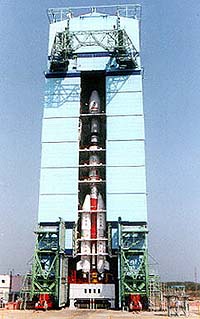
The Khrunichev State Space Science and Production Center will supply five new booster units, 12 KRB, for the Indian GSLV rockets within the next two or three years, General Director of the Khrunichev Space Center Alexander Medvedev told the press in Moscow last week.
It will be an absolutely new cryogenic booster unit for placing communication satellites in geostationary orbit. It uses ecologically friendly and highly powerful oxygen-and-hydrogen fuel, Medvedev said.
The Khrunichev Space Center started to work on the project in 1982. The Isayev Chemical Machine-Building Design Bureau based in Korolyov, in the Moscow region, assisted the works.
The launch of an Indian GSLV-D1 rocket, planned for the next few weeks, will be the first test space flight of the Russian cryogen booster unit, Medvedev said.
“The launch is very important for India, because it gives it access to the world space club and the international market of commercial launches of communication satellites to geostationary orbits,” he said.
“Yet it is most important that India gets the chance to launch its telecom satellites by its own rockets. That is profitable for the country.”
India plans one or two launches of its rockets equipped with the Russian cryogen booster units each year.
The first test launch of the Indian rocket with the Russian booster unit was planned for March 28, but cancelled shortly before take off due to problems in the first stage engine.
The malfunction is being repaired at the space station in the Andhra-Pradesh southern state.
 Copyright 2001 Interfax. All rights reserved. The material on this page is provided by Interfax and may not be published, broadcast, rewritten or redistributed.
