
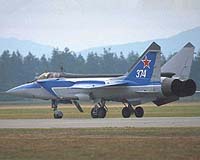
Kazakhstan and Russia have agreed on the development of a new civil satellite launching system using the Mig-31s Fighter and the Ishim missile as a platform from which to launch payloads of up to 200 kg into low earth orbits.
According to the Prime Minister of Kazakhstan, Danial Akhmetov, Kazakhstan and Russia are studying the creation of a small “space missile” launching system Ishim using a supersonic Mig-31st jet fighter.
Having detached from the carrier aircraft, the small missile reaches a higher altitude and puts a small 160-kilogram-heavy space vehicle into low earth orbit.
The major distinction of the Ishim launching complex is its carrier aircraft “MIG – 31” capable of lifting a missile with compact satellite to a requested altitude, with the satellite being further delivered into the orbit by the missile.
Last March, Prime Minister Akhmetov met with the chief designer at the Moscow Institute of Thermal Engineering (creators of the Ishim missile), Yuri Solomonov, to discuss this new launch complex.
The Mig-31s would take off, carrying the Ishim missile with its payload, launch the space missile at between 25,000m and 30,000m. The Ishim would then deliver the payload into low orbit.
Named after a river which flows through Kazakhstan’s Capital, Astana, into Russia, the Ishim space missile uses a solid-fuel engine which limits the use of toxic elements used for the construction of classic launchers.
Mr. Solomonov is very bullish about the proposed Russo-Kazakh programme: “We have planes, airfields and our institute can in a short time design and manufacture the new rocket.”
The programme is expected to cost US$1.5 billion over the next 15 years. Prime Minister Akhmetov has instructed state agencies to undertake a comprehensive feasibility study before undertaking the realisation of the programme itself.
Such a programme has extreme potential in offering a very low-cost civil launch system. This is but the latest step taken in bilateral Russio-Kazakh cooperation in space technology.
Noting the timeliness of the civil satellites launching complex being created, experts believe that in the following 15 years, the respective services market can attract up to USD 1,5 billion.
Kazakhstani Prime Minister Akhmetov pointed out that “the new Ishim complex is to enrich the Kazakhstan space program being developed” and commissioned to proceed with the work to create the Ishim launching complex.
Last year Kazakhstan extended the lease of the Baikonur Cosmodrome (where all major Russian launches – since that of the Sputnik – take place) to Russia for a 50-year lease. Kazakhstan has also started developing its own independent Space programme.
