

Approximately 24 kilometres south of Vangunu Island in the western Solomon Islands, in a part of the Pacific Ocean that lies just north of an active tectonic subduction zone, there is a submarine volcano called Kavachi. The volcano rises approximately 1,200 metres from the seafloor. Its summit is only 20 metres beneath the surface of the sea. The indigenous people of the surrounding islands, who have lived alongside it for centuries, call it Rejo te Kavachi, which translates approximately as Kavachi’s Oven.
Kavachi has erupted at least 39 times since 1939, when its activity was first formally recorded by European observers. The eruptions are violent. They produce columns of superheated water, steam, sulphur, ash, and rock fragments that sometimes break the surface and form ephemeral islands, which the ocean then erodes back below the waterline within months. The most recent eruptive phase began in October 2021 and has continued, with satellite-observable activity confirmed by NASA Landsat imagery as recently as March 2024.
The active crater of Kavachi, on the available oceanographic evidence, contains conditions that should preclude large vertebrate animals from living inside it. The water in the immediate vicinity of the vent is approximately ten degrees Celsius above ambient ocean temperature, is sufficiently acidic to corrode standard scientific instruments, contains elevated concentrations of carbon dioxide, methane, and sulphur compounds, is heavily laden with suspended particulate matter that reduces visibility to near zero, and is subject to violent disturbance from the underlying volcanic activity that can occur with little warning.
Inside that crater, in 2015, two species of sharks were documented living and hunting.
The January 2015 expedition
A peer-reviewed expedition report by Brennan Phillips and colleagues, published in 2016 in the journal Oceanography under the title “Exploring the Sharkcano: Biogeochemical observations of the Kavachi submarine volcano,” described the results of a National Geographic-supported research mission that reached Kavachi in January 2015. The expedition was timed, by what the team described as a combination of planning and good fortune, with a rare period of relative quiet in the volcano’s eruptive cycle. The expedition members were able to deploy instruments inside the active crater for several days without being driven off by an eruption.
The team’s instruments included autonomous baited cameras dropped into the crater from the surface, drifting water-sample collectors, and small disposable robots designed specifically for the mission. The team had designed the robots with the explicit assumption that they might be destroyed by an eruption during deployment. The robots were built from low-cost components including used PVC sewer pipe sourced from the nearest village, on the principle that anything sent into Kavachi’s crater needed to be inexpensive enough to lose.
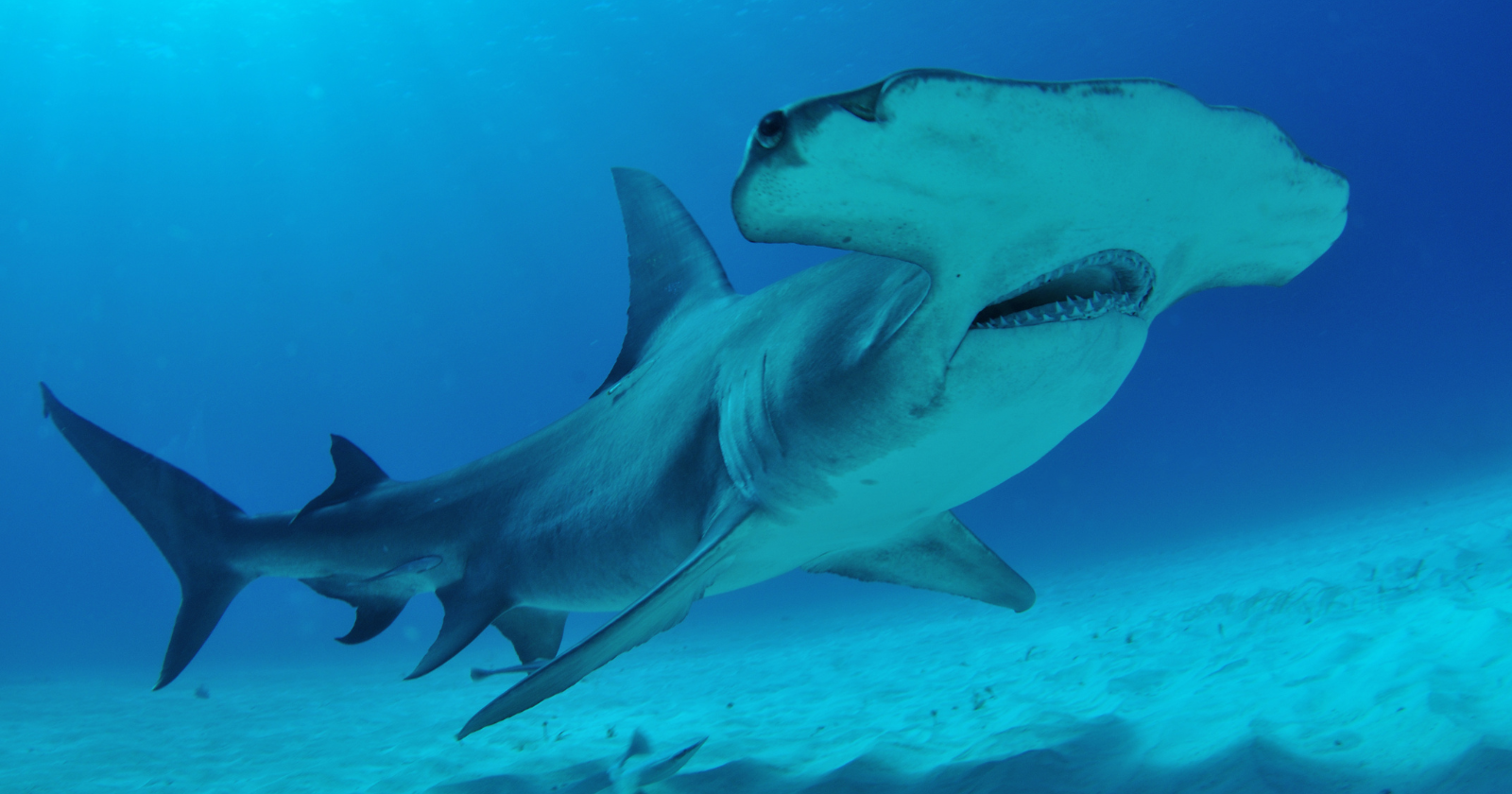
The expedition recovered footage and data from the crater interior that surprised the research team. Inside the active crater, at depths of approximately 50 to 80 metres beneath the surface, the cameras recorded silky sharks (Carcharhinus falciformis) and scalloped hammerhead sharks (Sphyrna lewini) swimming through the volcanic plume. The cameras also recorded multiple species of bony fish, including bluefin trevally and snapper. The crater walls contained extensive mats of orange and white bacteria belonging to sulphur-oxidising lineages that derive their energy from the chemistry of the volcanic emissions themselves. The crater was, on the team’s documentation, not a sterile or marginal environment. It was a functioning ecosystem.
The standard models of marine biology, on the available scientific consensus before the 2015 expedition, did not predict that large pelagic sharks would tolerate conditions of the kind documented inside Kavachi’s crater. The acidity should have interfered with the sharks’ electroreceptive sensing system, the elevated temperature should have exceeded the thermal tolerance of species adapted to open ocean conditions, and the violent disturbance should have driven any animal capable of leaving the area to do so. The sharks were doing none of these things. They were hunting in the plume.
What the sharks may be doing
The Phillips team’s interpretation of the shark observations, supported by subsequent peer-reviewed work and the comparative data from other active submarine volcanoes, points to several plausible explanations for what the animals are doing inside Kavachi.
The first is that the volcanic emissions concentrate prey species near the vent. Hydrothermal systems consistently produce localised increases in microbial productivity, which support secondary populations of small invertebrates and fish, which in turn attract larger predators. The volcanic crater may function, from a predator’s perspective, as a food-rich hunting ground that compensates for the costs of operating in extreme conditions. The sulphur-oxidising bacterial mats documented on the crater walls are evidence of this productivity at the base of the food web.
The second is that the sharks may be moving in and out of the crater opportunistically rather than residing there permanently. The 2015 expedition observed sharks darting in and out between plumes of denser volcanic discharge, which suggests that the animals are using the crater interior strategically rather than tolerating it continuously. The full range over which Kavachi’s resident sharks travel is not yet known and would require long-term tagging studies that have not been possible because of the danger of working at the volcano.
The third is that the species observed at Kavachi may have evolved specific physiological adaptations to high-acidity, high-temperature environments that are not present in conspecifics from less extreme habitats. The peer-reviewed evidence for this hypothesis is not yet sufficient to confirm it, but the persistence of large vertebrate animals in conditions that should be physiologically intolerable suggests that something about the local Kavachi populations is unusual. The team’s recommendation, repeated in subsequent commentary on the work, has been that the Kavachi sharks should be tagged and tracked, which would require either a substantially safer working window or substantially more disposable instrumentation than the original expedition could deploy.
The comparison with other volcanic kill zones
Kavachi is not the only active submarine volcano that has been studied biologically. Vailulu’u Seamount in American Samoa and the Kolumbo volcano off the Greek island of Santorini have both been examined by peer-reviewed research teams using submersible and remote-operated vehicles. Both sites contain water of comparable acidity and temperature to Kavachi’s crater. Both sites are surrounded by populations of marine animals that approach the vent regions.
Neither Vailulu’u nor Kolumbo, however, contains the kind of functioning vertebrate ecosystem that Kavachi does. Both other sites have documented kill zones at the crater interior, where carcasses of larger animals accumulate from individuals that ventured too close to the active vent and were overwhelmed by the local conditions. The standard model of how marine animals interact with active submarine volcanoes, derived from these other study sites, is that large vertebrates do not survive prolonged exposure to vent conditions.
The Phillips team proposed a specific geological explanation for Kavachi’s difference from Vailulu’u and Kolumbo. The other two sites have relatively deep, high-walled craters that physically entrain volcanic emissions and concentrate them within the vent region. Kavachi’s crater is comparatively shallow, with low walls, and sits in a region of strong surface currents that rapidly mix the volcanic emissions with surrounding ocean water. The result is that Kavachi’s crater interior is, on the team’s interpretation, less consistently lethal than other active vents, with frequent periods of milder conditions during which marine life can use the food-rich environment without being overwhelmed by it.
This interpretation is consistent with the observed shark behaviour. The animals are not residents of a continuously survivable habitat. They are visitors to a habitat that is sometimes survivable and sometimes not, and they appear to be timing their activity to coincide with the survivable periods.
The honest limitations
Several caveats apply to the literature described above.
The Phillips 2016 expedition was a single observational mission conducted during a single eruptive lull, which constrains how much can be concluded from its data. The Sharks documented in 2015 may not be representative of the typical Kavachi shark population. The conditions measured during the expedition may not be representative of typical crater conditions. The full range of variability in both biological and physical conditions at Kavachi has not yet been documented across multiple expedition windows, because no other peer-reviewed expedition has reached the crater interior since 2015.
The interpretation that Kavachi’s sharks are physiologically distinct from sharks of the same species in less extreme environments is plausible but not established. No tissue samples have been collected from the Kavachi sharks. No genetic analysis has been conducted on them. The hypothesis that local adaptation is occurring is consistent with the available behavioural observations but is not directly supported by physiological or genetic data.
The comparison with Vailulu’u and Kolumbo provides important context but the three sites differ in many geological and oceanographic respects beyond crater geometry, and the specific explanation the Phillips team proposed for Kavachi’s difference is one of several possible interpretations. The peer-reviewed dispute about exactly why Kavachi supports vertebrate life when other comparable sites do not is genuinely open.
The extent to which Kavachi’s biological community is stable across the volcano’s eruptive cycle is not known. The 2015 documentation occurred during a quiet phase. The crater may be largely depopulated during active eruptive phases and then recolonised during subsequent quiet phases, or it may sustain a continuous shark population that tolerates eruptions through behavioural avoidance. The available evidence cannot distinguish between these possibilities.
What it means
Several things follow from the Kavachi evidence that are worth saying clearly.
The first is that the range of environmental conditions under which large vertebrate animals can survive is, on the available peer-reviewed evidence, broader than the standard marine biology textbooks have assumed. Hammerhead sharks were not previously thought to tolerate water with the pH, temperature, and turbidity of Kavachi’s active crater. They appear, on the available documentation, to be tolerating it well enough to hunt there. The implications for the predicted range of marine life on Earth, and for the prediction of marine life on bodies elsewhere in the solar system where similar hydrothermal systems may exist, are substantial.
The second is that the relationship between extreme environments and biological occupancy is more contextual than the standard hydrothermal vent literature has suggested. The presence of large animals at Kavachi is, on the Phillips team’s interpretation, a function of the specific local geology that allows volcanic emissions to mix with surrounding water rather than concentrating in the crater. Active submarine volcanoes are not, in general, inhabited by sharks. Kavachi appears to be inhabited by sharks because of features of its specific physical configuration that other volcanoes do not share.
The third is that the methodological challenge of studying extreme marine environments is now genuinely tractable through the use of low-cost, autonomous, disposable instrumentation. The Phillips team’s robots, built partly from PVC sewer pipe and designed to be lost, recovered scientific data from inside an active submarine volcano that would not have been accessible to any conventional research approach. The same methodological principle is now being applied to other extreme marine environments worldwide, and the range of habitats accessible to direct biological observation has expanded substantially as a result.
The fourth, on the strongest current reading of the available peer-reviewed evidence, is that the indigenous communities of the Solomon Islands have known for centuries that something unusual lives in Kavachi’s Oven. The local name for the volcano carries the embedded knowledge that the place is hot and active and that creatures persist within it. The peer-reviewed scientific documentation in 2015 confirmed the substance of what the local naming tradition had been suggesting all along.
The sharks were not waiting to be discovered.
They were waiting to be documented.