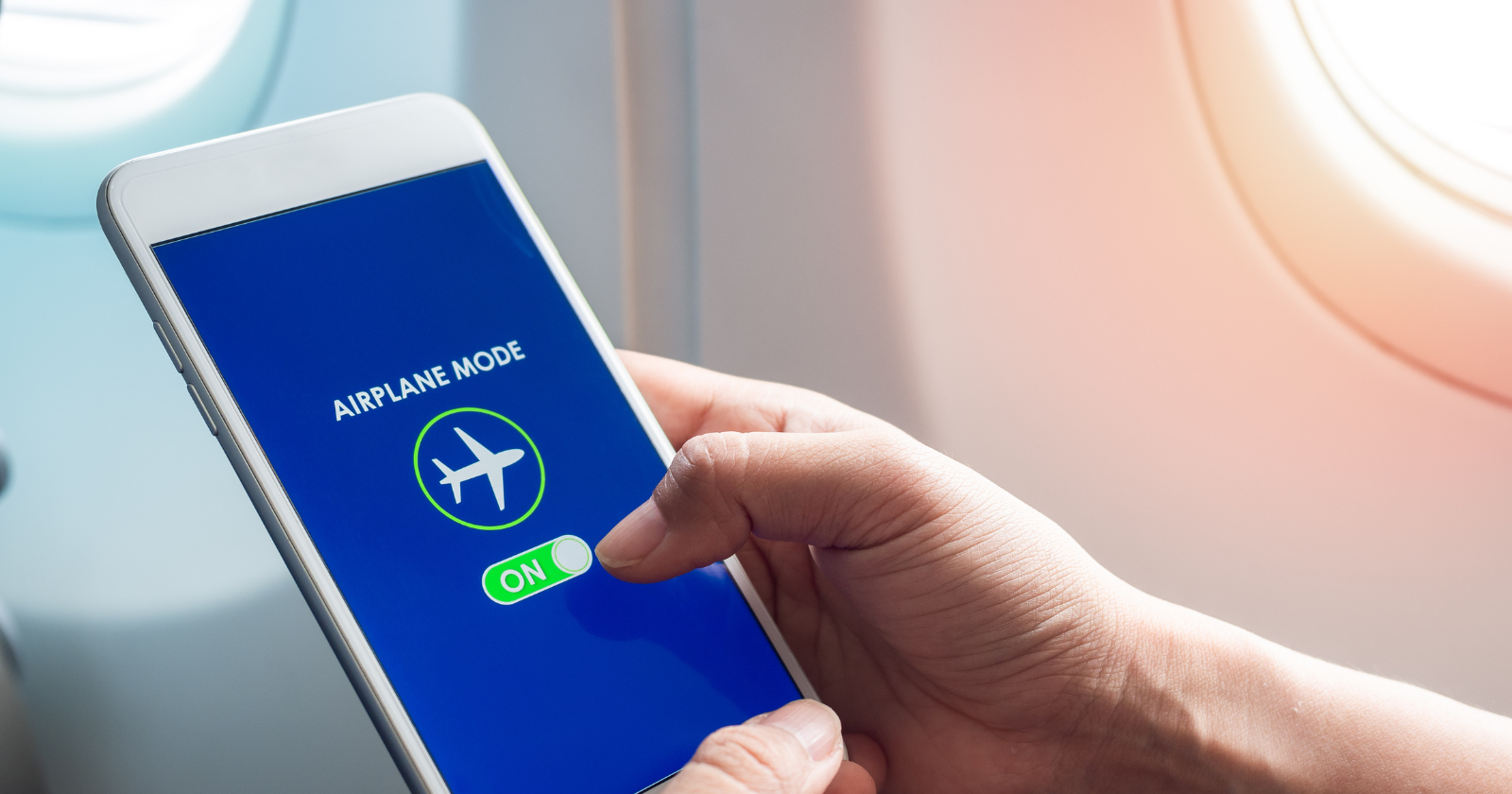
Almost everybody who has flown commercially in the past two decades has heard some version of the same instruction. Before pushback, before the safety demonstration, before the aircraft has begun to move at all, a member of the cabin crew asks everyone on board to switch their phones and other electronic devices to airplane mode. Almost every passenger complies, mostly because it is the rule, and mostly under a background assumption they have carried since childhood that leaving the phone on somehow poses a genuine risk to the flight. The image, absorbed from decades of news coverage, cabin announcements, and popular film, is of a phone signal quietly interfering with the aircraft’s navigation instruments, and of an unfortunate someday when the accumulated risk finally produces a real accident.
The regulatory record on this, when you read it directly, does not support that background assumption. There has, on the peer-reviewed and government evidence, never been a documented case of an air accident caused by a passenger’s phone. There are two separate rules requiring airplane mode, from two separate agencies, and neither of them, as currently written, is primarily concerned with keeping the aircraft in the sky.
What the rule actually is
According to the official text of the United States Code of Federal Regulations at 47 CFR §22.925, published by the Federal Communications Commission and maintained in the electronic Code of Federal Regulations, cellular telephones installed in or carried aboard aircraft must not be operated while such aircraft are airborne. The rule is short. It has been in effect since 1991. It applies whenever a phone is off the ground. And the reason the FCC created it, on the primary-source record of the original 1991 order, has nothing to do with the aircraft. It has to do with what happens to cellular networks on the ground when a phone starts transmitting from several thousand feet in the air.
The cellular network protocol was designed on an assumption that has held true for almost every phone that has ever existed. That assumption is that a given handset is located inside the ordinary geographic coverage area of a small number of specific cell towers, typically one or two at most, which the network can then use to route the call correctly and to charge the customer accurately. When a phone is at ground level, this assumption is trivially met. The nearest tower is a few kilometres away. Other towers are further, and their signals arrive too faint to matter.
When a phone is at thirty thousand feet, the assumption breaks. From that altitude, the phone can suddenly see hundreds of ground-based cell towers simultaneously, all of them at roughly the same distance and roughly the same signal strength. The network protocol was never designed to handle that configuration. The result, if a large number of phones on an aircraft were all transmitting from cruising altitude at once, would be a small but genuinely disruptive burden on the cellular networks below, which would have to allocate resources to serve handsets that were about to move over the horizon within seconds. The FCC’s 1991 rule, on the primary regulatory record, exists to prevent that congestion.
Watch here:
The second rule, run by a different agency, has separate origins. According to the Federal Aviation Administration’s Advisory Circular AC 91.21-1D, “Use of Portable Electronic Devices Aboard Aircraft,” most recently updated in October 2017, the FAA has maintained a separate concern about portable electronic devices dating back to a 1961 finding that portable FM radio receivers could interfere with aircraft navigation and communication equipment. That concern was broadened over the decades to cover all portable electronic devices, and it is the reason the FAA’s regulations require passengers to keep certain devices off during particular phases of flight. But the FAA’s own current guidance is explicit that the airplane mode requirement itself is primarily a mechanism for keeping passengers in compliance with the FCC’s separate cellular rule. The FAA’s Advisory Circular notes that requiring airplane mode during device operation “will help prevent violation of these regulations,” meaning the FCC’s ground-network rule.
The two agencies, in other words, are both worried about interference. But the modern interference the airplane mode switch is designed to prevent is not primarily interference with the aircraft. It is interference with the cellular network on the ground.
What actually happens if you leave the phone on
If you have ever forgotten to switch a phone to airplane mode before takeoff, and quietly discovered this several hours later at your destination, you have almost certainly experienced the actual consequences of the failure. Which is to say almost none. The phone probably lost signal within minutes of the climb. It probably drained its battery faster than usual as it searched fruitlessly for towers it could no longer reach. It probably picked up a handful of stray texts during descent as the aircraft came back within cellular range. Nothing else happened. The aircraft did not divert. The pilots did not notice. The passenger next to you did not know.
The specific real-world consequence airline crews do report, on the aviation industry’s own quality assessments, is smaller and more mundane than the popular imagination suggests. When multiple phones on the same aircraft are actively searching for cellular signal, meaning the ordinary background behaviour of an unlocked phone that has not been switched to airplane mode, the electromagnetic emissions from those phones can produce a faint audible interference in the pilot headsets. The interference is not a safety-critical event. It does not disrupt the aircraft’s navigation, control, or communication systems. What it does is produce a small buzzing or clicking sound in the audio of the cockpit intercom, similar to the noise a mobile phone produces when placed near a cheap speaker on the ground. Pilots have described it, in interviews, as an annoying mosquito-adjacent hum rather than a mechanical problem.
According to the FAA’s Information for Operators bulletin InFO 13010, published in October 2013 alongside the agency’s expanded rules on passenger portable electronic devices, the aviation certification community has, over the past three decades, tested modern aircraft extensively for tolerance to intentional and unintentional transmissions from portable electronic devices. The 2013 policy shift, which allowed passengers to use devices in airplane mode throughout all phases of flight including takeoff and landing, was made possible by the accumulated engineering evidence that modern aircraft are, by design, tolerant of the specific electromagnetic environment portable devices produce. Which is to say the aviation-safety concern the FAA was originally reacting to in the mid-twentieth century has, for practical purposes, been engineered out of the modern aircraft fleet.
The rule remains, in its current form, because two things about the underlying situation have not changed. The FCC’s ground-network concern is still live. Modern cellular networks are still not designed to have handsets at cruising altitude pinging hundreds of towers simultaneously. And the pilot-headset interference is still real, still annoying, and still preferably avoided during the phases of flight when audio clarity in the cockpit matters most, which is takeoff and landing.
Which leaves the whole rule as one of the more genuinely misunderstood pieces of ordinary regulatory life. It exists. It applies. It is not, on the primary regulatory record, particularly about the aircraft you are sitting in. The airplane mode switch is doing a small piece of work on behalf of the cellular network on the ground and a smaller piece of work on behalf of the pilots’ ability to hear the tower during landing. Neither of those is the reason most passengers believe they are being asked to do it. And neither of them, on the current engineering evidence, has anything to do with the aircraft falling out of the sky.
Kiran Athar is a writer, not a pilot or an aviation regulator. This piece draws on the official text of FCC and FAA regulations, the FAA’s own advisory circulars and information bulletins for operators, and follow-on industry analysis.