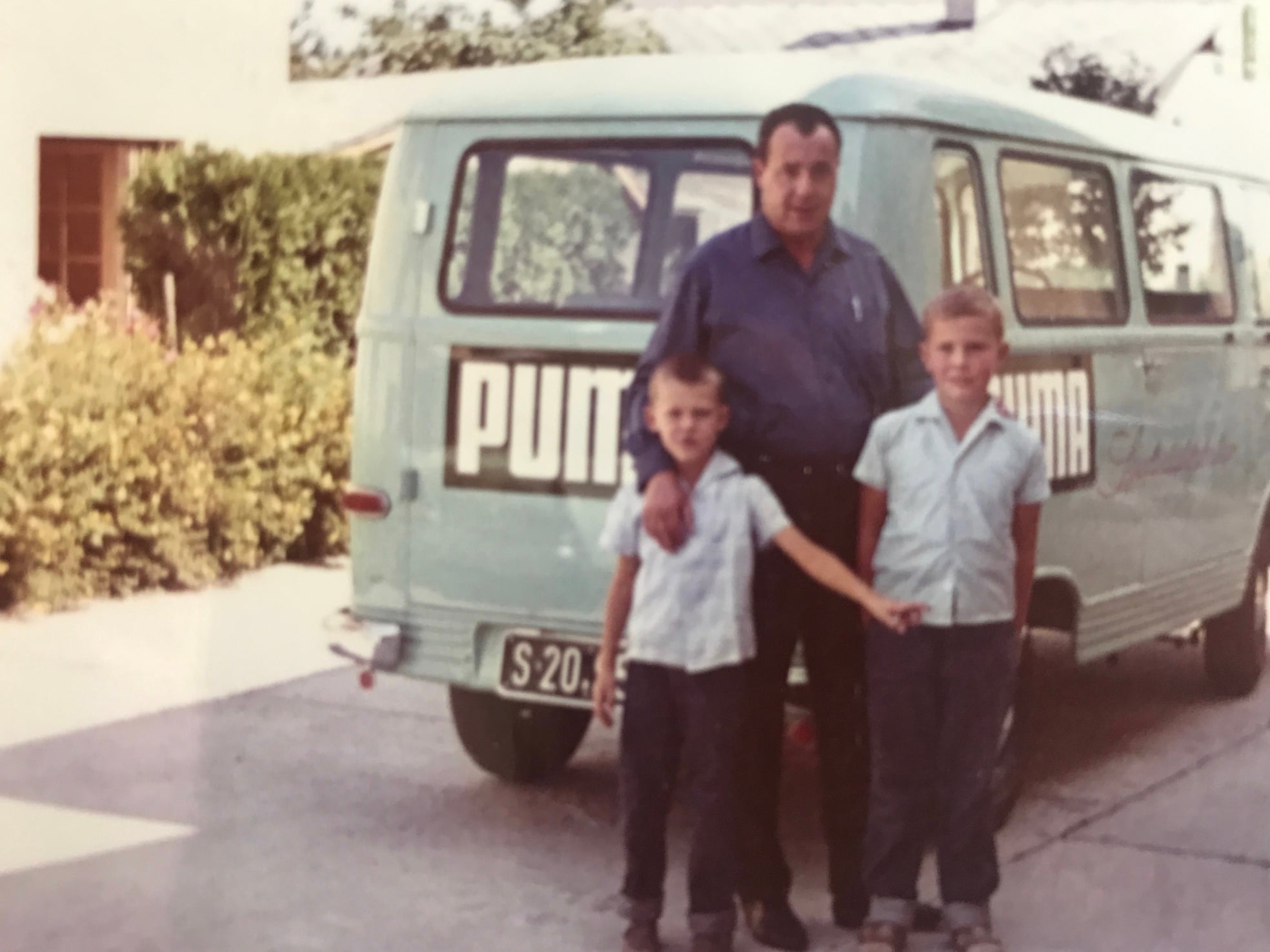
The town of Herzogenaurach sits about twenty kilometres northwest of Nuremberg, in the German state of Bavaria. It has a population today of around twenty-four thousand people. It has a river running through the middle of it called the Aurach, which gave the town its name. And for most of the second half of the twentieth century, it was one of the strangest small towns in Europe, because the two families who ran the two largest employers in it, Adidas and Puma, had been feuding since 1948, and the residents of the town, who worked for one company or the other, had organised their entire social lives around whichever side of the split their families had ended up on. Which bakery you bought bread at, which barber cut your hair, which school your children attended, which pub you drank in, and which football club you supported, all followed the same underlying logic. You were on the Adidas side of the river, or you were on the Puma side. There was no third option.
Locals called it “der Ort der gebeugten Nacken,” or the town of bent necks, because the first thing anyone did when meeting a stranger was look down at their shoes to work out which side they were on. The habit was so ingrained that it survived the deaths of the two brothers behind the split, who died four years apart in the 1970s and were, at their own separate requests, buried at opposite ends of the Herzogenaurach cemetery so that even in death they wouldn’t have to lie near each other. The feud, on the accumulated documentary record, was one of the more consequential family quarrels in the entire history of European business.
Two brothers who spent twenty years building something together
Rudolf Dassler was born in Herzogenaurach in March 1898, and his younger brother Adolf, who everyone called Adi, was born there in November 1900. They both fought in the First World War as young men, and both returned home in 1919 to a Bavaria that had been economically hollowed out by four years of continental warfare. Adi, the younger and quieter of the two, had trained as a cobbler before the war. He began making sports shoes in the wash-house of his mother’s small laundry business shortly after coming home. The shoes were good, the local demand grew, and by 1924, Adi’s older brother Rudi had joined the operation. That year, the two of them formally registered a partnership under the name Gebrüder Dassler Schuhfabrik, which translates as the Dassler Brothers Shoe Factory. They worked together for the next twenty-four years.
According to the detailed history published by Amusing Planet in September 2023, drawing on the Adi and Käthe Dassler Memorial Foundation’s official Chronicle and Biography of the Dassler brothers, together with reporting from Deutsche Welle and the Hindustan Times, the two brothers complemented each other well through the interwar period. Adi was the technical mind, meaning he designed the shoes, tested new materials, and pushed the athletic performance side of the operation. Rudi was the outgoing extrovert, meaning he handled sales, worked the customer relationships, and represented the company at trade shows and sporting events. Under their combined direction, the Dassler Brothers Shoe Factory grew steadily through the 1920s and into the 1930s, and by the middle of the decade had become the leading athletic shoe supplier in Germany.
Their most celebrated moment came in 1936, at the Berlin Olympic Games. The Games had been organised as a Nazi propaganda showcase, and the Dasslers, who had both joined the Nazi party in 1933 for what the family later insisted were purely commercial reasons, had secured contracts to supply footwear to a number of the German competing athletes. But the moment that made the company internationally famous involved an American athlete rather than a German one. Jesse Owens, the African-American sprinter from Ohio who won four gold medals in Berlin, ran in Dassler shoes. The endorsement, which Adi had personally travelled to the Olympic village to secure, was completed in defiance of the ideological framework of the Games and turned the Dassler brand into a globally recognised name in athletics almost overnight.
What actually broke them apart
Then the war came. Rudi was drafted into the Wehrmacht and shipped to the Eastern Front. Adi, on the direct intervention of the German athletic authorities, was designated essential to the war economy and was left in Herzogenaurach to run the factory, which had been partially converted to weapons production for the German military. When the war ended, Rudi came home to find that Adi had spent the previous four years alone at the head of the company, that Adi’s wife Käthe had taken on a substantial role in the business, and that the relationships between the two brothers, their wives, and their children, all of whom were still living in the same villa on Würzburger Street, had become impossible.
According to the Wikipedia summary of the Dassler brothers feud, drawing on multiple sources including the Barbara Smit book “Sneaker Wars: The Enemy Brothers Who Founded Adidas and Puma and the Family Feud That Forever Changed the Business of Sport,” published by HarperCollins in 2008, two specific incidents pushed the brothers past the point of reconciliation. The first was an incident during an Allied air raid on Herzogenaurach in 1943, when Adi and Käthe entered a bomb shelter Rudi and his wife Friedl were already in, and Adi reportedly muttered something that Rudi interpreted as an insult to himself and his wife rather than a comment about the bombers overhead. The second was the postwar denazification process. Rudi came to believe, on his own subsequent account, that Adi had denounced him to the American occupying authorities as a Nazi party member in order to have him arrested and removed from the company. Whether that was true or not, and the historical record is genuinely unclear on the point, Rudi believed it. And in 1948, the brothers dissolved the Dassler Brothers Shoe Factory, divided the assets and workforce between them, and never spoke to each other again.
Rudi took the original factory on Würzburger Street, on the southern side of the Aurach River, and about a third of the workforce. He registered a new company in January 1948 under the name Schuhfabrik Rudolf Dassler, then almost immediately renamed it Puma. Adi took the newer factory near the Herzogenaurach train station on the northern side of the river, and about two-thirds of the workforce. In August 1949, he registered his own new company, using a portmanteau of his own first and last names, which is where the name Adidas comes from. The two companies opened for business within a few hundred metres of each other, on opposite banks of the same river, and immediately began competing for the same customers, the same athlete endorsements, and the same distribution channels. Which is roughly what they continued to do for the next seventy-five years.
The residents of Herzogenaurach, roughly half of whom worked for one company and the other half for the other, adapted to the split by refusing to acknowledge the existence of the other side. Employees of Puma didn’t drink at the pubs used by Adidas employees. Adidas workers didn’t buy bread from the bakeries frequented by Puma workers. Marriages across the divide were considered scandals. Children born to families on one side of the line were sent to schools on the same side. Even the two main local football clubs, ASV Herzogenaurach and FC Herzogenaurach, sponsored respectively by Adidas and Puma, kept the rivalry going on the pitch every weekend. The town divided itself in half on the underlying logic of who worked for whom, and stayed that way for approximately fifty years.
Rudi died in October 1974, aged seventy-six. Adi died in September 1978, aged seventy-seven. Neither brother had attended the other’s business dealings, birthday parties, or family events since the 1948 split. Neither had reconciled. And both, according to instructions given to their families before their deaths, were buried at the maximum possible distance from each other within the Herzogenaurach cemetery, which is a small municipal cemetery on the outskirts of the town, about a fifteen-minute walk from either of the factories they had built. The rivalry between the two companies, which by then had become genuinely enormous global businesses, continued through their heirs and successors for another three decades. It wasn’t until 2009 that employees of the two firms played a friendly football match against each other in Herzogenaurach, and the fifty-year silence between the two workforces was finally broken. The Adidas and Puma logos still glint on opposite sides of the Aurach River today. The two men who built them are still buried in the same cemetery, at opposite ends, exactly the distance apart they wanted to be.