

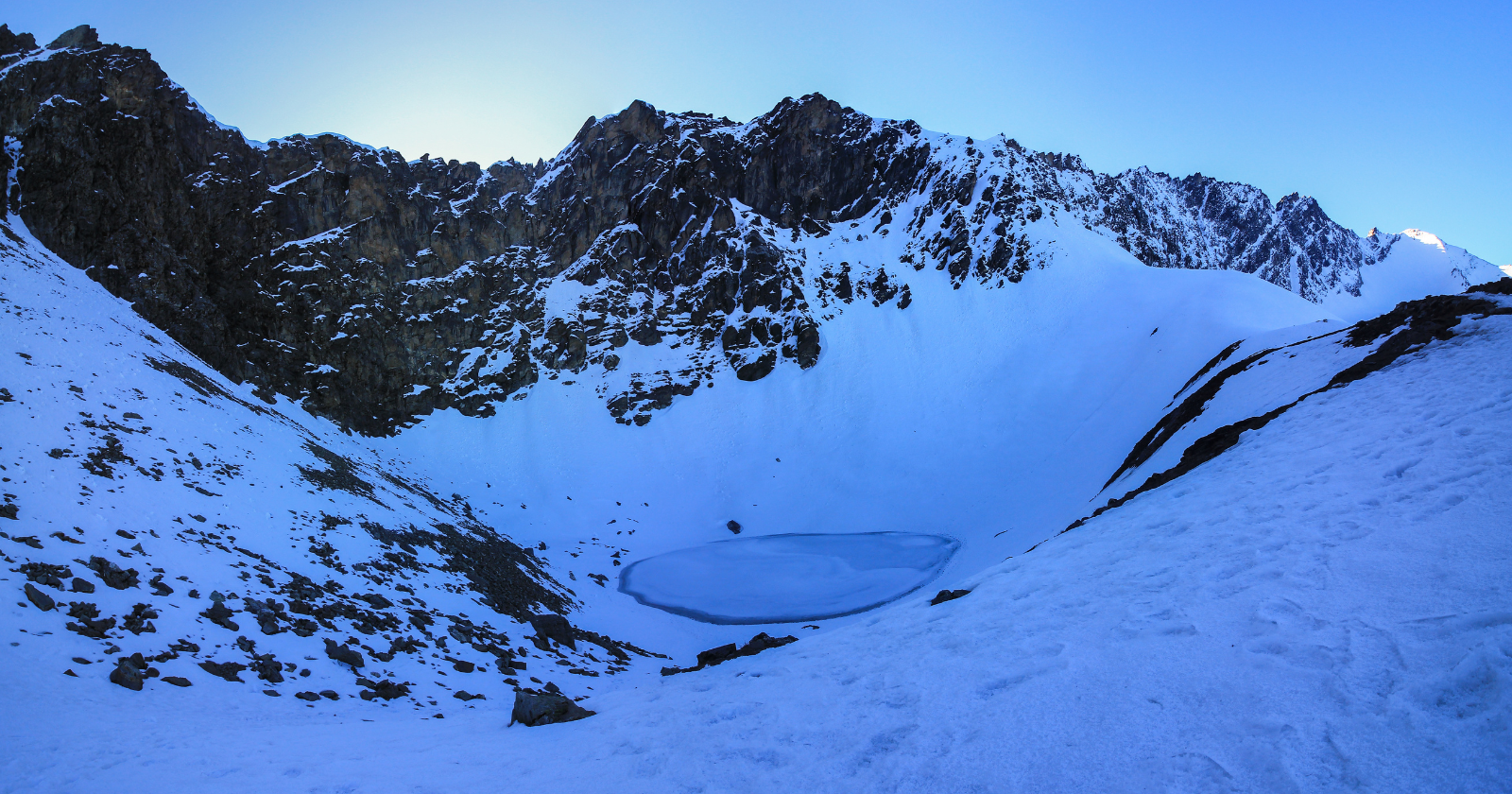
Roopkund Lake sits at 5,029 metres above sea level in the Chamoli District of Uttarakhand, India, between the peaks of Trishul and Nanda Ghunti. The lake is small, rarely more than 40 metres across, only approximately three metres deep, and frozen solid for most of the year. It is surrounded by rock-strewn glaciers and exposed alpine terrain at an altitude where the air contains roughly half the oxygen available at sea level.
In 1942, a forest ranger named Hari Kishan Madhwal, working in the Nanda Devi game reserve under what was then British India, climbed to the lake during a routine survey and saw what he initially took to be animal bones at the water’s edge. The bones were human. They were scattered across the lake margin in substantial numbers, in varying states of preservation. The eventual count, on subsequent surveys, was estimated at several hundred individuals.
Early hypotheses dispersed without surviving contact with the available evidence. The remains were not Japanese soldiers from the Second World War. They were not General Zorawar Singh’s army returning from the 1841 Tibet campaign. They were not victims of any documented epidemic. They were substantially older than any 19th- or 20th-century event could account for. The first systematic anthropological work at the site, conducted by the Anthropological Survey of India in the 1950s, catalogued the skeletons and produced the initial measurements that subsequent studies would build on.
The hailstorm hypothesis
The first attempt at modern scientific dating came in the early 2000s, when an international team that included Subhash Walimbe of the University of Pune, researchers from the Centre for Cellular and Molecular Biology in Hyderabad led by Lalji Singh, and the Radiocarbon Accelerator Unit at the University of Oxford performed preliminary radiocarbon dating and limited mitochondrial DNA analysis on a sample of the Roopkund skeletons. The radiocarbon placed the remains at approximately 850 CE, with a margin of approximately 30 years. The mitochondrial DNA suggested South Asian ancestry.
The findings were popularised through a National Geographic documentary, “Skeleton Lake,” broadcast in 2004 as part of the channel’s “Riddles of the Dead” series. The documentary advanced what would become the standard public explanation. A group of pilgrims travelling through the Himalayas in approximately 800 CE had been caught in a severe hailstorm. Hailstones the size of cricket balls had produced fatal head injuries. Some of the skulls did show blunt-force trauma to the top of the head and not elsewhere, consistent with impacts from above. The Nanda Devi Raj Jat, a religious procession through the area that has been performed every twelve years since at least the medieval period, was identified as a plausible cultural context.
The preliminary work that supported the hypothesis was not published as a standalone peer-reviewed paper. The samples and data eventually fed into a much larger collaborative project, which produced its first comprehensive peer-reviewed publication fifteen years later, with consequences none of the original investigators had anticipated.
The 2019 Nature Communications study
In August 2019, a team led by Éadaoin Harney at Harvard University, with David Reich at Harvard Medical School as senior author, published a paper in Nature Communications reporting a systematic genome-wide ancient DNA analysis of 38 skeletons from Roopkund Lake. The work was the product of a more than decade-long collaboration coordinated through the Max Planck Institute for the Science of Human History in Jena, the Birbal Sahni Institute of Palaeosciences in Lucknow, and the Centre for Cellular and Molecular Biology in Hyderabad.
The 38 individuals did not cluster as a single genetically related group. They fell into three distinct ancestry clusters, with no demonstrated genetic relationship between them.
The first cluster contained 23 individuals whose ancestry fell within the range of variation of present-day South Asians, drawn from a broader cross-section than a single endogamous community. The second cluster contained 14 individuals whose ancestry was typical of the eastern Mediterranean, with closest matches to present-day inhabitants of Crete and other parts of the Aegean. The third cluster contained a single individual whose ancestry was related to Southeast Asian populations.
The radiocarbon dating complicated the picture further. The 23 South Asian individuals dated to approximately 800 CE, but the distribution within the group was not consistent with a single deposition event. They appeared to have died across multiple events spanning at least several decades. The 14 Mediterranean individuals dated to approximately 1800 CE, roughly a thousand years later, and the dating was tight enough to suggest a single event or closely spaced sequence. The single Southeast Asian individual also dated to approximately 1800 CE.
The stable isotope analysis reinforced the multiple-population interpretation. The 23 South Asian individuals showed dietary signatures consistent with South Asian agriculture and pastoralism. The 14 Mediterranean individuals showed signatures consistent with diets containing significant marine and Mediterranean components, with no evidence they had been living in South Asia long enough for their isotopic signatures to shift toward local food sources.
The hailstorm story, revised
The 9th-century hailstorm hypothesis cannot be entirely discarded. The 23 South Asian individuals do date to approximately the right period. Some did die with apparent impact trauma to the skull. The Nanda Devi Raj Jat pilgrimage provides a plausible cultural context. The explanation, narrowed to apply only to part of the 9th-century cluster, remains consistent with the available evidence.
What the Harney team showed is that this explanation could only ever have covered part of what was happening at Roopkund Lake. The 14 Mediterranean individuals who died around 1800 CE are entirely outside its scope. They were not Indian pilgrims. They did not die in the 9th century. They came from approximately 6,000 kilometres away and arrived in the Himalayas roughly a thousand years after the events the original hypothesis was designed to explain.
The Roopkund site is not, on the strongest current reading of the evidence, the scene of a single ancient tragedy. It is the scene of at least two genuinely distinct mortality events, separated by approximately one thousand years, involving populations that had no documented connection to each other.
What might have happened in 1800 CE
The peer-reviewed evidence does not yet identify what brought the 14 Mediterranean individuals to Roopkund Lake or how they died there. The Harney team and subsequent commentators have proposed several hypotheses, none confirmed. The first is an unrecorded European expedition to the Himalayas connected to British colonial activity, possibly hiring eastern Mediterranean guides, soldiers, or labourers through existing maritime networks. The available historical records do not contain any documented expedition that matches the genetic profile. The second is a group of pilgrims or religious travellers from a Mediterranean Christian community on an unrecorded journey, although the Harney team noted that a Hindu pilgrimage seems an unlikely cultural context. The third is a separate weather event, possibly another hailstorm or a high-altitude blizzard. The Harney team’s own assessment was that the Mediterranean cluster represents one of the more unusual findings in recent ancient DNA work, and that further archival research would be needed to identify what had actually happened. No further peer-reviewed ancient DNA study of Roopkund Lake has been published since 2019.
The honest limitations
The 38 skeletons analysed represent a small fraction of the several hundred individuals at the site. Additional sampling could reveal further populations or different temporal patterns. The site itself has been substantially disturbed over the past eighty years by visitors, rockslides, snow melt, and deliberate removal of artefacts. The contextual archaeological evidence that would normally accompany burial sites of this kind has been largely destroyed. The 1800 CE Mediterranean cluster is the most striking finding of the 2019 study, but the available genetic and dietary evidence cannot, on its own, determine why these individuals were in the Himalayas.
What it means
The standard hailstorm explanation for the site is, on the strongest current reading of the peer-reviewed evidence, only partial. The popular framing of Roopkund Lake as the scene of one ancient disaster does not match the available evidence.
The Mediterranean ancestry finding is, on the available data, genuinely unexplained. Fourteen people whose closest modern genetic relatives are inhabitants of Crete and other parts of the Aegean died at 5,029 metres in the Indian Himalayas approximately 220 years ago, without leaving any documented historical trace of how they got there.
Ancient DNA analysis is now sufficiently developed that long-standing archaeological mysteries can be productively reinvestigated even at sites that have been substantially disturbed. The Harney team’s analysis of 38 skeletons from a high-altitude lake that has been frozen, thawed, rockslid, and trekked across for more than two centuries produced statistically robust results that resolved questions which the previous half-century of conventional archaeology had been unable to answer.
Several hundred people died at Roopkund Lake across approximately one thousand years of human history, in events that came from at least three different parts of the world.
The skeletons are still at the lake.
The questions that have not yet been answered about them are still on the table.