
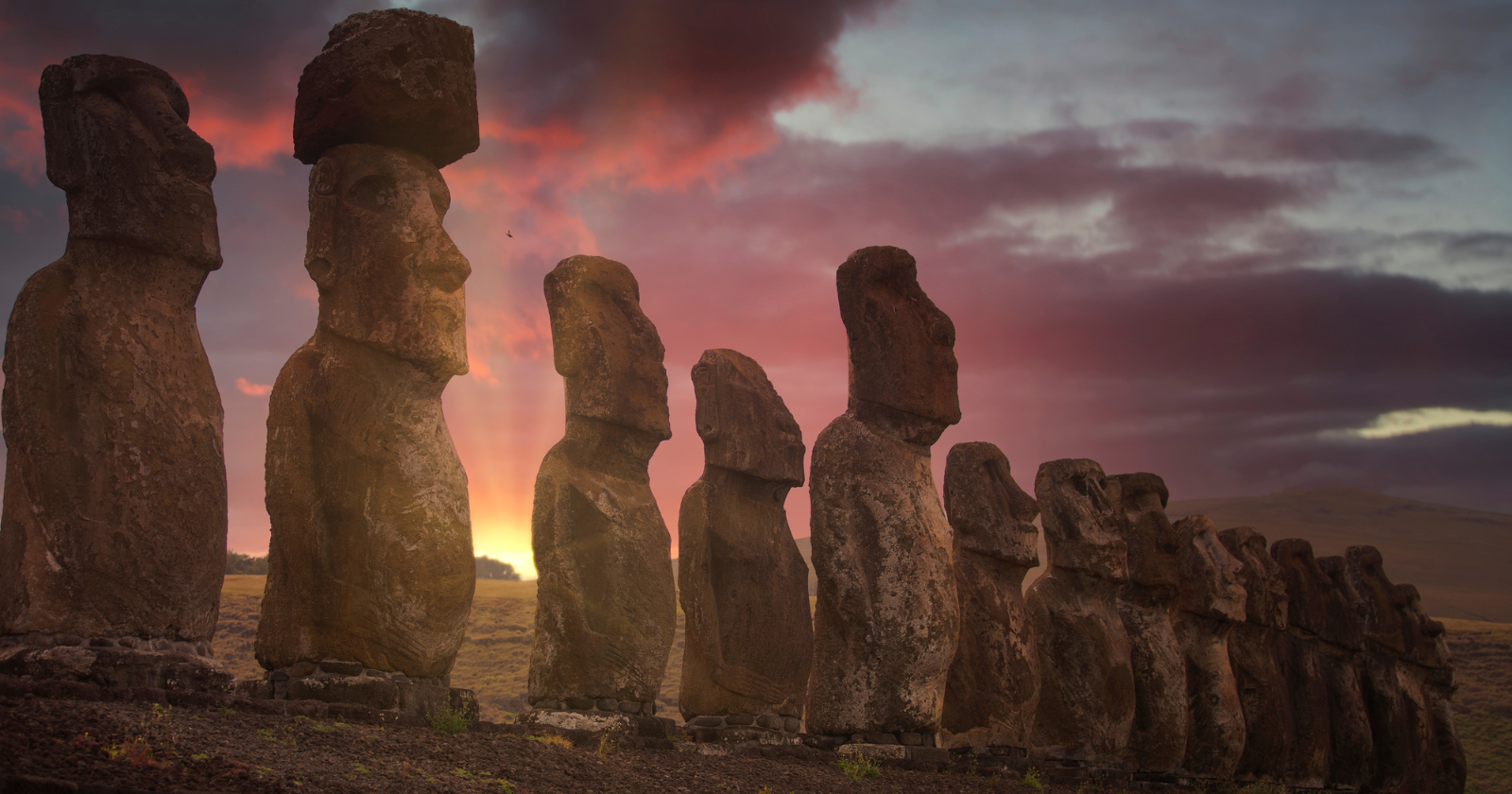
When the first European ship arrived at Easter Island in 1722, the Dutch sailors aboard found something they could not explain. Lining the coast of one of the most remote inhabited places on Earth, a tiny volcanic island approximately 3,700 kilometres from the nearest continent, were hundreds of giant stone statues. Some of them stood ten metres tall. Some of them weighed more than eighty tonnes. There appeared to be no equipment on the island capable of moving them, no trees large enough to provide the timber the Europeans assumed must have been used, and almost no one left who could explain how any of it had been done.
The mystery occupied European observers for the next three hundred years. The statues, called moai by the islanders, had been carved from the soft volcanic rock of a single quarry on the island’s eastern edge. There were nearly nine hundred of them. The largest weighed as much as a fully loaded transport aircraft. They stood, by the time of European arrival, on stone platforms around the coast, with their backs to the sea.
The question of how they had been moved became one of the most contested puzzles in archaeology. The question of why the trees had disappeared became one of the most cited cautionary tales in environmental writing. The two questions, on the dominant theory that emerged in the second half of the twentieth century, were the same question.
The dominant theory turned out, on the available peer-reviewed evidence, to be wrong.
The people who built them
The Rapanui people arrived at the island around 1200 CE. They were Polynesian navigators who had crossed thousands of kilometres of open ocean using only the stars, the currents, and the flight paths of seabirds. When they reached the island, it was covered in dense palm forest. The surrounding ocean was full of fish. There was nowhere further to go. Their arrival completed a maritime expansion that had taken modern humans out of Africa, across Asia, into the Pacific, and finally to the last uninhabited landmass on Earth.
Within a few generations, the Rapanui had built one of the most distinctive visual cultures in human history. The moai project began approximately a hundred years after settlement and continued for at least four centuries. Teams worked for over a year, in some cases, to carve a single figure. The completed statues were moved from the quarry across the island to stone platforms on the coast, where they were erected facing inland, watching over the living rather than out to sea.
The question that obsessed every European visitor was straightforward. How did a small island population, equipped with stone tools, no draft animals, and the technological resources of a Polynesian seafaring culture, move objects of that scale across kilometres of variable terrain and stand them upright at their destinations?
The log hypothesis and its problems
For most of the twentieth century, the dominant scientific theory was that the Rapanui had felled the island’s palm forest to use the trunks as rollers. The statues, on this account, were laid horizontally on wooden sleds, dragged across the island over rolling logs, and erected at their destinations using ramps and counterweights. The theory had the virtue of being mechanically plausible. It also had the convenient side effect of explaining the island’s deforestation, which the Europeans found and which was difficult to account for otherwise.
The combined story became one of the most famous parables in modern environmental writing. A small island civilisation, obsessed with its monumental architecture, cut down every tree it possessed in order to move its statues, collapsed into famine and warfare when the resources ran out, and toppled its own monuments in despair. Jared Diamond’s 2005 book Collapse popularised the framing for a global audience. The Rapanui became, in the public imagination, a warning to a world heading toward similar mismanagement of its own finite resources.
There was always one detail in this narrative that did not fit. When researchers asked the contemporary descendants of the original Rapanui how their ancestors had actually moved the statues, the answer was always the same. The descendants did not describe logs or sleds or horizontal dragging. They said the statues walked.
The Rapanui explanation
The walking-statue account had been passed down through generations of Rapanui families. The statues, on this telling, had been moved upright, by rocking them from side to side in a slow zigzag motion, guided by ropes pulled from the front and steadied from the back. Small groups of people had moved enormous figures across the island this way, slowly, by exploiting the statues’ own design rather than fighting against it.
European researchers had, for most of the past century, treated this account as folklore. The statues are massive, top-heavy, and apparently fragile. The idea that pre-industrial Polynesians could have walked them across rough volcanic terrain seemed, on the standard physical intuitions, implausible. The Rapanui descendants kept saying the same thing, and the scientific community kept declining to take them seriously.
The pattern continued until two archaeologists, looking at the statues abandoned along the island’s ancient transport roads, noticed something that no previous researcher had explained.
The road statues
Approximately one hundred moai had never reached their destinations. They lay along the routes between the quarry and the coast, in various states of breakage and abandonment, as if dropped in transit. Carl Lipo, an anthropologist at Binghamton University, and Terry Hunt, at the University of Arizona, began documenting their distribution in the early 2010s. They noticed, among the abandoned statues, two patterns that the log-rolling theory could not account for.
The first was directional. Statues abandoned on uphill sections of road had fallen backwards. Statues abandoned on downhill sections had fallen forwards. The pattern was systematic and consistent across the island. No log-rolling transport method produced that distribution of breakage. A statue being dragged on a horizontal sled, whether uphill or downhill, would not fall in opposite directions depending on the gradient. A statue being moved upright, rocked from side to side and balanced on a forward-leaning base, would. Specifically, a statue overbalanced on an uphill slope would tip backwards. A statue overbalanced on a downhill slope would tip forwards. The pattern in the field exactly matched the prediction of the walking hypothesis.
The second was structural. The statues found along the transport roads were not the same shape as the statues that had reached their destinations. The road statues had wider, D-shaped bases. They leaned forward by six to fifteen degrees. They had lower centres of mass than the finished statues on the coastal platforms. Each of these features made the road statues inherently unstable when standing still, which would have been a disastrous design for a statue meant to be placed permanently on a platform. The same features made the road statues ideal for being walked. The forward lean turned every step into a controlled fall. The wide D-shaped base allowed the statue to be rocked from corner to corner without tipping over.
The road statues, on the Lipo and Hunt analysis, were not failed final products. They were transport-stage statues, deliberately shaped for vertical movement, that had been intended to be re-carved into their final platform-ready forms at their destinations. The ones found along the roads had not been abandoned for lack of resources or social collapse. They had been abandoned because they had broken in transit, which is what happens when you are walking eighty-tonne stone figures across kilometres of rough volcanic terrain.
The 2025 confirmation
In October 2025, Lipo and Hunt published a paper in the Journal of Archaeological Science titled “The walking moai hypothesis: Archaeological evidence, experimental validation, and response to critics,” which presented the systematic case for the walking interpretation. The paper drew on a statistical analysis of 962 moai, with detailed examination of 62 road statues, combined with 3D modelling of the statues’ centres of mass, and field experiments using an accurately scaled replica.
The replica weighed 4.35 metric tonnes. It was shaped according to the specifications of the road statues, with the wide D-shaped base and the forward lean. The team rigged it with ropes pulled by hand. A working group of eighteen people moved the replica one hundred metres in forty minutes, using the rocking, zigzag motion that the Rapanui descendants had been describing for three hundred years. The technique worked. The physics, on the experimental data, matched what the descendants had said. The statues had walked.
The Lipo and Hunt analysis also identified a feature of the abandoned road statues that strengthened the case substantially. The distribution of their breakage points along the transport routes followed an exponential decay pattern, with 51.6 per cent of the abandoned statues concentrated within two kilometres of the Rano Raraku quarry. The decay pattern is the exact statistical signature that mechanical failure during transport would produce. It is not the signature that random abandonment, ceremonial placement, or social collapse would produce. The road statues were not abandoned for cultural reasons. They were dropped because the people walking them ran out of luck.
What this means for the larger story
The confirmation of the walking hypothesis has implications that extend well beyond the question of how the statues were moved.
The standard ecocide narrative of Easter Island, in which the Rapanui cut down their forest to move their statues and consequently destroyed their own civilisation, rests on the assumption that statue transport required massive timber consumption. On the Lipo and Hunt evidence, it did not. A statue could be walked across the island using ropes and eighteen people. Whatever happened to the palm forest of Easter Island, on the strongest current peer-reviewed reading of the evidence, was not driven by the obsession with moving the statues. The dominant theory built around that obsession, the resource depletion, the famine, the ecological suicide, starts to unravel from the inside.
The Rapanui descendants had, in fact, been telling the truth all along. The statues walked. The forest disappeared for reasons that had little to do with them.
What actually happened to the trees, what actually happened to the people of Easter Island, and what role disease and external violence played in the eventual collapse of the Rapanui population are questions with answers that have also been substantially rewritten by recent peer-reviewed evidence, including a major 2024 ancient DNA study in Nature that found no genetic signature of any population crash before the 1860s. The full story, on the current state of the science, is significantly different from the parable that most people learned in school.
We came across a video that covers this story in detail – click here to watch it.