
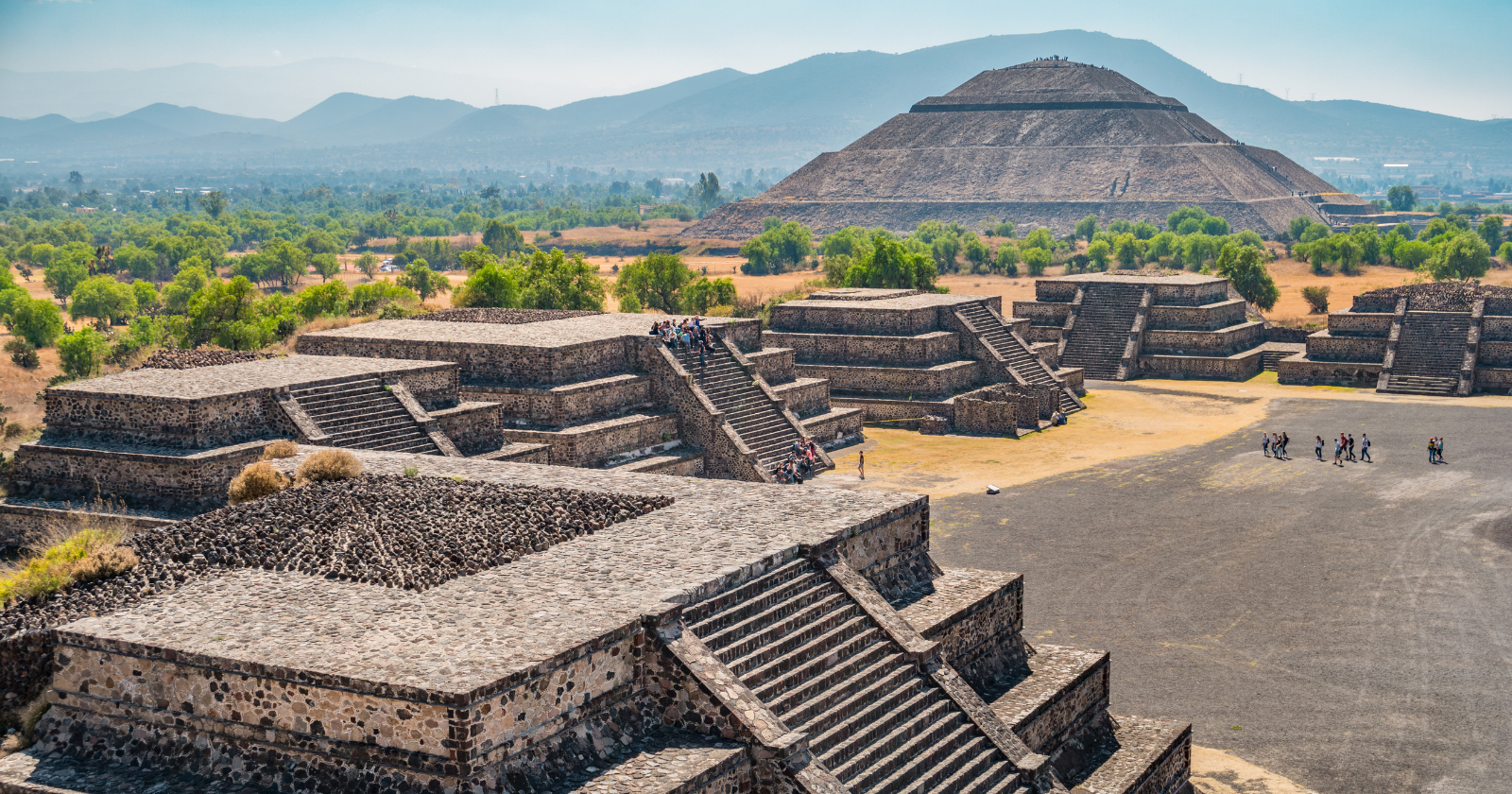
The Valley of Mexico sits at an altitude of approximately 2,240 metres in a basin that, in the early fourteenth century, was largely covered by an interconnected system of shallow freshwater lakes. The Aztecs arrived in the basin as outsiders. Every fertile shoreline was already claimed by older settled peoples. What the Aztecs had available to them was lake water and lake bed.
They built land.
Starting in the early fourteenth century, and continuing for the next two hundred years, Aztec farmers drove wooden stakes into the shallow lake beds around the southern shore of Lake Xochimilco. They wove reed fences between the stakes. They filled the enclosures with lake mud, decomposed organic matter, and vegetation dredged from the lake floor. They planted willow trees at the corners. The willows’ dense root systems anchored the structure and prevented the artificial island from eroding back into the water. Between each island, a canal ran just wide enough for a canoe.
They did this approximately twenty thousand times. The resulting agricultural system covered, at its peak, around 9,000 hectares of what had previously been open water. The uniformity of the plot sizes and orientations, confirmed by twentieth-century aerial surveys, indicates state-level planning and coordinated labour rather than ad-hoc family construction. The Aztec capital of Tenochtitlan, built on a larger island in the centre of the lake system, reached a population of approximately 200,000 people at its peak. The chinampa system, as the floating-garden agriculture is called in Nahuatl, provided the food.
A 2020 peer-reviewed analysis by Roland Ebel at Montana State University, published in HortTechnology, set out what the system was capable of. Through complex polyculture rotations of maize, beans, squash, tomatoes, chillies, amaranth, and ornamental flowers on the same plots year after year, chinampas could produce up to seven harvests in a single year without depleting the soil. The figure is, by some measures, the highest sustained productivity per unit area of any agricultural system ever documented anywhere on the planet.
The endangered animal that lives only in the canals of this surviving fragment of the Aztec system is one of the most scientifically significant amphibians on the planet, can regenerate parts of its own brain, and exists in numbers so small that a four-month search in 2013 found none of them at all. A short video we came across walks through what the survival of the chinampas has to do with the survival of this creature, and what the farmers still working the plots have been doing to keep both of them alive.
How the system worked
The mechanism that allowed chinampas to be cultivated continuously without external inputs is not, in retrospect, mysterious. It is a closed-loop nutrient cycle that the Aztec farmers built into the geometry of the landscape.
The canals between the plots served as a permanent irrigation system. The roots of the planted crops drew water upward through the soil by capillary action, independent of rainfall, because the water table was effectively at the surface of the lake. The same canals collected, on their floors, organic sediment from the decomposition of aquatic vegetation, fish, and human waste returning to the water from the city. Farmers dredged this nutrient-rich sediment from the canal floor periodically and layered it back onto the plot surfaces. The fertility of the soil was, in this way, self-renewing. The system did not require synthetic fertiliser because the canal sediment was the fertiliser, and the fertiliser regenerated itself continuously from the biological activity of the lake.
The canals also produced a microclimate that protected the crops. Water stores heat more efficiently than soil. The standing water in the canals absorbed solar energy during the day and released it slowly overnight, raising the local air temperature around the plots by a measurable amount and protecting the crops from the occasional frost that the Valley of Mexico’s altitude could produce. The Aztec farmers had, in effect, built passive thermal regulation into the agricultural landscape three centuries before the European thermometer was invented.
The willow trees at the corners of each plot did more than anchor the soil. The trees provided dappled shade, attracted pollinators, returned organic matter to the system through their fallen leaves, and produced wood that the farmers used for the construction of new plots. Nothing in the system left the system. The plots fed the city, the city’s waste returned to the canals, the canals fed the plots.
The 1519 arrival, and the slow erasure
The Spanish conquistador Hernán Cortés arrived at the Valley of Mexico in November 1519. He recognised, within weeks, that the chinampa system was the engine of Aztec civilisation. The siege of Tenochtitlan that ended on 13 August 1521 destroyed the Aztec capital itself. The destruction of the agricultural system that had supported it, however, was not an event but a process that played out over the following four centuries.
The lakes were progressively drained, beginning under Spanish colonial administration in the seventeenth century and continuing through the nineteenth and twentieth centuries under successive Mexican governments concerned about flooding in the growing urban capital. Lake Texcoco, the largest of the lake system, is now almost entirely dry. Lake Xaltocan is gone. Lake Chalco was drained in the 1890s and then partially recovered. Only the southern fringe of the original wetland survives, in the district of Xochimilco and four smaller adjacent areas, as a remnant of what was once a fully aquatic agricultural region.
Mexico City, built on the drained sediment of the buried lakes, is currently sinking. Some districts in the eastern parts of the metropolitan area are subsiding by up to fifty centimetres per year as the lake-bed clays compress under the weight of the city above. The city’s drainage and water-supply infrastructure has been repeatedly rebuilt to compensate. The deeper structural problem is that the foundation the city sits on is not solid ground; it is the sediment of the lake the city’s predecessors drained to make room for itself.
The 1987 designation, and what survived
UNESCO designated the historic centre of Mexico City and the canals and chinampas of Xochimilco as a World Heritage Site in 1987, recognising the surviving agricultural area as a continuous link to the pre-Hispanic landscape and the only remaining functional example of the lake-bed agricultural system that had once covered the basin. The designation did not, in itself, halt the decline.
The 2018 census conducted by the United Nations Food and Agriculture Organization, working with Mexican agricultural authorities, counted approximately 20,922 individual chinampa plots surviving across Xochimilco and four smaller chinampa-bearing districts in southern Mexico City. Of those plots, only 17 per cent were still being actively cultivated. The remaining 83 per cent had been abandoned, converted to recreational use, paved over, or left to fall into the canals. The same census led to the FAO’s designation of the chinampa system as a Globally Important Agricultural Heritage System in 2018, formal recognition arriving roughly seven hundred years after the Aztecs first built it.
The chinamperos, the people who still work the surviving plots, are by most accounts an ageing population. The knowledge of how to construct, maintain, and rotate a working chinampa is transmitted orally from one generation to the next, with no formal training programme and no comprehensive written manual. When a chinampero who has worked a plot for forty years stops working it, the knowledge of how that specific plot’s soil and water cycle behaves is at risk of disappearing with him.
The current restoration
Since the early 2010s, the Ecological Restoration Laboratory at the Institute of Biology of the National Autonomous University of Mexico, led by Luis Zambrano González, has been running a long-term programme to restore the working chinampas of Xochimilco. The programme has three main components. The first is an intensive fishing programme to remove invasive carp and tilapia from the canals, both of which were introduced in the twentieth century and both of which destroy the water quality the system depends on. The second is the installation of water filtration and the rehabilitation of secondary canals to restore the slow-moving freshwater environment the chinampas require. The third is direct collaboration with the remaining chinamperos to revive the traditional cultivation practices and to train younger farmers in the techniques their grandparents knew.
The programme has, in the past decade, brought several chinampa plots back into full production. Restaurants in central Mexico City have begun sourcing produce directly from the restored plots. The Mexican government has set a goal, in coordination with UNAM and international conservation partners, of restoring approximately 60 per cent of Xochimilco’s chinampas to working agricultural use over the next ten to fifteen years.
The restoration is slow, expensive, and dependent on the patience of farmers and scientists working in close coordination with each other. It is also, by every available measure, working. The plots being farmed are producing food. The knowledge that was at risk of being lost is being recorded and transmitted to younger chinamperos. The water quality in the restored canals has measurably improved. The endangered axolotl salamander that lives only in these waters, whose population had collapsed to fewer than 35 individuals per square kilometre by 2014, has begun to be observed in small numbers in the restored areas.
Mexico City is a metropolis of approximately 22 million people, with chronic food insecurity in its outer districts and an agricultural land base that has been progressively degraded by a century of conventional industrial farming on the country’s former lake beds. The Aztec system that fed the pre-Columbian city, on the small fraction of its original footprint that still exists, is now producing food again on plots that have been in continuous cultivation for seven centuries.
What the Aztecs built in the fourteenth century, what the Spanish conquest set about dismantling in the sixteenth, and what the modern Mexican city has been gradually losing for five hundred years, is being recovered in small visible pieces by people whose ancestors were the original builders. The pace is slow. The footprint is small. The methods are unchanged.
The system itself, on the evidence of the seven harvests now being produced again in the restored plots, still works.
