
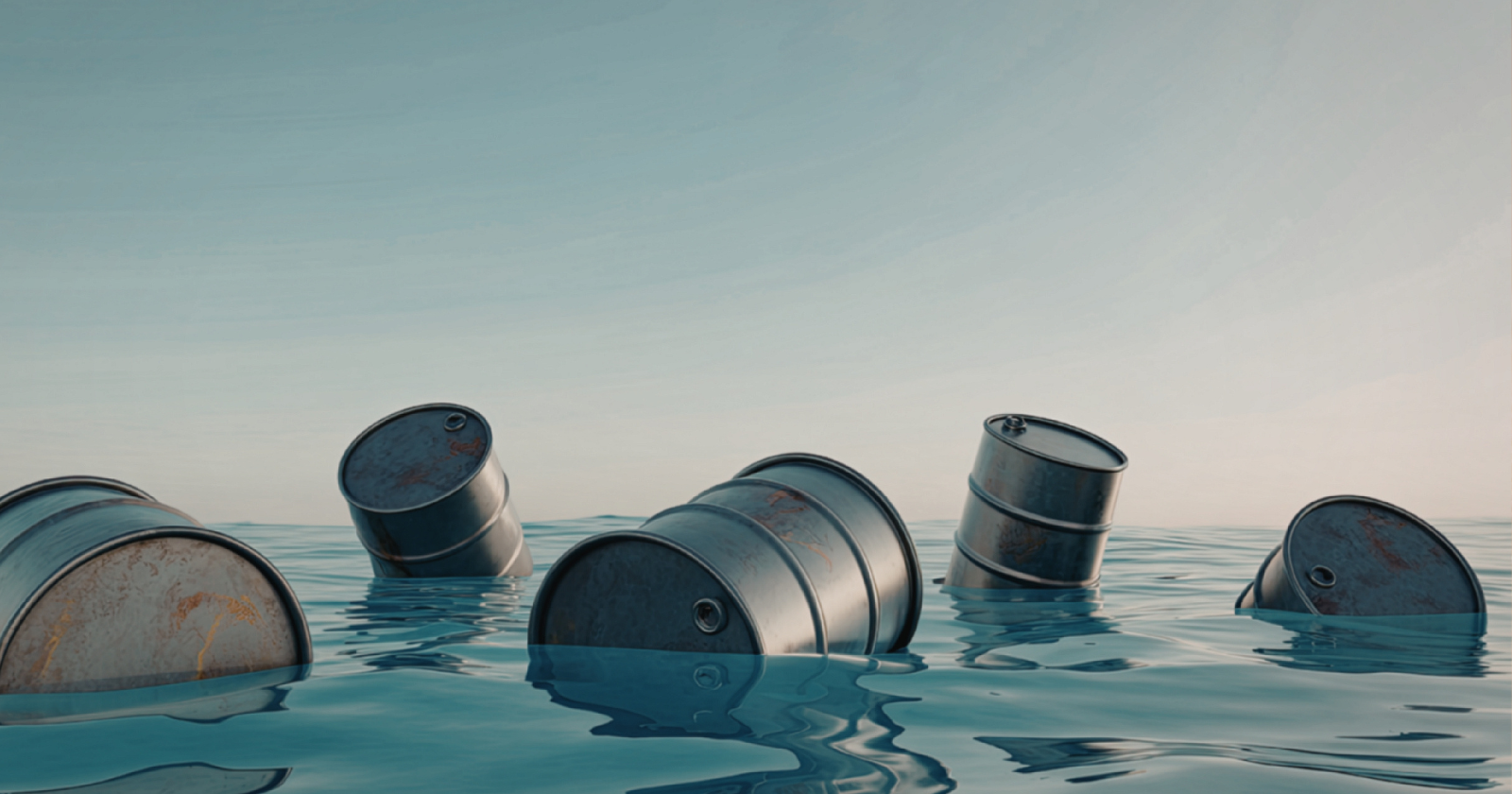
The practice was legal, coordinated, and internationally sanctioned throughout the period it was in operation. Over roughly four decades from the late 1940s to 1982, a number of European countries, including the United Kingdom, France, Belgium, the Netherlands, Sweden, Switzerland, and Germany, deliberately transported low- and intermediate-level radioactive waste to designated dump sites in the deep ocean and deposited it there in sealed drums. The disposal concept assumed that the containers would retain the waste while short-lived radionuclides decayed, followed by a slow release and dispersal of the remaining material in deep water. It treated the drums as temporary containment, not as vessels that would remain sealed forever.
The assumption is now being tested. Between the summer of 2025 and the summer of 2026, a French-led scientific programme took autonomous submersibles and then a manned submarine down to the drum fields in the abyssal plains west of France, the first close inspection in nearly four decades. The physical condition of the barrels, and what has and has not leaked out of them, is starting to become clearer.
The scale of what was dumped
The institutional record is now maintained by the OSPAR Commission, the treaty body responsible for the protection of the marine environment of the North-East Atlantic. According to OSPAR’s June 2026 briefing on the current NODSSUM research cruise, the majority of the dumping took place at depths of between 3,000 and 5,000 metres in the North-East Atlantic between 1949 and 1982, with the peak activity occurring during the 1970s. The total quantity of material discharged into the region was approximately 150,000 tonnes, carrying a total radioactive activity of 42.4 petabecquerels, the vast majority of it in the form of low-level solid waste sealed inside metal drums.
The specific waste stream was not spent nuclear fuel. It was the ordinary industrial residue of the nuclear age: process sludge from reprocessing plants, contaminated metal parts and tools, ion exchange resins from reactor cooling systems, laboratory glassware and protective clothing, and low-activity liquid waste absorbed into concrete or bitumen and packed into steel drums. The material contained beta-emitting isotopes such as caesium-137, alpha-emitting isotopes including plutonium, and tritium, all in low concentrations relative to reactor fuel but at aggregate quantities that reflected several decades of routine industrial nuclear activity across the continent.
Why it was thought acceptable
The regulatory framework surrounding sea disposal was not casual. The London Convention on the Prevention of Marine Pollution by Dumping of Wastes and Other Matter, adopted in 1972 and entered into force in 1975, was the first international treaty to formally regulate ocean dumping of wastes, and it prohibited the disposal of high-level radioactive waste from the moment it took effect. Low- and intermediate-level waste continued to be permitted under the Convention’s provisions until a voluntary moratorium was negotiated in 1983.
The scientific justification, which OSPAR now states plainly on its own record, was not that the drums would remain intact indefinitely. The disposal concept assumed that the containers would retain their contents for long enough to allow short-lived radionuclides to decay to negligible activity, and that the eventual slow release of the remaining, longer-lived material into the surrounding deep water would be dispersed by ocean currents in volumes sufficient to render it undetectable against the natural background radioactivity of seawater within some reasonable period. On the accumulated evidence of the safety publications from the period, this was a defensible engineering assumption. It was also, explicitly, an assumption that the barrels themselves were a temporary containment, not a permanent one.
Those barrels went down under assumptions about temporary containment and deep-water dispersal. The video below covers the life now documented on the same seafloor — and the industry lining up to strip-mine it for the metals in batteries and phones. Worth a watch:
The 1992 and 1993 bans
The formal end of the practice came in two stages. In September 1992, OSPAR prohibited the dumping of low- and intermediate-level radioactive substances in the North-East Atlantic maritime area, closing the door regionally. Then, in 1993, following Russia’s disclosure under the London Convention’s reporting requirements of the full extent of Soviet-era sea disposal operations, which had included dumping of high-level waste and, in the Arctic, entire nuclear reactor cores from decommissioned submarines, a total global prohibition on all sea disposal of radioactive waste, of any activity level, was adopted by the Contracting Parties. It entered into force on 20 February 1994.
The ban stopped further dumping. It did not, and could not, remove what was already on the seabed. The specific question of what to do with the existing inventory of drums, which by then numbered more than 200,000 in the northeast Atlantic alone, was left open. The prevailing view among the regulatory authorities on the current best interpretation was that recovery would be technically difficult, prohibitively expensive, and likely to cause more environmental disturbance than leaving the drums in place. The drums were, by policy default, allowed to remain where they had been placed.
The current expedition
The scientific programme now going down to inspect the drums is called NODSSUM, for Nuclear Ocean Dump Site Survey Monitoring. According to the French National Centre for Scientific Research’s official press release announcing the first cruise in May 2025, the programme is led by the CNRS in collaboration with the French Research Institute for Exploitation of the Sea, the French Nuclear Safety and Radiation Protection Authority, and international partners including the University of Bergen, Memorial University of Newfoundland, and the Johann Heinrich von Thünen Institute in Germany.
Two cruises have now been completed. The first, between 15 June and 11 July 2025, used the autonomous underwater vehicle UlyX to conduct a high-resolution sonar mapping of the primary dump site on the abyssal plains, approximately 650 kilometres west of the French coast, at depths of between 3,000 and 5,000 metres. The mapping located 3,355 individual containers and collected 5,000 litres of water samples, 345 sediment cores, and 34 fish and crustacean specimens. The second, from 27 May to 28 June 2026, deployed the manned submersible Nautile from the research vessel Pourquoi Pas? for twenty dives to depths below 4,700 metres. This was the first close visual inspection of individual barrels in more than three decades.
What was found
The specific findings, as reported by the mission’s principal investigators Patrick Chardon of Clermont Auvergne University and Javier Escartín of the École Normale Supérieure in Paris, fell into three categories. Several of the barrels were in an advanced state of corrosion, with visible material spilled onto the surrounding sediment. CNRS’s first results, republished by Phys.org, say on-site measurements confirmed radionuclides characteristic of the waste at activity levels higher than expected for the area, while the overall readings remained low enough for samples to be handled without major radiation-protection constraints. Laboratory analyses are needed to identify and quantify the radionuclides more precisely.
Third, and perhaps least anticipated, the drums have not proved to be dead objects on a dead seabed. Anemones, sponges, crabs, and other deep-sea invertebrates were photographed growing on and around the containers. The barrels, having failed to remain sealed, have instead become artificial reefs.
What comes next
The samples collected during the 2026 cruise are now being analysed in laboratories across France, Norway, Canada, and Germany. The specific question being asked, on the current best interpretation of what the surveys have already established, is not whether the drums have leaked, since that is now visually confirmed and was in fact anticipated by the original disposal concept, but at what rate the radionuclides escaping into the sediment are being taken up by the deep-sea food web, and whether that uptake represents a measurable risk to organisms further up the chain, including species that are commercially fished.
The available evidence at this point does not support any strong claim in either direction. The concentrations detected are elevated above background but not by orders of magnitude. The drum field covers approximately 14,500 square kilometres, of which only a small fraction has been surveyed. The natural background against which the leaking material must be measured includes contributions from 20th-century atmospheric weapons testing, from Chernobyl, and from decades of authorised coastal reactor discharges, and separating the drum signal from that background is not trivial.
What the surveys have established is narrower: some inspected drums have deteriorated and released material, while on-site measurements found radionuclides characteristic of the waste at higher-than-expected but still low activity levels. Whether those releases remain within the dispersal margins assumed by the original disposal concept, or exceed them, is what the continuing laboratory analysis is intended to determine.
