
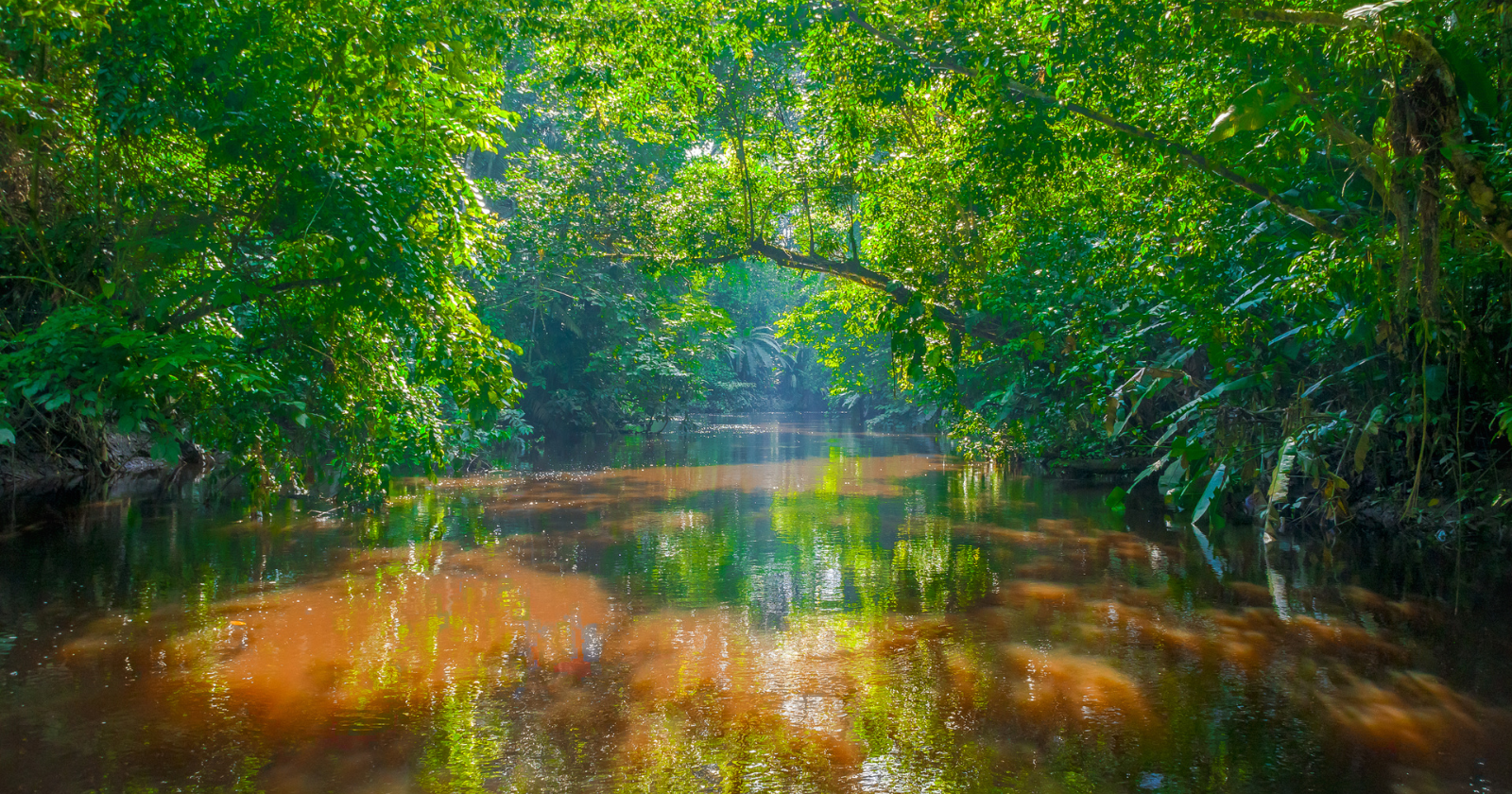
The river runs through the Mayantuyacu region of central Peru, in the Province of Puerto Inca in Huánuco State, on the eastern flank of the Andes where the foothills give way to the Amazon basin. The Asháninka people who have lived along its banks for centuries call it Shanay-timpishka, which translates from their language as “boiled with the heat of the sun.” The river is approximately 9 kilometres long, up to 25 metres wide, and up to 6.1 metres deep at its hottest sections. It is a tributary of the Pachitea River, which itself feeds the Ucayali, which itself feeds the Amazon, which itself empties into the Atlantic Ocean approximately 5,000 kilometres to the east.
The river’s source is marked by a boulder shaped like the head of a snake.
The Asháninka believe the river is the work of Yacumama, the Mother of Waters, a giant serpent spirit who gives birth to hot and cold water from her body. The boulder at the headwaters is, in the local cosmology, Yacumama’s head. The shaman of Mayantuyacu, who has authority over access to the river, has historically permitted only a small number of outsiders to study it.
How hot it actually is
The river’s temperatures have been measured by a small number of scientific expeditions, beginning systematically in 2011. The hottest single temperature recorded in the river is 99.1 degrees Celsius (210.4 degrees Fahrenheit), measured in a hot spring at the river’s hottest pool. The hottest average river temperature recorded along the heated stretch is approximately 95 degrees Celsius. The water cools as it flows downstream, dropping from near-boiling at its hottest pool to ambient Amazon river temperature within a few kilometres of its emergence.
The 4-kilometre heated stretch is consistently hot enough to be lethal to anything that enters it. The geothermal scientist Andrés Ruzo, who has spent more than a decade studying the river, has described what he has personally witnessed happening to animals that fall in. The eyes go first. Eyes, he has noted, cook very quickly, turning a milky-white colour within seconds. The flesh follows. The animal, in the time it takes a human observer to register what is happening, is essentially being cooked alive in the water it has fallen into.
The local people have used the river’s water, harvested from the cooler downstream sections, for cooking, brewing tea, and cleaning, for at least as long as the oral history of the area records. The water itself, despite its temperature, is remarkably safe to drink once cooled. Chemical analysis has shown that the water is, by the standards of Amazon waterways, unusually free of the parasites and pathogens that contaminate most other local water sources. The Asháninka have long understood the river as a place of healing as well as danger.
Why no one believed it existed
The river was, until very recently, considered by the international scientific community to be a legend. Boiling rivers, the standard model held, exist only in association with active volcanoes. The geothermal heat that sustains them comes from magma chambers within a few kilometres of the surface. Yellowstone, Iceland, the geothermal features of New Zealand and Japan and Chile, all sit directly above active volcanic systems. The Peruvian Amazon does not.
The nearest active volcanic centre to Shanay-timpishka is more than 700 kilometres away. The interior of the Amazon basin is, geologically, one of the most tectonically quiet regions on Earth. There is no magma close to the surface. There is no obvious heat source. By every prior model of how geothermal water comes to be at the temperatures Shanay-timpishka achieves, the river should not exist where it does.
Ruzo, who grew up in Peru and trained as a geothermal scientist at Southern Methodist University in Texas, first heard about the river from his grandfather as a child. He spent the next twelve years assuming it was a legend. When he raised the possibility with his PhD colleagues during his work on a thermal map of Peru, the response was unanimous. Boiling rivers exist, his colleagues said, but they are always near volcanoes. There are no volcanoes in the central Peruvian Amazon. Therefore the boiling river does not exist.
It was Ruzo’s aunt, on a family visit to Peru, who corrected him. She had been to the river herself. She had swum in its cooler downstream sections. Her friend was married to the shaman who guarded it. In November 2011, Ruzo travelled to Mayantuyacu with his aunt as a guide, became the first geoscientist granted shamanic permission to study the river, and set out the scientific account that would eventually become his 2014 TED Talk and his 2016 book on the project. Until that point, the river had been known to local people and to a handful of curious travellers, but had not been the subject of any sustained scientific investigation. It had also been doubted by the Peruvian government, by international academic institutions, and by the fossil fuel industry, all of whom had reason to want to know whether the geothermal claim was real but had not committed resources to confirming it.
What is heating the water
The current best understanding of the river’s mechanism, set out in Ruzo’s published and conference work, is that it is heated by a deep hydrothermal circulation system rather than by any local volcanic source. Rainwater falling in the surrounding mountains, including possibly as far away as the Andes, percolates through fault systems into the deep crust. The water descends several kilometres into the bedrock, where the natural geothermal gradient heats it to temperatures approaching the boiling point. The heated water then rises back to the surface through other fault systems in the Mayantuyacu region, emerging at a small number of specific hot springs that feed the river. The heat is therefore not magmatic. It is the ordinary background heat of the Earth’s crust, concentrated by a fault geometry that allows water to descend, heat, and return to the surface in the same location.
The mechanism is not, in itself, unusual. Deep hydrothermal circulation is a well-documented process. What is unusual at Shanay-timpishka is the scale. The volume of water reaching the surface, and the temperature at which it emerges, exceeds anything else documented at a non-volcanic geothermal site on the planet. The river is, by current measurement, the largest documented non-volcanic geothermal feature on Earth.
The full scientific characterisation of the system remains incomplete. Ruzo’s geothermal analysis has been published in conference proceedings, in a 2016 TED Books volume, and in the National Geographic Society’s Young Explorer reports, but the detailed geochemistry and hydrology of the river’s source have not yet appeared in a peer-reviewed scientific journal. The work continues.
What it tells us about everything else
In 2021, a team of biologists from the University of Miami’s Jungle Biology lab, led by the graduate student Riley Fortier and his colleague Alyssa Kullberg, recognised that the Shanay-timpishka river offered something that no laboratory could replicate. The river produces a permanent thermal gradient along its course, with cool forest at one end and forest growing in soils heated by the river at the other. The rainfall, the humidity, the soil chemistry, and the species pool are all approximately the same at every point along the gradient. Only the temperature changes.
The site is, in effect, a natural warming experiment running across a 9-kilometre stretch of Amazon rainforest.
In November 2024, Fortier, Kullberg, Ruzo, and their colleagues published their first major findings in the peer-reviewed journal Global Change Biology. They had measured the canopy and understory temperatures along the river at thirteen monitoring stations over a full year. The annual average air temperature in the coolest forest plots was 24 to 25 degrees Celsius. In the hottest plots near the river, the annual average was 28 to 29 degrees Celsius, with maximum air temperatures approaching 45 degrees Celsius. The hotter plots, the team found, supported approximately 11 per cent fewer tree species per degree of warming. The composition of the surviving species shifted toward heat-tolerant pioneer trees. The forest, in the hottest sections, was visibly simpler, drier, and more sparsely vegetated than the cooler sections only a few hundred metres away.
As Fortier set out in coverage by Mongabay, the implication is direct. The temperature gradient at Shanay-timpishka is approximately what the broader Amazon basin is projected to experience over the next several decades under continued warming. The species lost from the hot end of the gradient are species that, on the published trajectory, may be lost across much wider areas of the Amazon if global temperatures continue to rise. The river that the Asháninka understood as the work of Yacumama, and that the Spanish conquistadors reported as part of the legend they assumed was a fantasy, has turned out to be one of the most useful natural laboratories on the planet for understanding what the tropical rainforests of the next century will look like.
What it means for the river itself
Mayantuyacu and the surrounding region face the same pressures as the rest of the western Amazon. Illegal logging, cattle ranching, road construction, and oil and gas exploration are gradually encroaching on the forest within which the river flows. The Boiling River Project, founded by Ruzo as a conservation nonprofit, has worked since 2016 to advocate for legal protection of the river and its surrounding watershed. The Peruvian government has not yet granted the site formal protected status. The shaman of Mayantuyacu and his successors continue to control direct access to the headwaters.
The river has flowed at its current temperatures for, by the best available estimates, at least several thousand years and possibly far longer. The Asháninka knowledge of the river’s behaviour, recorded in oral tradition rather than scientific literature, contains observations of its seasonal flow rates and temperature variations that the published scientific literature has not yet matched in detail. The local people, in this case, have been the long-term observers of a geothermal system that science is still in the process of catching up with.
What other rivers run hot in other parts of the world’s tropical rainforests, in places that international science has not yet visited and that local people have not yet been asked, is a question the published literature does not address.
