
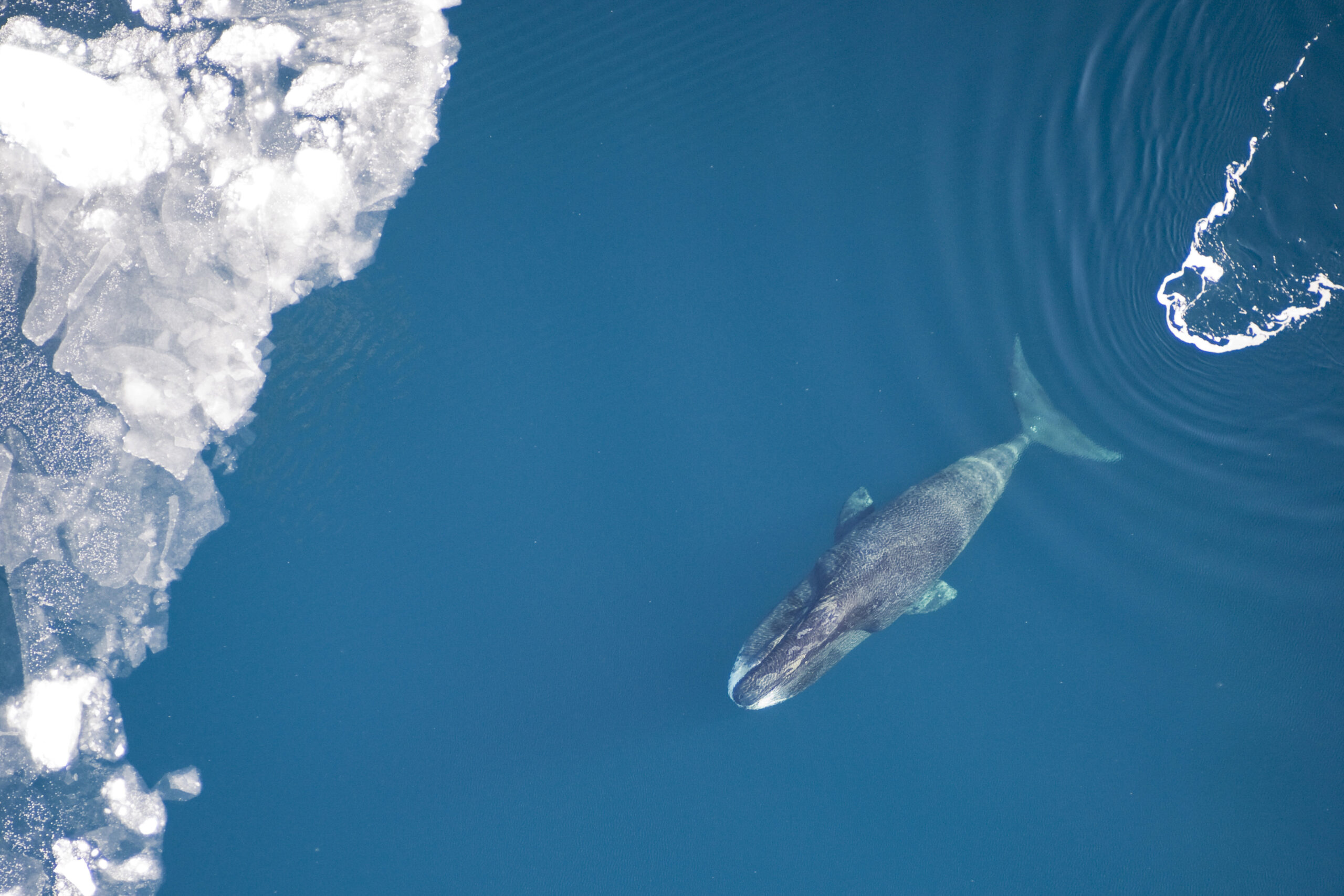
The discovery happened in the routine course of an Iñupiat subsistence hunt off the coast near Utqiaġvik, the northernmost settlement in Alaska. The whale, a 49-foot male, had been killed in May 2007 by hunters working under the quota system administered by the Alaska Eskimo Whaling Commission and the International Whaling Commission. The Iñupiat have hunted bowhead whales for at least two thousand years, and subsistence whaling continues under tightly regulated annual quotas. The whale was being processed for meat and blubber, in the traditional method, on the sea ice near the village.
Craig George, a wildlife biologist with the North Slope Borough Department of Wildlife Management, was on site as part of his long-standing research collaboration with the Iñupiat whaling community. As the hunters carved the carcass with chainsaws, George noticed an unusual fragment of metal lodged in the bone between the whale’s neck and shoulder blade. The fragment was approximately 3.5 inches long, arrow-shaped, and recognisable to George as something other than modern equipment. He sent it to John Bockstoce, an adjunct curator at the New Bedford Whaling Museum and a leading authority on the history of 19th-century Arctic whaling.
Bockstoce identified the fragment as the explosive tip of a bomb lance, a patented Victorian-era whaling weapon manufactured in New Bedford, Massachusetts. The particular design and notch pattern allowed him to date its manufacture to between 1885 and 1895, give or take a few years. The bomb lance had been embedded in the whale’s body for approximately 120 years.
The whale had been alive when Queen Victoria was still on the British throne.
How the whale survived
The bomb lance was designed to detonate after embedding itself in a whale’s body, with the explosion intended to deliver a fatal internal wound. In the case of the 2007 whale, the device had either failed to detonate fully or the explosion had missed the vital organs the design was meant to reach. The fragment had lodged in bone in the shoulder region, which is well outside the heart, lungs, and major blood vessels. The whale’s blubber, which on bowhead whales reaches up to 50 centimetres thick, would have absorbed much of the residual impact. Bowhead whales also have exceptionally efficient wound-healing capabilities, which the genetic literature on the species has since linked to specific molecular adaptations.
The whale survived. It continued to feed, migrate, and presumably reproduce for another 12 decades, carrying the metal fragment as a permanent passenger embedded in its shoulder bone, until it was killed by a modern projectile from the next generation of the same indigenous community that had likely been the original target of the 19th-century hunters.
How the whale’s age was confirmed
The bomb lance fragment was not the only evidence of the whale’s extreme age. Since 1999, a team led by the same Craig George, working with the chemist Jeffrey Bada at the Scripps Institution of Oceanography, has been using a different method to estimate bowhead whale ages, published in the Canadian Journal of Zoology. The method depends on a chemical process called aspartic acid racemization. In humans and other mammals, the aspartic acid in the protein-rich nucleus of the eye lens is laid down in one specific molecular orientation, called the L-isomer, when the lens forms in the developing fetus. From that point onward, the molecules slowly convert to the alternative orientation, called the D-isomer, at a temperature-dependent rate that does not change throughout the animal’s lifetime. By measuring the ratio of D to L in the eye lens of a deceased whale, researchers can estimate how many years have elapsed since the lens first formed.
The George and Bada study applied this method to 48 bowhead whale eye globes collected from subsistence hunts between 1978 and 1997. Of the 48 samples, 42 produced usable age estimates. Most of the whales were in the expected range for marine mammals, between 20 and 60 years. A small number, however, returned ages well above 100 years. One sample produced an estimated age of 211 years, with a standard error of approximately 35 years either way. The figure was extraordinary enough that the researchers checked the calibration repeatedly before publishing.
The 2007 whale’s age, on aspartic acid racemization, was independently estimated at approximately 130 years. The Victorian harpoon embedded in its shoulder, with its independently traceable manufacturing date, confirmed the estimate within the method’s standard error. The convergence of the two independent dating methods is now considered, in the peer-reviewed literature, one of the strongest confirmations of bowhead longevity ever obtained.
What the genome reveals
In 2015, a team led by Michael Keane at the University of Liverpool, working with João Pedro de Magalhães, Craig George, and a consortium of researchers across multiple universities, published the first complete sequencing of the bowhead whale genome in the journal Cell Reports. The team compared the bowhead genome to the genomes of other cetaceans and other mammals to identify the molecular mechanisms that allow the bowhead to live for two centuries while other large whales rarely exceed 100 years.
The findings identified specific genetic adaptations that distinguish the bowhead. The first was in the ERCC1 gene, which encodes a protein involved in DNA repair, particularly the repair of DNA strands damaged by oxidative stress and ultraviolet radiation. The bowhead has a unique variant of ERCC1 not found in any other cetacean, with mutations consistent with enhanced repair capacity. The second adaptation was a duplication of the PCNA gene, which encodes a protein essential for DNA replication and damage repair. The duplication is rare in mammals and is associated, in other species, with reduced rates of cancer. The third adaptation was a set of changes in genes involved in cell-cycle regulation, several of which appear to slow the rate at which cells become cancerous.
The Keane team noted that bowhead whales have approximately a thousand times more cells than humans, which by basic statistical reasoning should make them roughly a thousand times more likely to develop cancer over a given lifespan. They do not. Bowhead whales show very low rates of cancer until extremely advanced age, despite their enormous cell number and their two-century lifespan. The genome data suggests that the bowhead has evolved a suite of molecular cancer-resistance mechanisms that compensate for what should otherwise be a substantial cellular risk.
The findings have implications well beyond bowhead biology. The molecular mechanisms that allow the bowhead to live for 200 years without developing cancer are precisely the mechanisms that human ageing research has been searching for. Several research groups are currently working to characterise the bowhead-specific gene variants in laboratory mouse models, with the aim of identifying whether the same mechanisms could be transferred to other mammalian systems.
What the Iñupiat already knew
One of the more interesting threads in the scientific literature on bowhead longevity is that the peer-reviewed findings have largely confirmed something the Iñupiat had been saying for generations. Iñupiat oral tradition describes bowhead whales as living for “two human lifetimes”, a description that maps directly to the modern peer-reviewed estimate of 150 to 200 years. Iñupiat whalers have for centuries recognised specific individual whales by their scars, behaviour, and markings, and have passed observations of particular whales through multiple generations of the same hunting families. Several of the whales that have produced the oldest scientific age estimates were identifiable to Iñupiat hunters as animals their grandparents had also seen.
The recognition that indigenous ecological knowledge had pre-empted the scientific finding has been increasingly explicit in the peer-reviewed literature. Craig George, who has worked with the Iñupiat whaling community for more than three decades, has been a co-author on most of the bowhead longevity papers and has consistently credited the original observations to Iñupiat hunters. The 2007 harpoon discovery itself was made possible by the close working relationship between George and the hunters who killed the whale.
The honest limitations of the evidence
Several methodological caveats apply to the bowhead longevity literature.
The aspartic acid racemization method has substantial standard errors, particularly for the oldest whales. The 211-year estimate, with its ±35-year standard error, could in principle range from approximately 175 to 245 years. The method is sensitive to the temperature at which the eye lens formed and to the calibration of the underlying chemistry. The original George and Bada 1999 paper acknowledged these uncertainties explicitly. Subsequent refinements, including a 2013 update by Cheryl Rosa and colleagues in Marine Mammal Science, have improved the precision but have not eliminated the underlying limitation.
The peer-reviewed lifespan estimate of “over 200 years” is therefore a strong central tendency rather than an exact figure for any particular whale. What is established beyond reasonable doubt is that bowhead whales routinely live past 100 years and that the oldest individuals in the population probably live to at least 150 years. The exact upper bound is less precisely known.
The 2007 harpoon-and-whale finding is, by contrast, one of the most precisely datable longevity records in the literature on any wild mammal, because the harpoon’s manufacturing date is independently verifiable from historical records.
What it means
Several things follow from the bowhead longevity evidence that are worth saying clearly.
The first is that the longest-lived mammal on Earth is not a primate, a rodent, or a domesticated species. It is a baleen whale that lives almost its entire life under the ice of the Arctic Ocean, in conditions where systematic study is extraordinarily difficult. The discovery of bowhead longevity required the convergence of indigenous ecological knowledge, modern molecular biology, and the chance survival of a 19th-century weapon inside a 21st-century whale.
The second is that the bowhead’s longevity is not, on the current scientific evidence, an accidental feature of cold-water marine life. It is the result of specific molecular adaptations, including enhanced DNA repair and cancer suppression, that have been identified at the genome level. These mechanisms are now being studied as potential models for extending healthy lifespan in humans.
The third is that some of the bowhead whales currently feeding in the Arctic Ocean were already adult animals when the United States entered the First World War. The whales swimming under the ice near Utqiaġvik today include individuals that have lived through the entire span of modern industrial history, the development of motorised whaling, the near-extinction of their own species, the moratorium that protected them, and the slow recovery of their population in the late twentieth century.
They will, on the available evidence, continue to swim under the ice well after every human alive today is dead.
The 19th-century whaler from New Bedford who fired that bomb lance in 1890 had no way of knowing that his target would still be alive in 2007. The whale that carried his weapon had no way of knowing that the same indigenous community that had likely sent the original hunters would, more than a century later, kill the same whale with a more modern weapon.
The Iñupiat, on the available oral evidence, were not surprised.
