

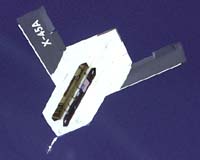
Target confirmation, arm and cleared to release. With those three commands from its human operator, an X-45A technology demonstrator for the Joint Unmanned Combat Air Systems (J-UCAS) program made aviation history by releasing an inert (non-explosive) Global Positioning System-guided Small Smart Bomb and hitting a ground target Sunday at the Naval Air Warfare Center Weapons Division Range, China Lake, Calif. This marks the first time that an unmanned aircraft has released a GPS-guided weapon.
Once the operator authorized release and the aircraft determined it was within range, it dropped the GPS-guided 250-pound weapon from its internal weapons bay at 35,000 ft. And 0.67 Mach (approximately 440 mph).
The aircraft autonomously performed all attack maneuvers, bay door operations, and weapon-away release sequences under human operator supervision. The bomb hit within a few feet of the target, which would have been destroyed, had a live warhead been used.
“I’d like to recognize the hard work and diligence of the entire J-UCAS team. Boeing, NASA Dryden Flight Research Center, the Air Force Flight Test Center, and China Lake worked together brilliantly to accomplish this joint ‘first’ for unmanned aviation. This is a significant milestone in our path towards developing a lethal unmanned aircraft that can work seamlessly under human control,” commented CAPT Ralph N. Alderson, USN, X-45 Program Manager.
The J-UCAS program is a joint Defense Advanced Research Projects Agency/Air Force/Navy effort to demonstrate the technical feasibility, military utility, and operational value of a networked system of high performance, weaponized unmanned air vehicles to effectively and affordably prosecute 21st century combat missions.
The Boeing X-45A vehicles are tools for demonstrating the initial technical feasibility of the J-UCAS concept. Boeing and Northrop Grumman are now developing the next generation of vehicles (the X-45C and X-47B,respectively) to demonstrate the military utility and operational value of the J-UCAS concept.
JUCAS will also employ a Common Operating System that enables the two air vehicle types to operate together and also interoperate with other systems within the Department of Defense global information grid.
