
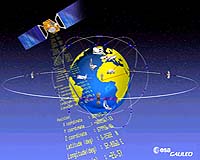
A joint bid by two previously competing consortia won a contract Monday to run a future European satellite navigation system, Galileo, aimed at rivaling the US-run Global Positioning System (GPS).
The winning joint consortium, bringing together the European Aerospace Defence and Space Company and Thales, and another consortium led by Alcatel and Finmeccanica, will now launch talks on building and running the Galileo project.
The European Union says the globe-girdling satellites will enable the development of new services in areas such as transport, the environment, agriculture and fisheries that are eventually expected to cover the running costs of the system, estimated at 220 million euros (268 million dollars).
The Galileo Joint Undertaking, set up by the European Commission and the European Space Agency, chose the two consortia after they dropped competing bids for the contract in May in order to make a combined offer.
“The joint offer contains substantial improvements compared to the separate offers that were on the table,” commission vice-president Jacques Barrot said in a statement.
“It foresees higher commercial revenues thanks to a concentration of the know-how of the two bidders,” he added.
The final contract will give the companies the right to operate Galileo for 20 years and reap the commercial gains from it.
Galileo said that the fact that it is a joint bid “does not pose any problem as far as the markets and competition are concerned”.
The two consortia said their joint bid was good news for everyone.
“Our merged consortia brings together the highest levels of European technological expertise to deliver a European solution to this technical challenge,” they said in a joint statement.
“We believe this path will generate significant advantage to the people of Europe and the wider world,” they added.
The offer was widely expected to be selected even though Germany’s position was uncertain due to concerns about how much its industry was likely to benefit from the new bid.
related report
Eurely and iNavSat consortia applaud green light
The founding members of the Eurely and iNavSat consortia applaud the green light received from Galileo Joint Undertaking (GJU) to pursue their joint approach for the Galileo Concession.
Both Eurely and iNavSat can now complete the merger of their consortium and, jointly with the GJU, proceed towards the final concession contract negotiations which will formalize the Galileo Public Private Partnership by the end of this year.
Today’s GJU decision is an important step forward for both Egnos and Galileo programs as it brings the momentum of the confidence that the programs are on track. This decision marks a milestone in the development of one of Europe’s largest common programs.
“Our merged consortia brings together the highest levels of European technological expertise to deliver a European solution to this technical challenge. We believe this path will generate significant advantage to the people of Europe and the wider world. We are committed to a team solution, within the timeframe agreed with the GJU,” said representatives from the two consortia.
The merger of the consortia will enable them to exploit numerous synergies offered by the combination of respective resources and competencies:
The market perspective for the downstream European industries is enhanced with the potential creation of thousands of jobs throughout Europe.
Furthermore, the Galileo and Egnos programs will contribute to the European global influence, combining the industry commitment with the European Union’s strategic ambitions.
The founding members of Eurely and iNavSat are: AENA, Alcatel, EADS, Finmeccanica, Hispasat, Inmarsat, and Thales.
