

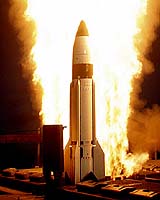
Japan and the United States will conduct around March 9 their first joint test of Japanese-developed technologies for an advanced interceptor under a joint missile defense project, sources familiar with Japan-U.S. relations told the Kyodo news service, according to report published Monday.
The joint test, to be held off Hawaii, will test the capabilities of a Japanese nose cone. However, another scheduled experiment to test an infrared sensor system has been canceled, U.S. government sources told Kyodo.
Japan was scheduled to dispatch a P-3C aircraft equipped with the infrared sensor to Hawaii for the joint test, but it notified Washington that it would not do so, the U.S. sources told Kyodo. Further information on the reasons behind the cancellation was unavailable, the news service said.
The nose cone and infrared sensor are for a larger and upgraded version of the Standard Missile-3 interceptor to be deployed on Aegis destroyers to defend against ballistic missiles.
The joint test follows a decision by the Japanese Cabinet in late December giving the green light for Japan to proceed with joint development of the next-generation missile interceptor with the United States.
In the joint test, the nose cone will be attached to a conventional SM-3 missile, the version that Japan plans to deploy by the end of fiscal 2007. The missile will be fired from the U.S. Lake Erie Aegis destroyer, the sources told Kyodo. However, the test may be postponed depending on weather conditions and other factors, they said.
The nose cone is an essential component for protecting sensors and other devices that come off in the final stage of intercepting an incoming ballistic missile. The test will check if the nose cone breaks off properly from the interceptor in midair.
Japan plans to shoulder $1 billion to $1.2 billion of the cost of the joint development of the missile defense system.
Tokyo and Washington launched their joint missile defense research in 1999 after North Korea test-fired a long-range missile in 1998, part of which flew over the Japanese archipelago into the Pacific Ocean.
Japan plans to begin establishing a missile defense shield with the conventional SM-3 interceptors by March 2008, Kyodo said.
Source: United Press International
