

Japan is seeking its first increase in military spending in four years amid mounting concern in Tokyo about North Korea and China, an official said Wednesday.
The Defense Agency, a branch of government, has asked for 4.9 trillion yen (44 billion dollars) as its budget in the year to March 2007, representing a 1.2 percent gain, an agency official said.
Japan’s defense spending had been curtailed for the past three years as Prime Minister Junichiro Koizumi advocated an austere budget without exception.
It was brought down by 1.0 percent for the year to March 2006.
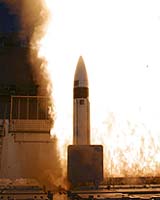
The defense budget for the next year includes 150 billion yen for missile defenses, including a new three-billion-yen package for joint development with the United States of a sea-based system to intercept ballistic missiles.
The idea of developing a joint anti-missile system was initiated after North Korea fired a suspected ballistic missile over Japan and into the Pacific in 1998.
The anti-missile shield will consist of land-based Patriot Advanced Capability 3 (PAC-3) interceptor missiles and seaborne Standard Missile 3 (SM-3) interceptors.
The Defense Agency also plans to buy a helicopter carrier, a mine-sweeper and submarines for a total of 182 billion yen, the official said.
Additionally, it wants to acquire six F-2 fighters for 76 billion yen, 11 tanks for 8.9 billion yen and 20 helicopters, he added.
The budget request, which requires approval by the finance ministry, comes amid high tensions with both China and North Korea.
An August 2 white paper by Japanese defense planners, echoing a Pentagon report, questioned an increase in China’s military spending, saying it raised questions about the communist giant’s intentions.
The two nations have seen their relations deteriorate in recent months as they dispute over energy resources and how they remember Japan’s 1931-1945 occupation of parts of the mainland.
North Korea also remains engaged in a standoff with the international community over its nuclear ambitions.
The fourth round of the six-party talks among the two Koreas, the United States, Japan, Russia and host China had been scheduled to resume this week following a recess on August 7 after two weeks of unsuccessful bargaining.
But North Korea said Monday it would not return to the talks in Beijing until the week beginning on September 12, blaming the delay on military exercises between the United States and South Korea.
In the annual white paper, the Defense Agency had warned against threats from North Korea’s nuclear arms and ballistic missiles.
“North Korea needs to be watched carefully because of the problems it poses with its development, deployment and proliferation of ballistic missiles as well as the nuclear problems in general,” the white paper said.
Japan’s parliament enacted a law in July to let the defense chief order the interception of a missile without prior cabinet permission in a crisis.
The bill was drafted amid worries that officially-pacifist Japan would waste time in administrative procedures before reacting to an attack, as a missile fired from North Korea would reach the country in 10 minutes.
