

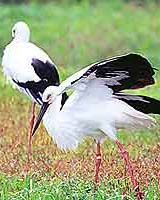
Five artificially bred white storks flew into open skies from a Japanese park Saturday as part of a half-century effort to protect and return the endangered species to the wild, officials said.
“All the five took off just fine,” said an official at a protection centre for the endangered storks in Hyogo prefecture in western Japan.
Prince Akishino, the second son of Emperor Akihito, and Akishino’s wife Kiko cut a red-and-white ribbon to open a box and release the first of the five storks in a ceremony joined by 200 academics, politicians and local officials.
Thousands of spectators applauded and cheered as the white birds with black-hemmed wings were released.
It was the first time that artificially-bred oriental white storks had been released in an attempt to bring them back to the wild, the park said.
It was also the first time in more than three decades that the birds had flown in Japanese skies as the last domestic wild stork died shortly after being taken into protective captivity in 1971.
“As there are no boundaries for birds, I hope the day will come when we see oriental white storks flitting about in Northeast Asia,” Hyogo Governor Toshizo Ido said after the release.
There are only about 2,000 oriental white storks in the world, the majority of them in Russia and China.
Japan designated the storks as a national treasure in 1956 as their numbers plunged following rapid urban development and increasing pollution.
The state and Toyooka city in Hyogo started projects to breed the bird in the 1960s. The first success came in 1989 using a pair donated by the then Soviet Union.
The five storks released Saturday were three females and two males born between 1998 and 2003 which had been trained to fly and feed themselves in order to survive in the wild.
Each of them is carrying an 80-gram (2.8 ounce) tracking device on their back which will send data to a US weather satellite 850 kilometers (530 miles) above Earth. The data will then be passed to Japanese researchers via the Internet.
