
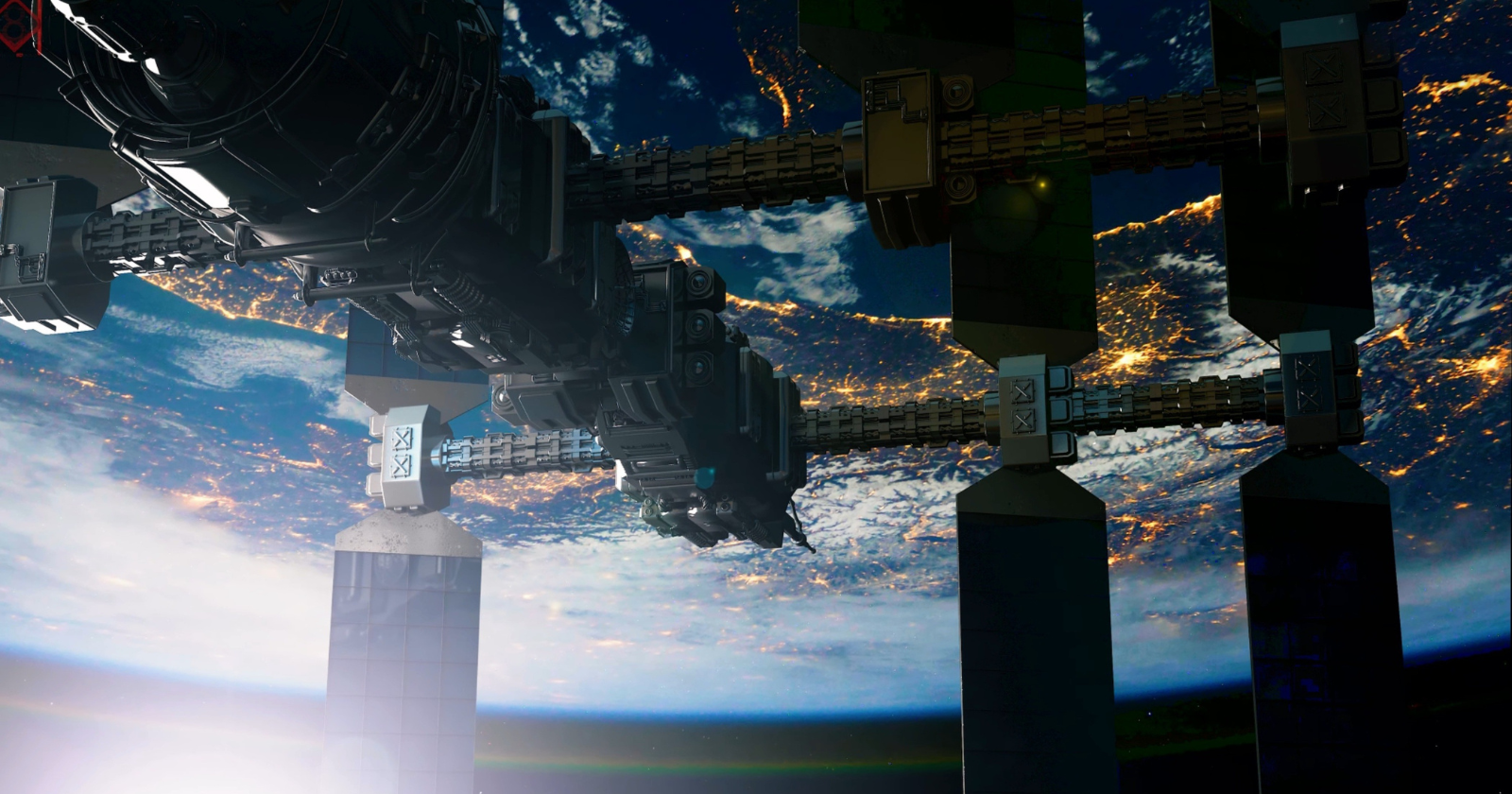
SpaceX signed a contract with NASA in June 2024 worth up to $843 million to build one machine, the U.S. Deorbit Vehicle, whose sole purpose is to grab the International Space Station, fire its engines for hours, and drag 430 metric tons of orbiting laboratory down through the atmosphere until what survives the fireball splashes into a remote stretch of the South Pacific. The vehicle will fly once. It will not come back. It is, in effect, a single-use tugboat for the largest object humans have ever assembled in space, and it represents the most expensive demolition job ever commissioned.
The station has been continuously inhabited since November 2000. When the deorbit vehicle finally docks with it sometime in 2030, the ISS will have been circling Earth for more than three decades and hosted hundreds of astronauts from dozens of countries. Then, over a period of about a year and a half, it will be lowered, tugged, and finally pushed to its death.
Why the station cannot simply be left alone
Left to itself, the ISS would not stay up. At its operating altitude, the station skims the very top of the atmosphere, where there is still just enough air to create drag. Without periodic reboosts from visiting Russian Progress freighters and, more recently, Northrop Grumman’s Cygnus cargo ships, the station gradually loses altitude. Cut the reboosts entirely, and within a year or two it would begin a chaotic, uncontrolled tumble through the atmosphere.
An uncontrolled reentry of a 430-ton structure is not a hypothetical concern. The Soviet station Salyut 7 came down over South America in 1991, scattering debris across populated areas. Skylab broke up over Western Australia in 1979 and dropped chunks near the town of Esperance, which issued NASA a fine for littering. The ISS is several times the mass of Skylab. Pieces of its truss, its docking adapters, and its dense pressurized modules would survive reentry. Mission planners estimate that without active control, debris could rain down anywhere within the station’s orbital range, a zone that covers most of the world’s population.
Controlled reentry into a remote oceanic disposal zone is the only responsible exit. The chosen impact area is called Point Nemo, the most isolated patch of ocean on the planet. It already serves as a graveyard for retired spacecraft, including the Russian Mir station, which was deorbited there in 2001.
What SpaceX is actually building
The U.S. Deorbit Vehicle, often shortened to USDV, will be a heavily modified Dragon spacecraft. NASA’s June 2024 contract announcement specified that the vehicle will need significantly greater propellant capacity and power generation than a normal Cargo Dragon. The standard Dragon trunk and capsule architecture will be adapted with a much larger propulsion section, capable of carrying substantially more propellant than typical missions.
The vehicle’s main engines will need to fire for an extended period during the final deorbit burn, providing enough thrust to push the station from its parking orbit down into the atmosphere on a precise trajectory. The burn must be timed so that the breakup happens over open ocean, not over Auckland or Santiago. NASA has stated that the deorbit phase, from final burn ignition to ocean impact, will take a matter of hours.
In an unusual arrangement, SpaceX will build and deliver the spacecraft, but NASA will own and operate it throughout the mission, rather than buying the deorbit as a commercial service the way the agency does for ISS cargo and crew flights. After splashdown, the vehicle will sink to the bottom of the Pacific along with whatever ISS debris reaches the surface intact.
The price tag, broken down
The $843 million figure is the contract ceiling, not the full mission cost. The total deorbit operation, including launch services, ground support, and Roscosmos coordination, will exceed the contract value. Launch alone will require one of the most powerful U.S. rockets available, likely a Falcon Heavy, because the USDV will be substantially heavier than any Dragon ever flown.
For comparison, the entire Mir deorbit in 2001 cost a fraction of the planned ISS operation. The difference reflects both scale and stakes. Mir was significantly smaller. The ISS is more than three times that mass and far more structurally complex, with truss segments, solar arrays the size of football fields, and pressurized modules from five different space agencies bolted together over more than two decades of assembly flights.
Why not save it
The question of whether the station could be preserved rather than destroyed has been raised, most recently by lawmakers on the House Science Committee. In early 2026, members advanced a NASA authorization bill requiring the agency to formally study whether the ISS could be boosted to a higher “storage” orbit instead of destroyed. The idea has cultural appeal. The station is a working monument to two decades of international cooperation that included the Russian and American space agencies even during the worst diplomatic stretches of their relationship.
The engineering reality is harsher. Boosting the ISS to a graveyard orbit would require enormous amounts of propellant and many sequential burns, each of which stresses a structure that was never designed to be moved as a single rigid body. Aluminum modules launched in the late 1990s are now well past their original certified lifetimes. Cracks and air leaks have been documented in the Russian Zvezda service module in recent years. The trusses have absorbed thousands of thermal cycles. Pushing the station upward risks tearing it apart in slow motion.
Disassembly and return is even less feasible. The modules were welded, bolted, and plumbed together in microgravity by spacewalking crews over hundreds of EVAs. Many connections cannot be undone with current tools. And no spacecraft exists that could bring even a single module back to Earth intact.
The timeline and the handoff
The current plan retires the ISS in 2030. Beginning in the late 2020s, station altitude will be allowed to drop more aggressively. By late 2030, the USDV will launch and dock with the forward port of the Harmony module, the same port used by Crew Dragon and Cargo Dragon today. The final crew will depart. The vehicle will perform a series of small braking burns over several weeks to lower the orbit, then execute the final deorbit burn that commits the station to atmospheric reentry.
What happens next in low Earth orbit is the subject of intense planning. NASA has awarded development contracts to several companies to build commercial successor stations. The agency wants to be a customer renting research time, not an operator. The hope is that at least one private station will be operational before the ISS comes down, so that American astronauts do not lose continuous presence in orbit. The schedule is tight. None of the proposed commercial stations have flown a full station to orbit yet, and any slip in their timelines could leave a gap in U.S. presence.
China’s Tiangong station, by contrast, is fully operational and has been continuously crewed in recent years. A gap in U.S. presence would mean that for the first time since 2000, the only humans living off Earth would be Chinese taikonauts. That political dimension is part of why the broader question of orbital and lunar leadership has become a recurring theme in congressional hearings.
What survives the fire
During reentry, the ISS will experience extreme temperatures. The solar arrays, radiators, and external trusses will tear off first at high altitude. The pressurized modules, built of aluminum and shielded with Whipple bumpers against micrometeoroids, will hold together longer before breaking apart in the lower atmosphere. Dense components, including the gyroscopes, docking mechanisms, and the heavy nodes that connect modules, are expected to reach the ocean surface largely intact.
Mission planners estimate that several tons of debris will survive the fall. All of it is designed to land within a debris footprint entirely within the Point Nemo disposal zone. Maritime and aviation authorities will close the airspace and ocean lanes for the duration of the reentry window.
A monument that ends as a streak of light
The ISS is currently bright enough to see with the naked eye from almost anywhere on Earth on a clear night. It looks like a fast-moving star, brighter than Venus, crossing the sky in about five minutes. Generations of children have watched it pass overhead with their parents pointing it out. By the early 2030s, that light will be gone.
The final descent itself will be visible, briefly, to anyone within a few hundred kilometers of the reentry path over the South Pacific. The station will become a long, bright streak with smaller pieces flaring off behind it, like a meteor shower made of a single object. The whole event will last under half an hour. The Boeing-built modules that have sheltered every astronaut since 2000, the cupola where crews have photographed thousands of sunrises, and the Russian segment where cosmonauts and astronauts have worked together for decades, will all end as fragments cooling on the ocean floor, more than five kilometers below the surface, in the loneliest water on the planet.
SpaceX’s $843 million machine will be down there with them.
