
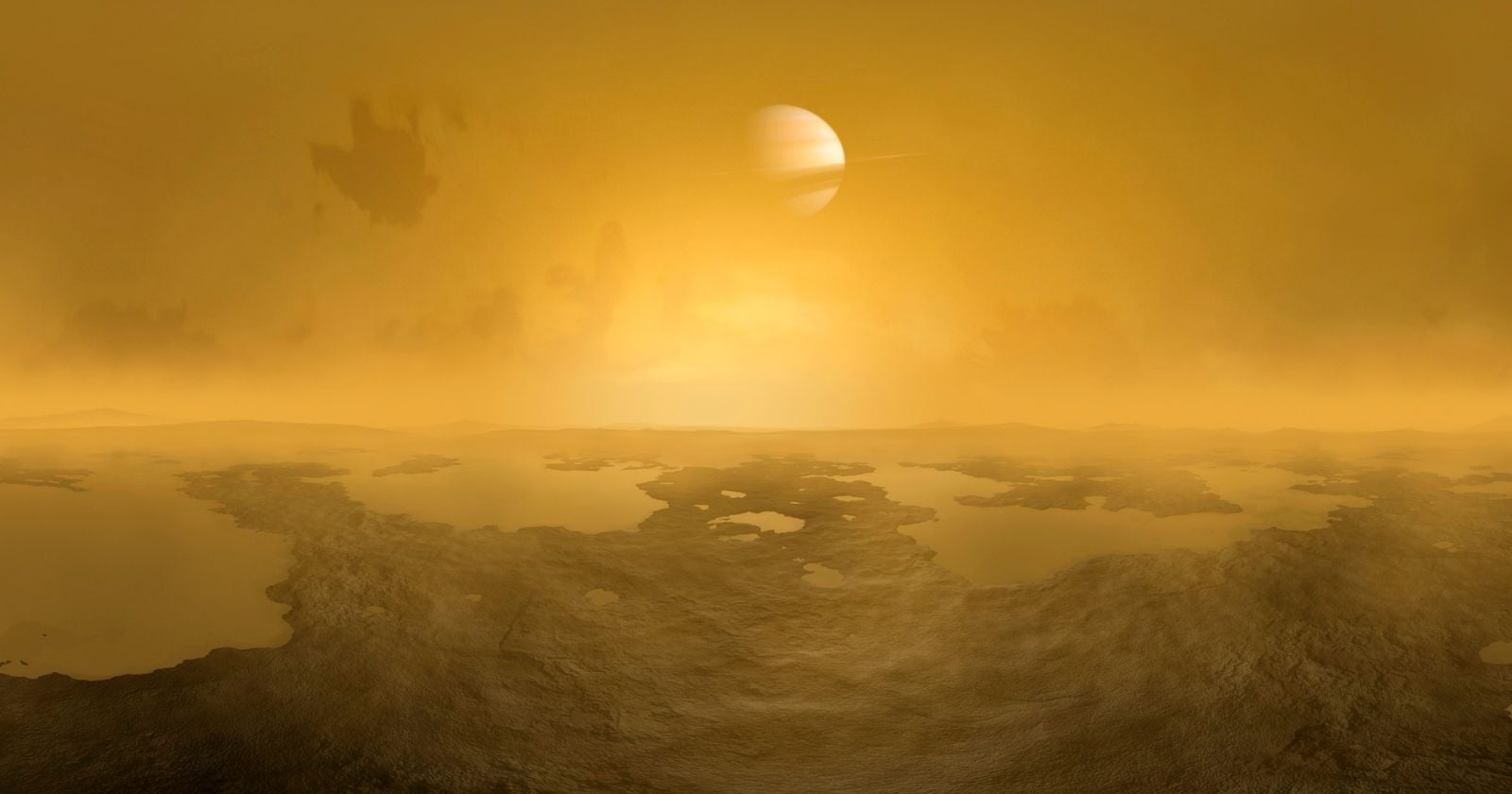
The Huygens probe drifted under a parachute through an orange haze on January 14, 2005, and set down on a plain of rounded pebbles that looked, in the first grainy image ever taken from the surface of an outer-solar-system world, exactly like a dry riverbed on Earth. The pebbles were water ice, cold-soaked to roughly minus 179 degrees Celsius and behaving mechanically like granite. The damp ground the probe splashed into was liquid methane. Titan, Saturn’s largest moon, was running weather.
Rain had fallen there. Rain would fall there again. And every drop of it was natural gas.
An Earth-shaped world with the wrong ingredients
Titan is the only body in the solar system besides Earth with standing liquid on its surface and a thick, weather-driven atmosphere overhead. The nitrogen in its air (about 95 percent, with roughly 5 percent methane) gives the sky a hazy tangerine cast and pushes surface pressure to about 1.5 times what a person feels at sea level in Miami. Radar had to be used to see through the haze at all, because visible light gets scattered into a permanent smog by photochemical byproducts drifting down from the upper atmosphere as fine dark soot.
Underneath that haze, the machinery of weather works the way a meteorology textbook says it should. Methane evaporates off the seas. It rises. It cools. It condenses into clouds. It rains back down. It carves channels into the ice bedrock, pools into lakes, feeds into seas, and eventually evaporates again. The methane cycle on Titan is a direct structural analogue of Earth’s water cycle, running on a molecule that on Earth is used to heat houses.
Bedrock cold enough to ring like rock
The ground itself is the part that keeps tripping up intuition. Titan’s crust is water ice, and at the surface temperature of roughly 94 kelvin (about minus 179 Celsius), that ice is not the slick, brittle stuff on a winter sidewalk. It is a stiff, load-bearing solid, harder than a lot of terrestrial stone. Mountains on Titan are ridges of frozen water. Boulders are chunks of frozen water. The pebbles Huygens landed among were frozen water, rounded by long tumbling in methane rivers the way quartz gets rounded in an Appalachian creek.
Recent modeling suggests the crust is not uniform, either. A team analyzing Cassini gravity and topography data concluded that Titan has an insulating methane-clathrate layer up to about ten kilometers thick sitting on top of the water-ice shell — a lid of frozen methane-and-water compound that traps heat from the interior and helps keep the atmosphere loaded with methane in the first place.
The seas that would float a boat
Titan’s northern hemisphere holds three seas large enough to have earned proper names: Kraken Mare, Ligeia Mare, and Punga Mare. Kraken alone is roughly the size of the Caspian, the largest inland body of water on Earth. Cassini radar sounded Ligeia Mare and found it more than 160 meters deep in places, deep enough that the radar echo from the bottom came back clean through a column of liquid so still and clear it startled the mission team.
The seas are mostly methane and ethane, with a little dissolved nitrogen. They are cold enough that a splash would freeze a bare hand into uselessness in seconds, but they behave, in bulk, like water. Waves have been detected on their surfaces, small ones, a few centimeters high, kicked up by Titan’s slow winds. Tides slosh through the straits between basins. And because the atmosphere is thick and the gravity is weak — about one-seventh of Earth’s — a person in a pressure suit could plausibly row a boat across Kraken Mare with a paddle.
Rivers that carved the ice
The most Earthlike images Cassini ever sent back were of Titan’s river networks. Dendritic drainage patterns branch across the terrain the way the Mississippi tributaries branch across a topographic map of Missouri. Some channels are hundreds of kilometers long. They meander. They braid. They cut canyons into the ice with steep walls and flat floors, and one system, Vid Flumina, was measured by Cassini’s radar altimeter as a canyon nearly 600 meters deep filled with liquid hydrocarbons — a methane fjord.
Not everything about Titan’s fluvial systems looks familiar, though. A recent SETI Institute analysis pointed out that Titan appears to be missing the river deltas that ought to form where its rivers dump sediment into its seas. On Earth, deltas fan out at nearly every major river mouth. On Titan, Cassini’s imaging turned up almost none. The reason is still being argued — sea levels may rise and fall too fast, tides may sweep sediment away, or the sediment itself may behave differently in cryogenic methane than sand does in water — but it is a reminder that the resemblance to Earth is a resemblance, not an identity.
Where the rain comes from
Methane rain on Titan is rare and heavy. Cassini watched thunderheads build over the equator and dump storms that darkened the ground for weeks afterward. The drops themselves would fall slowly — roughly 1.6 meters per second in Titan’s thick air and low gravity, about a sixth the speed of a raindrop on Earth — and they would be larger, close to a centimeter across. A person standing outside in a Titan storm would see fat gasoline-scented droplets drifting down through the orange sky at roughly the pace of falling snow.
The atmosphere is only about 5 percent methane by volume, but that is enough to drive the whole cycle. Sunlight, weak as it is at Saturn’s distance (about 1 percent of what reaches Earth), breaks apart methane molecules in the upper atmosphere. Those fragments recombine into ethane, heavier hydrocarbons, and the dark tholin haze that gives Titan its color. The haze drifts down and settles as sediment. That is why Titan’s beaches are black: the sky is slowly falling on them.
Why the atmosphere hasn’t blown away
By every quick calculation, Titan should not have an atmosphere. It is smaller than Mars. Mars lost most of its air billions of years ago. Titan holds onto a nitrogen envelope denser than Earth’s despite lower gravity and constant bombardment by Saturn’s magnetosphere. Its low temperature helps — cold molecules move slowly and are harder to strip away — and the methane keeps getting resupplied from somewhere below the crust, possibly from that methane-clathrate lid, possibly from cryovolcanic vents that have not yet been directly imaged.
Some of that history may have been violent. Modeling published through SETI proposes that Titan’s current orbit and spin were shaped by a catastrophic ancient impact that reset the moon’s rotation and helped drive the tidal migration that carries it slowly outward from Saturn to this day.
Lakes that might be building cells
The strangest recent finding is not geological but biochemical. A NASA study published in 2025 modeled the interfaces between Titan’s methane lakes and the tholin sediment that falls onto them, and found that cell-like vesicles can form spontaneously under Titan conditions. On Earth, the leap from chemistry to biology likely began when fatty acids folded themselves into little membrane-bound sacs — the first proto-cells. The NASA modeling suggests that the same trick works in liquid methane, using different molecules. Independent work has raised similar possibilities about bubble-like structures essential to life forming at Titan’s lake surfaces.
Nothing in that work says Titan is alive. It says Titan is one of the very few places off Earth where the raw geometry of a living cell might assemble itself out of local ingredients, in the local solvent, under the local sky.
What Dragonfly will fly into
NASA’s Dragonfly mission, confirmed and in development, will send a nuclear-powered rotorcraft to Titan’s Shangri-La dune field in the 2030s. The lander is a quadcopter roughly the size of a compact car, and it will fly because the air is dense and the gravity is light. It will hop from science site to science site, sampling dunes, ice bedrock, and possibly the floor of an ancient impact crater where liquid water and organic tholins may have mixed for tens of thousands of years — long enough, on the low end of prebiotic chemistry, for interesting molecules to appear.
Titan is one of the destinations where the vocabulary of Earth science works and the substance of Earth science does not. Rivers, yes. Rain, yes. Seas, yes. Bedrock, yes. Weather that runs the same cycle in the same order — evaporation, condensation, precipitation, runoff, back to evaporation — yes.
Just made of the wrong things. Every one of them. All the way down.
