
The Cassini spacecraft’s radar swept across Titan and returned an image that made the mission’s scientists stop and stare: dark, smooth patches carved into the landscape with the unmistakable shorelines of lakes. On any other body in the solar system that would have been a puzzle. On Titan, where the surface temperature sits at roughly minus 179 degrees Celsius, it meant something no one had ever confirmed before — an alien world with standing liquid on its surface, and the liquid was not water but ethane and methane, the same stuff that fuels a backyard barbecue.
Titan is Saturn’s largest moon, bigger than the planet Mercury, and the only moon in the solar system wrapped in a thick atmosphere. Stand on its surface and the sky above would glow a dim orange-brown, thick with organic haze. The pressure at your boots would be about 1.5 times what you feel at sea level on Earth. And the ground itself — the mountains, the cliffs, the pebbled riverbeds — would be made of water ice so cold it has stopped being anything a human hand could recognize as ice.
Ice that behaves like granite
At Earth-surface temperatures, water ice is soft. It scratches with a fingernail. It sublimates in sunlight. It creeps under its own weight, which is why glaciers flow.
Drop the temperature to 94 kelvin — Titan’s average surface reading — and water ice becomes something else entirely. Its crystalline structure locks. Its yield strength climbs into the range of terrestrial silicate rock. At cryogenic temperatures, substances change character dramatically; even stainless steels behave differently near absolute zero, gaining strength as thermal motion drains out of the lattice. Water ice on Titan sits in the same physical regime. It is not slippery, not soft, not slushy. It is the load-bearing bedrock of an entire moon.
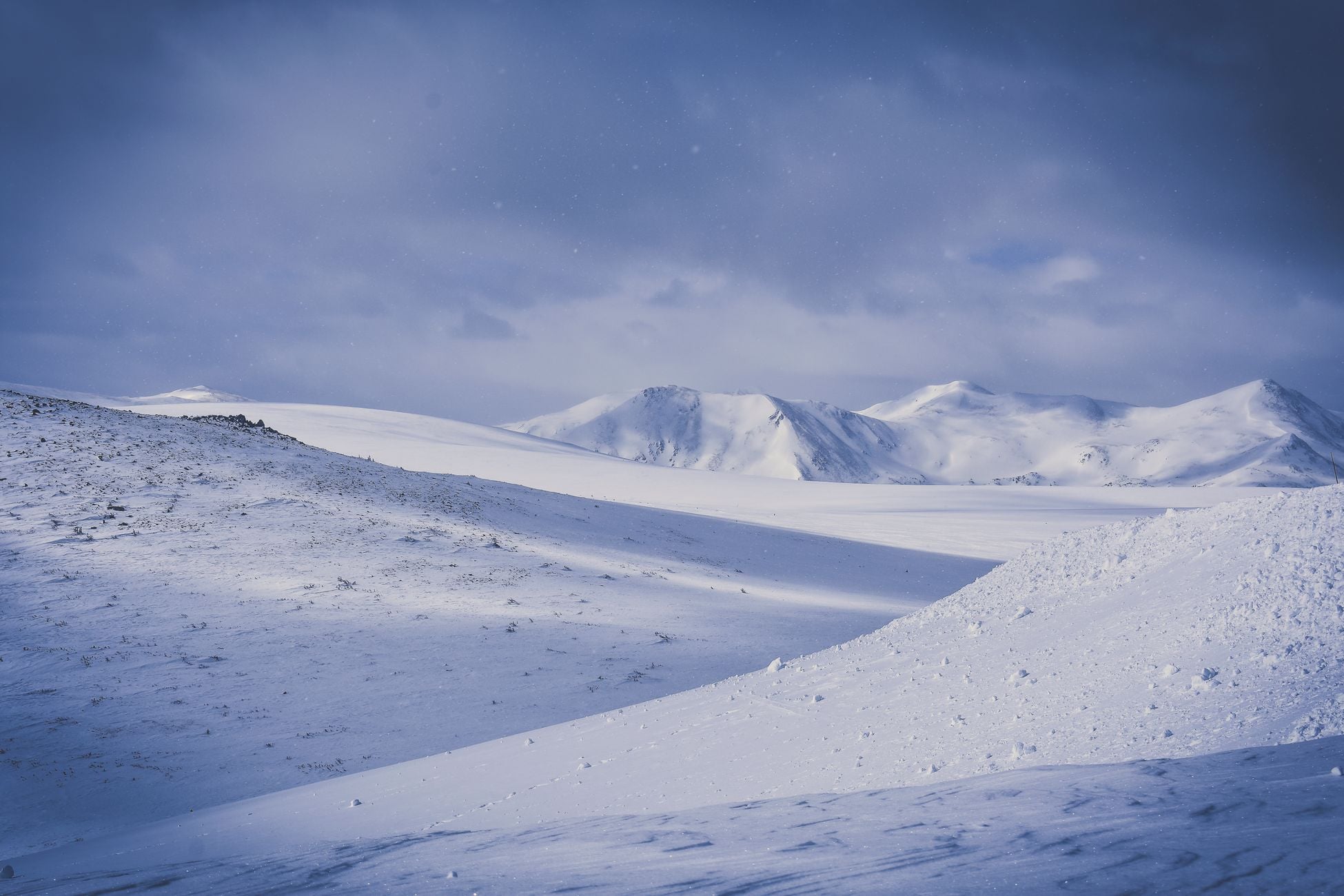
The mountains Cassini imaged along Titan’s equator rise several hundred meters and hold their shape against erosion over immense timescales. They are, in the most literal sense, mountains of frozen water. If you carved into one with a chisel, the fragments would ring like ceramic.
Seas of liquid natural gas
Above the ice bedrock, Titan runs a weather cycle that mirrors Earth’s — clouds, rain, rivers, lakes, seas — except every component of that cycle has been swapped out for hydrocarbons. Methane evaporates from the surface, rises, condenses into clouds, and falls again as rain. Where Earth has the water cycle, Titan has the methane cycle.
The seas cluster near the north pole. Kraken Mare, the largest, spans roughly 400,000 square kilometers, comparable in area to the Caspian Sea on Earth. Ligeia Mare and Punga Mare sit nearby. Smaller lakes freckle the surrounding terrain, some only a few kilometers across, some with the sharp geometric outlines of drowned karst basins.
NASA confirmed the composition of one southern lake, Ontario Lacus, using Cassini’s Visual and Infrared Mapping Spectrometer, detecting the spectral fingerprint of ethane dissolved in a methane-nitrogen mix. That was the first standing liquid ever identified beyond Earth. The temperature of that liquid hovers near minus 180 Celsius, cold enough that a splash on a bare hand would flash-freeze the skin instantly.
The seas are not still. Cassini’s radar caught faint ripples that scientists interpreted as waves, possibly kicked up by seasonal winds as Titan’s northern summer approached. Over the years the mission watched the shorelines shift — lakes brightening, darkening, appearing to fill after cloud activity in the tropics moved north. Rainstorms of liquid methane appear to feed them, on a cycle that runs on Titan’s 29-year orbit around the Sun rather than the 12-month calendar Earth uses.
Beaches the color of soot
Look down at the shoreline of one of those seas and the beach would not sparkle white or tan. It would be dark — nearly black in places — because the sand is not silicate at all.
High in Titan’s atmosphere, ultraviolet light from the distant Sun breaks apart methane and nitrogen molecules. The fragments recombine into heavier and heavier organic compounds — ethane, propane, benzene, acetylene, and eventually complex nitrogen-bearing polymers that scientists lump together under the name tholins. Those tholins are what give Titan’s sky its orange haze. And when they grow heavy enough, they fall.
They drift down through the atmosphere like a slow, endless snow of soot. Over geologic time they accumulate into vast dune fields along the equator — sweeping ridges hundreds of kilometers long, sculpted by winds into shapes that closely resemble the linear dunes of Namibia and the Arabian Peninsula, only made of hydrocarbon grains instead of quartz. The dunes are dark. The beaches around the northern seas are dark. The moon is, at ground level, a black-and-orange world with rivers of clear liquid gas cutting through it.
Ice that floats where you would not expect
One of the stranger findings from the Cassini team came when researchers modeling the density of methane-ethane mixtures at Titan temperatures realized something unusual could happen at the shoreline. If a chunk of solid methane broke off from the surrounding terrain and rolled into the sea, it might float rather than sink — but only if it contained trapped nitrogen bubbles. Warm the sea by a few degrees over Titan’s long summer, or change the ethane-to-methane ratio, and the same chunk would abruptly sink to the bottom.
The implication is that Titan’s seas may go through cycles where floating hydrocarbon rafts appear and disappear on seasonal timescales. Whole flotillas of solid methane, drifting for a Titan-year, then dropping out of sight all at once as the chemistry shifts.
How a probe survived the descent
Only one spacecraft has ever touched Titan’s surface. The Huygens probe, built by the European Space Agency and carried to Saturn aboard Cassini, parachuted through Titan’s atmosphere in January 2005. It sent back surface data before its batteries died, along with images of a plain scattered with rounded pebbles of water ice, streaked by what looked like drainage channels from methane rainfall.
Huygens landed with a soft thud into a surface the consistency of damp sand — later interpreted as a crust of hydrocarbon-rich sediment over a slightly softer layer beneath. The probe’s inlet caught a whiff of methane vapor as its warmth briefly boiled the ground beneath it. That single measurement remains the only direct sample of Titan’s surface chemistry ever taken.
Titan’s atmosphere is so thick and its gravity so gentle — about one-seventh of Earth’s — that a human wearing wings could theoretically fly across its skies by flapping. The same conditions make Titan one of the easiest large worlds in the solar system to descend onto with a spacecraft, which is why NASA has picked it as the destination for its next flagship robotic mission.
A helicopter to a frozen world
NASA’s Dragonfly is a nuclear-powered rotorcraft designed to take advantage of Titan’s dense atmosphere by flying — hopping from site to site, sampling dune material, cliff faces, and impact ejecta at multiple locations across the moon’s equatorial region.
The chosen landing area near the Selk crater is one where scientists believe liquid water may have briefly pooled after the ancient impact melted through the ice bedrock, mixing with the surface organics before refreezing. That mixture — liquid water plus complex organic molecules plus energy — is the recipe for prebiotic chemistry. Titan may be the best place in the solar system to see what happens when the ingredients for life sit together, on their own, for hundreds of millions of years.
Dragonfly’s science goals include measuring how far that chemistry has progressed, whether amino acids or other biological precursors have formed, and how the surface organics interact with any subsurface liquid water reservoir. Beneath the ice bedrock, scientists suspect, lies a global ocean of salty liquid water — kept liquid by internal heat, sealed under a shell of frozen H2O that may be 100 kilometers thick.
A world that runs on the wrong chemistry
Everything on Titan is running the wrong way, from an Earth perspective. Water is the rock. Methane is the rain. Ethane is the sea. Sunlight builds the sand instead of bleaching it. Wind carves organic dunes instead of quartz ones. The only working analogy is to imagine Earth’s entire chemistry catalog placed in a walk-in freezer at cryogenic temperatures and left to run for four billion years.
The seasons take three decades to turn. The rains come in bursts that may leave lakes filled for centuries before evaporating back into the haze. Somewhere beneath the ice mountains, a hidden ocean sloshes against a rocky core, isolated from the surface by a shell of frozen water that behaves like continental crust.
Cassini burned up in Saturn’s atmosphere in September 2017, ending 13 years of orbital observations. The next visitor is still a decade away. Until then, Titan continues its slow, dark weather cycle in silence — methane clouds drifting over black dunes, ethane waves lapping at ice cliffs, tholin soot falling on a shoreline no one has seen since Huygens went quiet.
